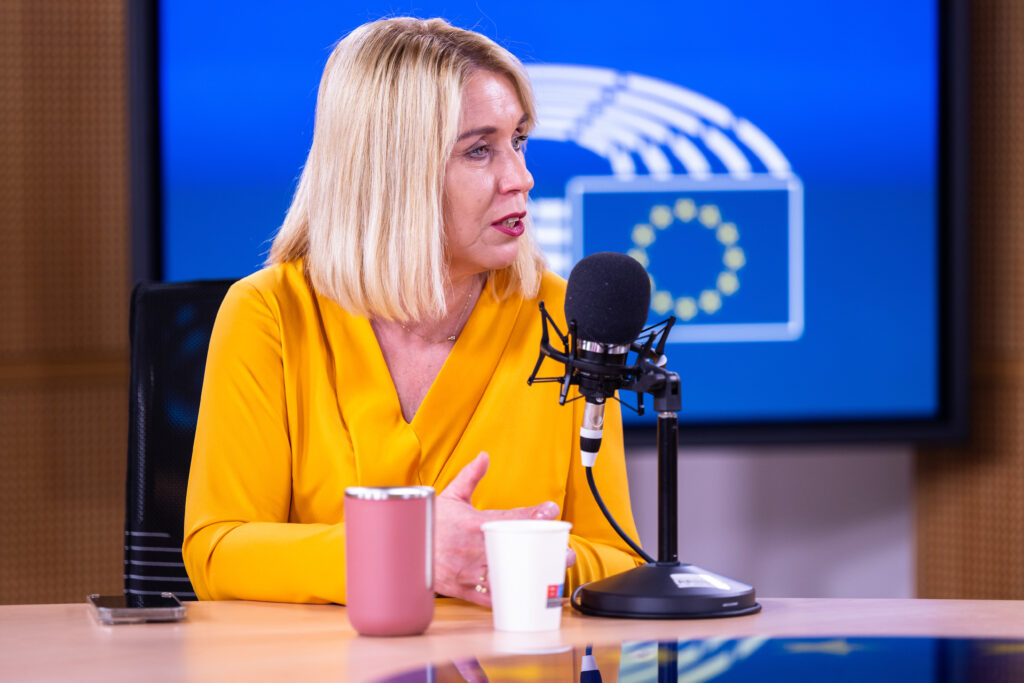
The EU’s next long-term budget talks will have to square the circle by adding new spending needs without any certainty about new sources of revenue. According to MEP Danuše Nerudová (EPP/CZE), hard battles lie ahead for the negotiators. The European Parliament plans to play a clear role.
As one of the European Parliament’s key negotiators on the next Multiannual Financial Framework (MFF), Ms Nerudová finds herself at the centre of what is shaping up to be one of the most difficult budgetary negotiations in recent EU history. The next seven-year budget, which will run from 2028, must reconcile traditional policy priorities (think agriculture and cohesion) with new demands ranging from defence to competitiveness — all while repaying past common debt. The MEP shared her thoughts in the latest EU Perspectives podcast episode.
“I’ve been on the board of very important negotiations, and the last one was very sharp,” Ms Nerudová said, describing tense exchanges with the European Commission over the latter’s initial proposal. “We were very sharp with the Commissioner for the budget trying to change the proposal which is on the table.”
Nerudová has a seat in a high-level negotiating group representing the European Parliament, alongside Parliament President Roberta Metsola, political group leaders and rapporteurs. That group recently threatened to reject parts of the Commission’s proposal outright. The move marked a departure from past practice, when Parliament often played a secondary role in shaping the MFF.
Parliament flexes its muscles
“The threat was very serious,” Nerudová said, noting that leaders of the largest political groups sent a letter warning the Commission they could block the proposal.
Three major concerns drove Parliament’s opposition. First, MEPs criticised the plan to model cohesion policy on the Recovery and Resilience Facility (RRF), which sidelined the Parliament, Ms Nerudová argued. “It’s just a ping-pong between the Commission and the national member states,” she said.
Second, the Commission proposed merging agriculture, forestry and cohesion into a broad policy envelope without clear safeguards. “Nobody wanted, for example, in some countries to devote 100 per cent to agriculture policy and zero for cohesion policy,” Nerudová explained.
Finally, Parliament objected to what it saw as a reduced institutional role compared to the current MFF. “This is money of the European taxpayers and we are the only institution which is directly voted in elections,” she said. “Therefore, we want to have control over the money Europe spends.”
The so-called “negotiating box” the MEPs presented to the Council has partially addressed two of these concerns. Ms Nerudová called this a small victory for Parliament; but stressed that the fight over parliamentary oversight is far from over.
A structural problem
Beyond institutional power struggles, Nerudová argues the central problem is structural. Once inflation and debt repayments are taken into account, the Commission’s proposal offers little real increase in spending power.
“If you deduct the repayments of the previous common debt and involve inflation, we are talking more or less about the same amount of the budget as in the previous term,” she said. “And this is the budget of Denmark — for 27 member states.”
At the same time, 20 per cent of annual EU spending will go to repaying the debt taken on during the pandemic. “So we have like 20 per cent minus every year,” Nerudová said.
The result, she warned, is deep cuts to traditional policies. The share of the budget devoted to agriculture, cohesion and fisheries would fall from 66 to 44 per cent, with fisheries funding alone dropping from €6bn to €2bn.
“We are adding new priorities like common defence, but with the same amount of money,” she said. “This equation doesn’t work.”
New money or new debt?
As rapporteur on new “own resources”—EU-level revenue streams—Ms Nerudová is pushing for a serious debate on how to fund a more ambitious Union without repeating past mistakes. “We don’t want to have another common debt,” she said. “Previously, 27 member states agreed to raise common debt without agreeing how to repay it. Now we are paying the price.”
Proposals for new resources, including a levy on large corporations or revenues from emissions trading, have already met fierce resistance in the Council. But Ms Nerudová insists avoiding the discussion is unrealistic.
“Every member state is saying: I want more for agriculture, more for cohesion, more for competitiveness — but I don’t want to increase revenues,” she said. “Honestly, this doesn’t work.” She noted shifting attitudes in some capitals, including her native Czechia’s Prague. “For decades, the Czech Republic wanted a minimum EU budget,” she said. “Now we are starting to think that with this minimum budget we cannot finance common defence.”
Nerudová also warned that any expansion of EU spending must go hand in hand with strict oversight, pointing to developments in Hungary and Slovakia as cautionary examples.
Rule of law and spending control
“We have to stick to the rule of law,” she said, criticising Slovak Prime Minister Robert Fico’s moves to weaken anti-corruption institutions. “All these steps together are creating an intransparent environment and a vast space for corruption.” For her, this reinforces the need for a stronger parliamentary role. “We have to care about how the money of European taxpayers is spent across Europe,” the MEP said.
With unanimity still required in the Council, the MEP acknowledged the path to a deal will be long and politically fraught, especially amid rising populism and geopolitical uncertainty. “Europe needs to care about itself,” she said. “None of our countries are able to defend themselves alone.”
Despite the obstacles, she remains cautiously optimistic. “As for myself, I will invest maximum effort to reach a good deal,” Ms Nerudová said. “We have just started — and we still have two years of negotiations ahead.”