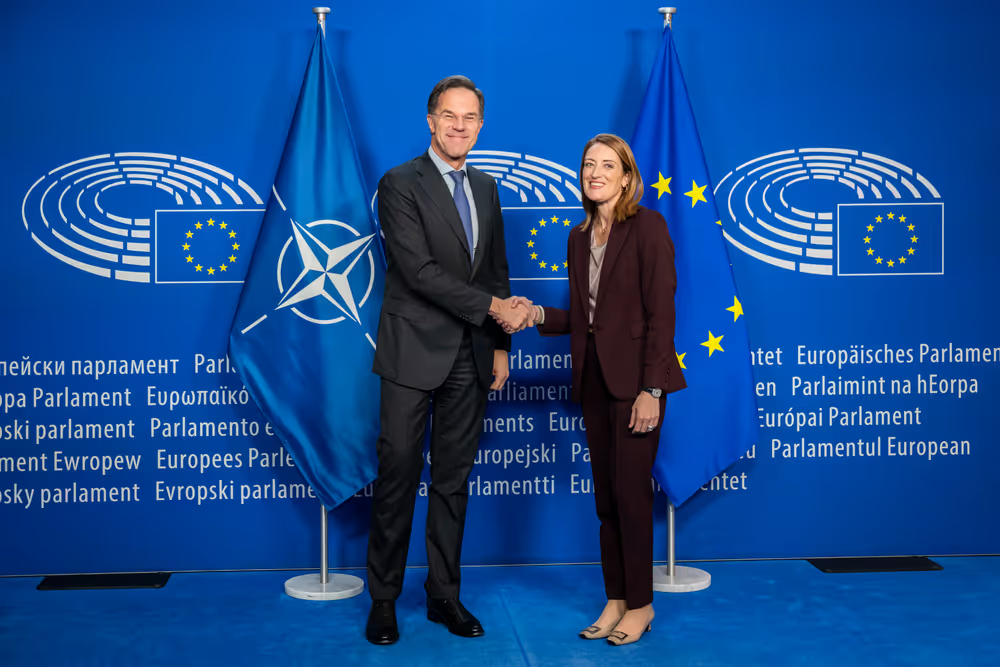
Europe should be grateful to Donald Trump for pushing European states to increase defence spending, NATO Secretary General Mark Rutte told MEPs on Tuesday. He delivered the message while urging lawmakers not to only consider Greenland, but the broader security of the Arctic—an approach Mr Rutte suggested Donald Trump has also long had in mind. While Danish parliamentarians pressed for stronger support for their territory, Rutte downplayed concerns over US intentions.
In his address at the Global Europe Forum organised by Renew in the European Parliament this week, secretary General Rutte opened by stressing the need to accelerate defence innovation and production, arguing that increased investment benefits all Europeans. “When supply goes up, the result is more security, more economic growth, and more jobs. The defence dividend is real,” he said. The security situation, he added, demands sustained spending. The dangers are “real and lasting,” with Russia remaining the most significant threat and actively seeking long-term confrontation.
But this was not what the room wanted to hear. MEPs quickly steered the discussion towards Greenland.
Avoiding condemnation
Unwilling to condemn recent US statements referring to a potential military invasion of Greenland, Rutte instead pointed to warnings made by Trump during his first presidential term about growing Chinese and Russian activity in the Arctic. “Sea lanes are opening up,” Rutte said, adding that both Russia and China are becoming increasingly active in the region.
For this reason, he insisted, the focus should be on jointly protecting the Arctic—an area which, aside from Russia, consists exclusively of NATO countries: Canada, Denmark (through Greenland), Finland, Iceland, Norway, Sweden, and the United States.
As climate change accelerates ice melt and the Arctic offers the shortest trajectory between the United States, Russia, and China, the region is becoming ever more strategically important. Greenland sits at the centre of this geography, acting as a critical choke point for monitoring submarine movements and securing transatlantic air and sea routes.
MEPs press Rutte on alliance unity
Several MEPs attempted to press the Secretary General on whether he was comfortable with one NATO member militarily threatening another. Mr Rutte repeatedly refused to comment on what he called disputes between member states — that’s not up for me to comment on”—returning instead to his core message on the Greenland situation: the need for common protection of the Arctic.
MEPs, however, were unconvinced. Danish MEP Stine Bosse warned that people in Greenland are “scared stiff” and “more than just worried.” She noted that Denmark has long allowed extensive US military involvement under a 1951 defence agreement, which permits the United States to maintain bases in Greenland and to establish new ones or deploy troops if deemed necessary by NATO. The current threat is the US, not China or Russia, she insinuated. “There are not one single Chinese or Russian ship around,” she added.
Bosse also asked what the alliance can do “if two countries within the alliance cannot agree”—a question met with wide applause throughout the room.
Denmark’s defence efforts and Trump’s legacy
Moderator Teri Schultz, Senior EU and NATO Correspondent, highlighted Denmark’s active role in High North security, with a €14bn investment to boost defence—including in Greenland—while noting the country should have acted sooner.
This, however, did little to shift Mr Rutte’s position. He refrained from offering any condemnation of the US. Instead, he once again reminded MEPs—“and you will hate me for this,” he said—that Europe should be grateful to Donald Trump for pushing European states to increase defence spending.
His comments came before a key meeting on Wednesday when a meeting between US Vice President JD Vance and US Secretary Marco Rubio and the foreign ministers of Denmark and Greenland ended without any way past what many see as a growing impasse.