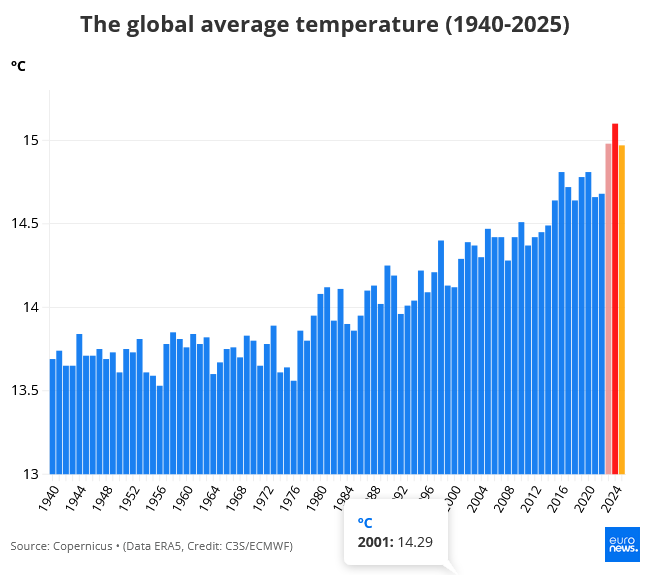
The global average temperature in 2025 was 14.97 °C exceeding the average of period 1991–2020 by 0.59 °C, EU’s Earth observation programme Copenicus says. Data reveals that 2025 was the third year in a row to average above 1.5 degrees Celsius compared to pre-industrial levels. Ongoing build-up of greenhouse gases in the atmosphere and El Niño event were the main drivers of warming.
The differences may seem minimal, but the trend is undeniable. Last year was once again one of the warmest in the history of detailed measurements worldwide. In terms of average global temperature, 2025 is surpassed only by 2024 (average 15.10 °C) and, by a mere 0.01 °C, also by 2023 (14.98 °C). The last 11 years have been the 11 warmest years in recorded history. Fresh data was provided by Copenicus, the Earth Observation component of the European Union’s space programme.
The warming trend is crystal clear: expert
“The fact that the last 11 years have been the warmest in recorded history provides further evidence of an undeniable trend towards a warmer climate,” commented Carlo Buontempo, director of the Copernicus program, on the fresh results. According to director, the world is rapidly approaching the long-term temperature limit set by the Paris Agreement. “It is certain that we will exceed it; now we have a choice of how best to manage the inevitable exceeding of this limit and its consequences for society and natural systems,” added Mr Buontempo whose surname translates from Italian as “good weather.”
The fact that the last 11 years have been the warmest in recorded history provides further evidence of an undeniable trend towards a warmer climate. – Carlo Buontempo, director of the Copernicus program
In 2025, the global surface air temperature was 1.47 °C higher than in the pre-industrial period. Climatologists often use comparisons with the pre-industrial era to illustrate global warming.
The detailed data shows that for Europe, 2025 also marked the third-warmest year on record. The average temperature in Europe reached 10.41 °C which was 1.17 °C above the 1991–2020 reference period. Heat waves and windy conditions contributed to record wildfires. Emissions resulting from wildfires in Europe in 2025 were highest since monitoring began 23 years ago.
El Niño contributed to high temperatures
The Copernicus report emphasises that there are two main reasons why the years 2023, 2024, and 2025 were exceptionally warm. First, there is a build-up of greenhouse gases in the atmosphere. This is caused by continued emissions coming mainly from fossil fuels burning, plus ther has been a reduced uptake of carbon dioxide by natural sinks like forests.
Second, sea-surface temperatures reached exceptionally high levels across the ocean. This is associated with the periodical El Niño event and other ocean variability factors. Further minor factors like changes in the amounts of aerosols, or variations in atmospheric circulation complete the overall picture.