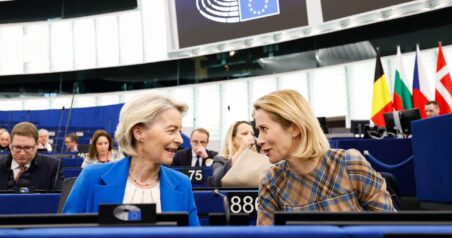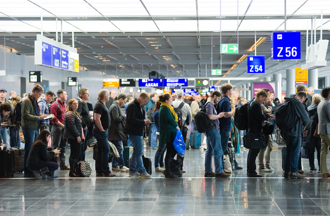
A rare consensus across political factions was seen in the European Parliament during Tuesday’s debate on air passenger rights. Virtually all speakers, including Commissioner Tzitzikostas, spoke in favor of maintaining or strengthening the current level of rights, with frequent calls for one piece of hand luggage for free. The vote on Parliament’s position, scheduled for tomorrow, is thus likely to go through smoothly.
For twelve years now, since 2014, there has been a debate among European institutions about updating air passenger rights. That includes better access to compensation for delayed or stranded air passengers, or clearer rules about how airlines should deal with passenger complaints. Air passenger rights are currently still governed by Regulation No. 261/2004.
National governments are now pushing to weaken these rights while Parliament is set to insist on preserving and strengthening them. As an example, under the current Regulation, air travellers can claim compensation if a flight is delayed by more than three hours or is cancelled, or if they are denied boarding. Council is now proposing that travellers should be compensated only after a four- to six-hour delay, depending on flight distance.
The Parliament’s position offers a comprehensive list of extraordinary circumstances, such as natural disasters, weather conditions or unforeseen labour disputes, that would release airlines of their responsibility to pay compensation. Council favours an open-ended list.
You might be interested
Three hours as a red line
“The Council wants to remove 60 percent of current air passenger compensation, we must not allow that to happen.” By this statement began Andrey Novakov (EPP/BLG), rapporteur for passenger rights, his rather emotional opening speech. Mr Novakov also said that Parliament is not going to allow watering down people’s rights using an example of excess hand luggage fees charged by some airlines. “The payment of €75 for 1 centimeter excess is simply ridiculous and this must stop,” rapporteur said.
Parliament is not going to allow watering down people’s rights. — MEP Andrey Novakov (EPP/BLG), rapporteur for passenger rights
Apostolos Tzitzikostas, Commissioner for Sustainable Transport and Tourism, said in his speech that Commission’s position is very close to the Parliament’s one. He emphasized the need to maintain the three-hour delay threshold beyond which airlines are required to pay compensation to passengers. “Three hours threshold is a red line,” stressed Mr Tzitzikostas.
The enforcement of passenger rights is crucial. – Apostolos Tzitzikostas, Commissioner for Sustainable Transport and Tourism
Comissioner Tzitzikostas, however, was less clear on some other points of contention. “Comission is ready to facilitate a compromise how to define ’extraordinary circumstances’, Mr Tzitzikostas said. On the enforcement side, he labelled it ’crucial’ as currently some airlines keep using different loopholes in order to avoid compensation payments.
Hand luggage for free, families together
Plenary is also expected to defend the right to carry on board, at no additional cost, one piece of hand luggage of clearly specified dimensions. Currently, carry-on baggage rules vary from airline to airline, which, according to a number of MEPs, leads to confusing chaos.
MEPs have repeatedly pointed out as unfair the practice of some airlines charging special fees to families if parents and children want to be guaranteed seats next to each other. These fees, as an example, are currently charged by Ryanair, Europe’s largest airline in terms of passenger numbers.
In 2014, Parliament reacted to a Commission proposal to update air passenger rights, proposing that delayed or stranded air passengers should receive better access to compensation, with clearer rules about how airlines should deal with passenger complaints. Differing positions among EU countries blocked this file for 11 years. In June 2025, however, EU ministers reached a political agreement. Subsequent negotiations with Parliament started in October 2025, but so far did not end in an agreement. That forced the Parliament to proceed with the adoption of its second reading position.