Key European lawmakers agreed Wednesday to halt work on the EU-US Turnberry trade deal—a direct response to President Trump’s tariff threats against European countries showing solidarity with Greenland.
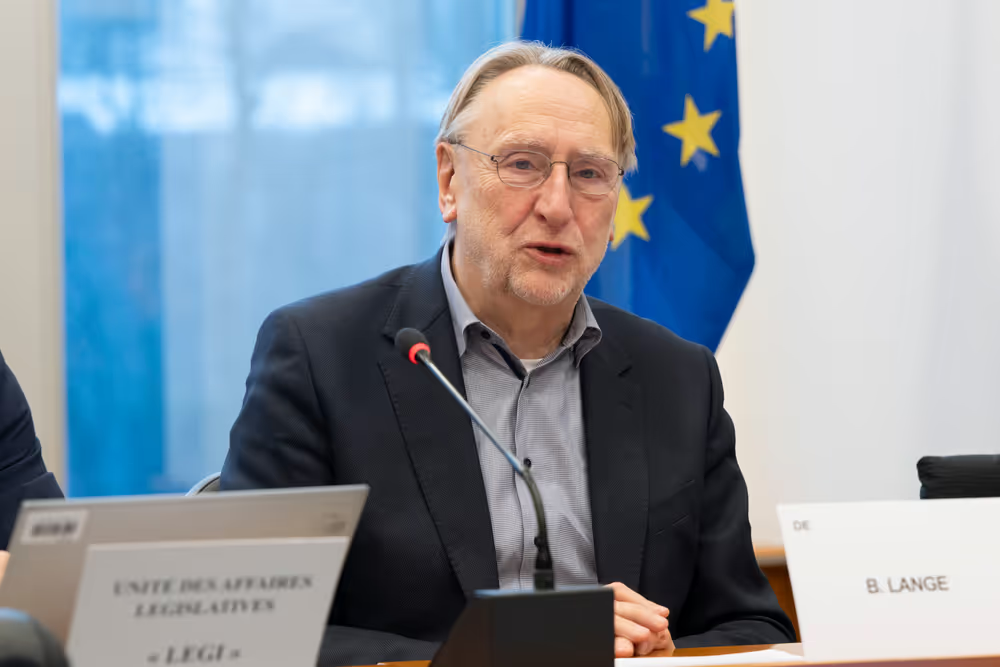
“By threatening the territorial integrity and sovereignty of an EU member state and by using tariffs as a coercive instrument, the U.S. is undermining the stability and predictability of EU-U.S. trade relations,” MEP Bernd Lange (S&D, DE), chair of the Parliament’s international trade committee (INTA), said in a statement Wednesday.
That’s why, according to his statement, key MEPs working on the formal approval and implementation of the deal decided to suspend their work until further notice. The announcement came after a meeting of the so-called shadow rappoteurs, or representatives working on the file on behalf of their political groups.
According to critics, the July 2025 Turnberry deal heavily favored the US: it had the EU eliminating all tariffs on US goods while accepting 15% US tariffs plus nonbinding commitments to $600 billion in US investment and $750 billion in US energy purchases.
Trump says he won’t use force to take Greenland—but still wants it
Trump has not backed down on his ambitions to take Greenland. In an hour-long speech in Davos on Wednesday, Trump urged Europeans to negotiate on the sale of Greenland, while emphasizing that he did not want to use military force. Though, the White House has confirmed it has weighed various approaches to taking Greenland, including the possibility of military action.
In response to Trump’s speech at Davos, Lange said, “I guess he didn’t revise his position. He wants to have Greenland as part of the United States as quick as possible.”
Trump has threatened to impose a 10% tariff from February on Denmark, Sweden, Norway, France, Germany, the Netherlands, Finland and the United Kingdom until “a deal is reached for the complete and total purchase of Greenland.” With that rate rising to 25% by June should no agreement be reached. EU agri-food exports to the US totaled €24.2 billion between January and October 2025, with proposed tariffs potentially adding €7.3 billion in costs.
The enforcement problem
Trump’s threat to impose tariffs on just six individual EU member states represents a fundamental misunderstanding of how the European Union works. To enforce such a tariff scheme would present a major obstacle: the EU customs union. Under EU rules, goods manufactured in the bloc are only marked as being of EU origin, and with no internal borders, products move freely between member states without customs controls.
“There’s no border between Spain, Italy, Germany and France. Anybody can ship a good through another country quite easily if we try and tariff individual states”, NYU professor Joseph Foudy told CNN. This means Trump’s tariffs would either prove unenforceable or force U.S. Customs to demand proof of origin on all EU goods—effectively creating tariffs on the entire bloc regardless of intent.
Europe’s next move
This will be a primary topic of discussion for the remainder of the World Economic Forum in Davos. Trump told CNBC at the White House before departing for Davos, “We have a lot of meetings scheduled on Greenland, and I think things are going to work out pretty well.”
EU leaders meet Thursday night to coordinate response. The Anti-Coercion Instrument is on the table. The never used before nuclear option for the EU to respond to aggressive trade bullying. It was designed for this exact scenario—economic coercion to influence political choices—though Brussels built it with China, not America, in mind.
“Tariff threats are unacceptable … Europeans will respond in a united and coordinated manner should they be confirmed,” French President Emmanuel Macron wrote on X on Saturday. “We will ensure that European sovereignty is upheld.”