The new European Democracy Shield committee published its draft report this week. It sets out a sharper and more operational vision for protecting EU democracy from foreign interference, disinformation and hybrid threats.
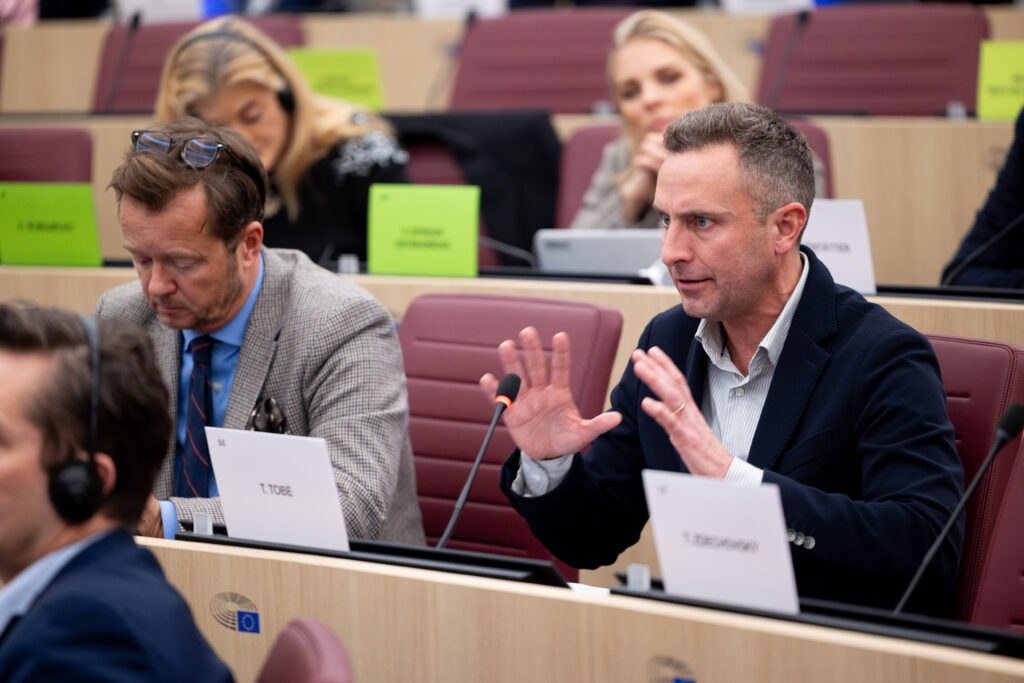
Presenting the document, rapporteur MEP Tomas Tobé (EPP/SWE) left several recommendations. He warned that the European Commission’s current plans fall short of the scale and sophistication of the threats facing the Union.
“The European Democracy Shield is an important step, but the Commission’s level of ambition does not yet match the scale of the threat we face”, Mr Tobé said. The MEP pointed to an increasingly coordinated landscape of foreign information manipulation, election interference and hybrid attacks that individual member states cannot counter alone.
The report is the result of months of hearings and expert consultations within the EUDS (European Democracy Shield) Special Committee. It will serve as Parliament’s basis for negotiations later this year.
European Centre for Democratic Resilience
One of the central points is the proposed European Centre for Democratic Resilience, presented in the 2025 State of the Union Speech. While welcoming the idea, MEP Tobé argued that the centre risks becoming another coordination hub without real operational power.
The report criticised the lack of clear governance, a defined mandate and budget lines. “If the Centre remains only another hub, network, platform or framework among others this could further reduce the EU’s capacity to make efficient use of the full spectrum of tools available at present, and add to the shortcomings identified in the joint communication, including reduced reactiveness, fragmentation and stretched budgets”, the document states. It urges the Commission to clarify how it would support member states in building real-world capabilities to detect and counter interference.
Election manipulation
Protecting electoral integrity is another central recommendation. The document urges the EU to provide additional support to candidate countries facing election interference and to integrate hybrid-threat preparedness into Common Security and Defence Policy missions. The rapporteur also argues that sanctions should target more precisely those who undermine democratic processes.
Only through timely cooperation and shared political responsibility can we deliver a credible and effective contribution to strengthening our Union’s democratic resilience – MEP Tomas Tobé (EPP/SWD)
Societal resilience and long-term funding
Beyond institutions and elections, the report places strong emphasis on societal resilience. Governments and institutions must sustain support for independent media, civil society organisations, and media literacy programmes to safeguard democracy, particularly during crises.
Also, the rapporteur links democratic resilience directly to the EU’s next long-term budget. It asks for adequate funding in the 2028–2034 Multiannual Financial Framework as a way ensure preparedness under disruptive conditions.
Next steps
The draft report will be formally presented to the EUDS Special Committee on 29 January. After, political groups will table amendments ahead of a final vote in plenary.
MEP Tobé said he is seeking swift cross-party engagement to translate the proposals into a united parliamentary position. “Only through timely cooperation and shared political responsibility can we deliver a credible and effective contribution to strengthening our Union’s democratic resilience”, he concludes.