Persistent technological gaps and fragmented national approaches undermine European security, highlights a drone–focused report MEPs approved in Strasbourg last week. The urgency of strengthening EU strategic autonomy in defence has never been more acute.
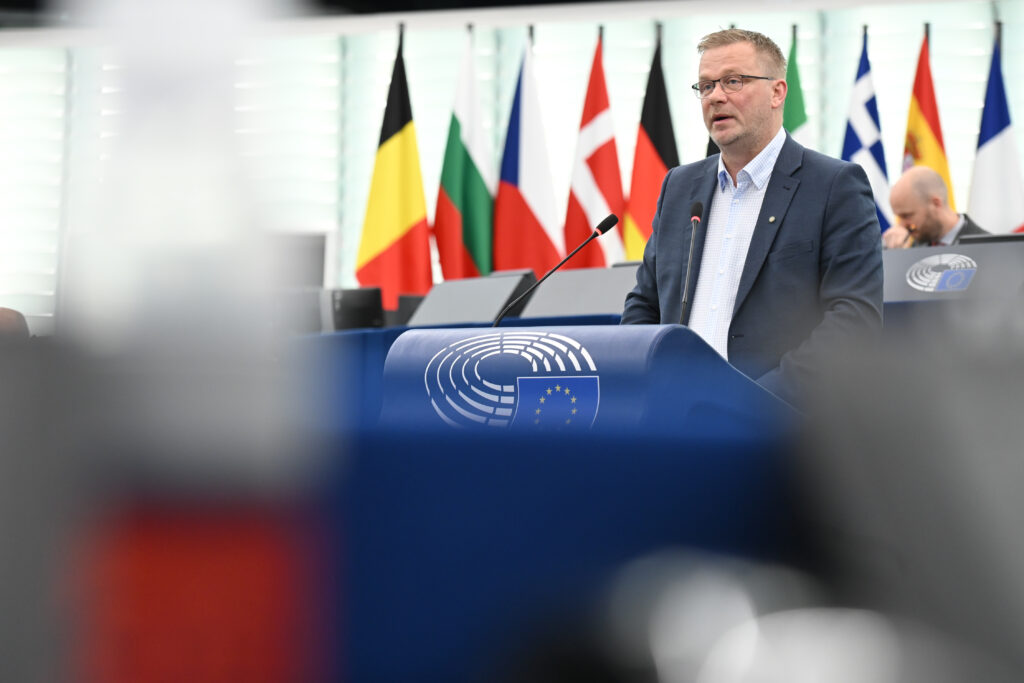
Drones have become a structural feature of Europe’s evolving security threats. Their rapid proliferation, alongside increasingly autonomous systems of warfare, is forcing the EU to rethink how it protects its territory and strategic interests. EU Perspectives discussed these challenges with the rapporteur for the report, MEP Reinis Pozņaks (ECR/LAT).
What’s the core of the report?
The report is to become a strategic blueprint for the EU to overcome the many challenges of drone warfare. It contains over 300 policy recommendations focusing on equipping member states with both drone and counter-drone warfare capability. It features training our armed forces and security services for the modern battlefield. Besides, it addresses the many resilience needs of Europe over the next 1-3 years.
It covers a range of key themes such as rapid response needs, NATO-EU cooperation, integrating new technologies, training and certifying drone pilots, critical infrastructure protection, establishing shelters and protective spaces, support to SMEs, intra-EU transfers, EDF grant structure, regional manufacturing development and various other elements. We worked hard to be very comprehensive and had the pleasure to collaborate with many key stakeholders ranging from frontline soldiers in Ukraine to industry and experts around the world.
What do you expect to become the new warfare systems?
Although drones are not new, they have become a defining feature of modern warfare. This shows in Ukraine, where they have inflicted more casualties than any other weapon. It was only five years ago that drones were almost ‘exclusively’ in the hands of very few countries. Today, drones have spread to multiple conflicts worldwide. They feature in Gaza, Israel, Lebanon, Iran, Yemen, Sudan, Myanmar, Nagorno-Karabakh as well as in attacks on international vessels in the Red Sea.
Regarding the new systems we promote in this report, this largely focuses on three things. First, resilient command and control infrastructure. Member states need digital-native C2 to become the new standard across development models. These must be highly resistant to electronic warfare (EW) to ensure that data transmission communication functions. This has to take place in a battlefield we can expect to be awash in drones and barrage jamming. Second, C-UAV systems that utilize emerging technologies such as EW, lasers, acoustic detection systems and AI-guided interception.
This would enhance the mobility and significantly lower the per-intercept cost of drones. We cannot continue to scramble fighter jets or use million-euro missiles to shoot down a €40,000 drone. Third, forward-deployed repair-and-regeneration hubs, co-located with NATO depots, to ensure sustained operational readiness and the rapid rotation of upgraded components. This is necessary to cope with the growing pace of change in drone developments. We need plug-and-play compatibility to ensure we can swap components such as sensors and radios, from multiple different suppliers, in and out without any issues.
How could the EU adapt to the security challenges?
Europe is not ready at all for a mass drone swarm attack and there are many ways we need to adapt. All of them aim to enhance our resilience. Many of which are simply a matter of utilizing the tools we already have in our toolbox.
The are ten most critical ones in my view. First, we must adapt our sourcing and procurement processes. Particularly with pre-approved vendors, priority rated orders and regulatory fast-tracking so we can bring drones into the field as quickly as possible. Second, we must adapt our certification procedures and regulations. This is not only a matter of speed, but critical for our small and medium enterprises. They are the ones making the cutting-edge new materials and systems we need. These should streamline certifications and airworthiness standards to reduce duplications.
Third, we need to take major steps to address our supply chain vulnerabilities. Especially given the fact that 60 per cent of drone components are coming from the US or China. Even more vulnerable are the critical raw materials. This is why we call for EU-origin criteria compliance. Fourth, we need a significant overhaul in the way the EU’s defence grants and financial envelopes are structured. They need to be more flexible, open to non-traditional vendors, and designed in a way to ensure operational impact and cost-efficiency in the battlefield and must address the growing problem of defence inflation. Fifth, stockpiling. We need to stockpile components, not full systems, and lots of them fast.
Sixth, many more testing facilities need to be created and the regulations of these testing facilities need to be reformed so that our drone teams can practice 24/7 and train in real-world scenarios. Seventh, many strategic agreements with trusted non-EU countries should be signed for critical components such as semiconductors and raw materials. Eighth, co-financing regular joint trainings between our armed forces, NATO, EU and Ukraine at least once a year. Ninth, protective spaces and shelters need to be built alongside a revised civil preparedness strategy. Unfortunately, detecting and shooting down 100 per cent of drones is not possible. We need to make sure that our citizens know what to do and have a safe place to go to in the event of a drone attack.
And in conclusion, align our doctrines and aggregate our demand so we can streamline development and integration of drones.
Which are the main security challenges now and in the future?
We have many security challenges now and in the future, and quite frankly, I expect the challenges to get worse in the next few years. When discussing drones, my view is that if we follow the recommendations of this report, Europe will get stronger, faster, than the security challenges will get worse. The drone is a tool, but it has changed the way we must manage our security and will be the key weapon used against us and our Allies.
In terms of key challenges that we must address, I consider the ever-looming threat of further Russian aggression in Europe and Chinese aggression against Taiwan to be two current and future threats that we must overcome, and we must do so in close cooperation with our Allies, in NATO, EU and beyond.