The European Union is stepping up efforts to achieve space sovereignty by developing autonomous and secure satellite communications for member states. With the first steps taken in early 2026, Europe is on track to have a viable alternative to Elon Musk’s Starlink by 2029.
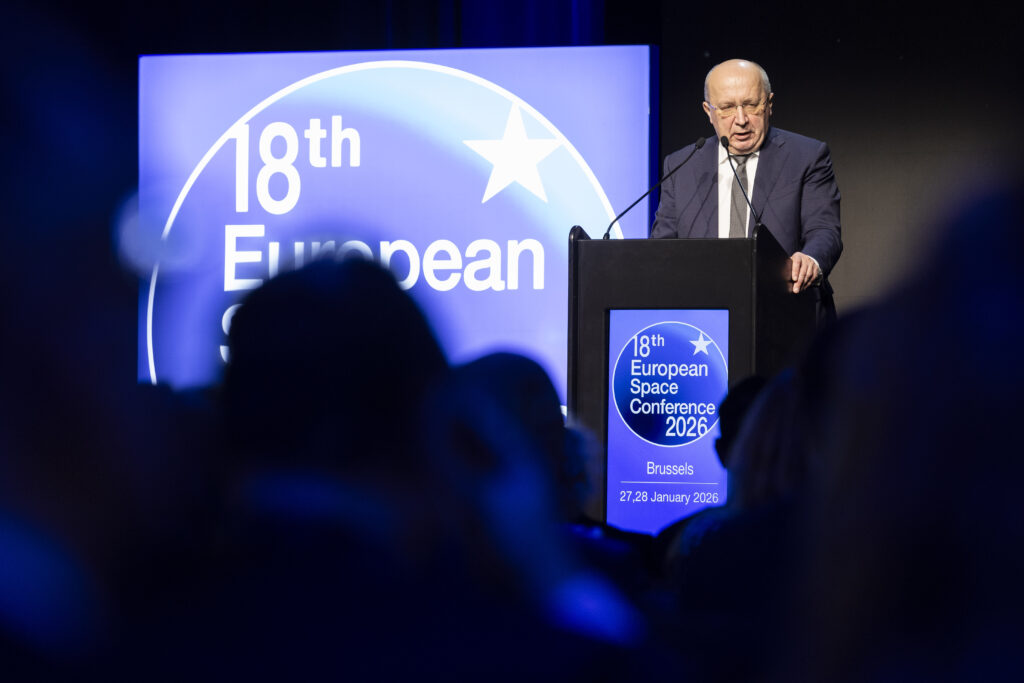
The plan is structured in three phases, the first of which became operational just recently. At the European Space Conference in Brussels, European Commissioner for Defence Andrius Kubilius announced that “Govsatcom operations were launched last week”, referring to the European programme for secure governmental satellite communications based on the pooling of existing national resources.
Phases one through three
“At present, we have eight satellites from five countries already providing this service,” Commissioner Kubilius said, specifying that Govsatcom communications are “military and governmental, secure and encrypted”, and are “operated in Europe, under European control”.
The second phase, scheduled for 2027, foresees the expansion of coverage and bandwidth on a global scale, “to cover the entire world”, through the acquisition of new capacities from commercial operators offering “additional levels of security”.
The third phase, expected in 2029, will coincide with the entry into service of Iris2, the EU’s satellite constellation for internet connectivity, described as Europe’s alternative to Elon Musk’s Starlink system. “The big news last week is that Iris2’s military Ka-band frequencies have been brought into service, enabling the provision of governmental services,” Mr Kubilius said, calling it “a very important event” that demonstrates the project’s progress and “the value of the public-private partnership model”.
The focus should be on how to make us stronger as Europe. – EU Commissioner for Defence Andrius Kubilius
The commissioner also said he had asked partners to “intensify and accelerate work on Iris2”, adding: “I am confident that we will be able to roll out initial services as early as 2029”. This timeline could also have implications for debate in Italy, following earlier so far inconclusive discussions on potential cooperation with Starlink for strategic satellite connectivity services.
US in the sky
In his address to the annual conference of the European Defence Agency, Andrius Kubilius referred to the new US National Defence Strategy, which identifies the Indo-Pacific and the Western Hemisphere as Washington’s strategic priorities.
“They expect us Europeans to take responsibility for the conventional defence of Europe,” he said, explaining that the United States will “reduce its presence on the European continent”. For the EU, this means “building our independence very quickly. Independence in defence, without delays and without excuses”. Kubilius stressed, however, that independence does not mean “being alone” but rather strengthening a European pillar within NATO.
“No single member state is stronger than Russia”
“We are currently working with member states and with Ukraine on EDIP priorities, such as missiles. This is an urgent priority,” Kubilius said, announcing the launch of a direct dialogue with industry. “I will ask how many missiles you can produce and where the bottlenecks in supply chains are,” he added, with the aim of increasing Europe’s defence production. According to the commissioner, fears of an imminent war are driving a rapid increase in defence spending. In this context, the development of national space capabilities can strengthen individual countries, but also carries the risk of fragmentation.
“The focus should be on how to make us stronger as Europe,” he said, calling for interoperability and integration from the design stage. “If we protect only our own country, we will not deter Putin. Only unity can deter Putin and defend the European Union”. The proposal put forward is a partnership that would function as a “virtual European space command”, enabling member states to use shared space resources in times of crisis or conflict.
EU sets the rules
On the regulatory front, the Italian MEP Elena Donazzan (ECR), rapporteur for the EU Space Act, told the European Space Conference that “the Space Act must be born under the banner of simplification”, with clear rules, predictable timelines and less bureaucracy to build a genuine European space market.
“I deliberately speak of a market, because the risk is that Europe once again ends up penalising itself through excessive regulation,” Donazzan added, warning that the legislation would succeed only if it avoids mistakes already made in other strategic sectors. She recalled that 2026 will mark “a decisive milestone for one of the central dossiers of the current legislative term”. Simplification, she concluded, must avoid “duplications and overlaps”, clarify responsibilities, and ensure balanced governance that respects the role of member states and national agencies, without imposing additional bureaucratic burdens on companies.