The European Commission‘s revised Urban Wastewater Treatment Directive puts access to essential drugs in jeopardy. Acknowledging the concerns, Olivér Várhelyi, the health commissioner has signalled cautious openness to delaying the legislation.
The signal came on Tuesday in the European Parliament’s public health committee (SANT). The commissioner acknowledged that a temporary “stop-the-clock” could create time for reflection. The Commission, however, maintains that headline cost estimates remain within earlier projections.
The exchange followed the publication of an updated cost study in December by the Commission’s Joint Research Centre. It examined the financial impact of the directive’s Extended Producer Responsibility (EPR) scheme.
A red line on medicine shortages
The revised Urban Wastewater Treatment Directive strengthens requirements for removing micropollutants from urban wastewater. Under its EPR scheme, pharmaceutical and cosmetic companies must cover at least 80 per cent of the cost of this additional treatment. The rule reflects their contribution to micropollutant loads in wastewater.
The commissioner stressed that avoiding medicine shortages remains a clear red line for the Commission. “I still stand by my opinion that we have to make sure that the implementation of the Urban Wastewater Directive does not lead to any shortages when it comes to medicines,” he told the committee.
“And this is the policy line also agreed by the College. And I stand by that.”
Asked directly whether he would support a one-year pause, he pointed to institutional constraints. “What I see, on the other hand, is this proposal to stop the clock, where I was asked to react,” he said.
“I’m bound by the College. I don’t think I can step beyond that.”
Personal openness to reflection
Despite that constraint, the commissioner made clear that he saw value in the rationale behind a pause. “But personally, I think it might do some good to create time and space for proper reflection,” he said. That reflection, he suggested, could help meet the directive’s environmental objectives without triggering shortages or wider social consequences linked to medicine supply.
“Without jeopardising or calling into question the targets, maybe there are ways to implement the targets of the Directive in a way which will not lead to any shortages or even social problems when it comes to the supply of generics,” he said.
I think it might do some good to create time and space for proper reflection. — Olivér Várhelyi, EU health commissioner
He stressed that the issue extends beyond industrial economics to patient needs. “Most of those products are taken by people, not by personal preference. But because of chronic conditions,” he said, citing diabetes, high blood pressure, antibiotics and contraceptives. “If the EPP achieves such a stop the clock,” he added, “I think it should provide us with time and space to have proper reflection. Maybe the study is the first step in this.”
Parliament keeps up the pressure
The commissioner’s remarks came in response to mounting concern in Parliament that the updated cost study does not resolve the risks that matter most in practice. MEP Tomislav Sokol (EPP/HRV) said that despite the updated study published in December, “fundamental issues remain unresolved.”
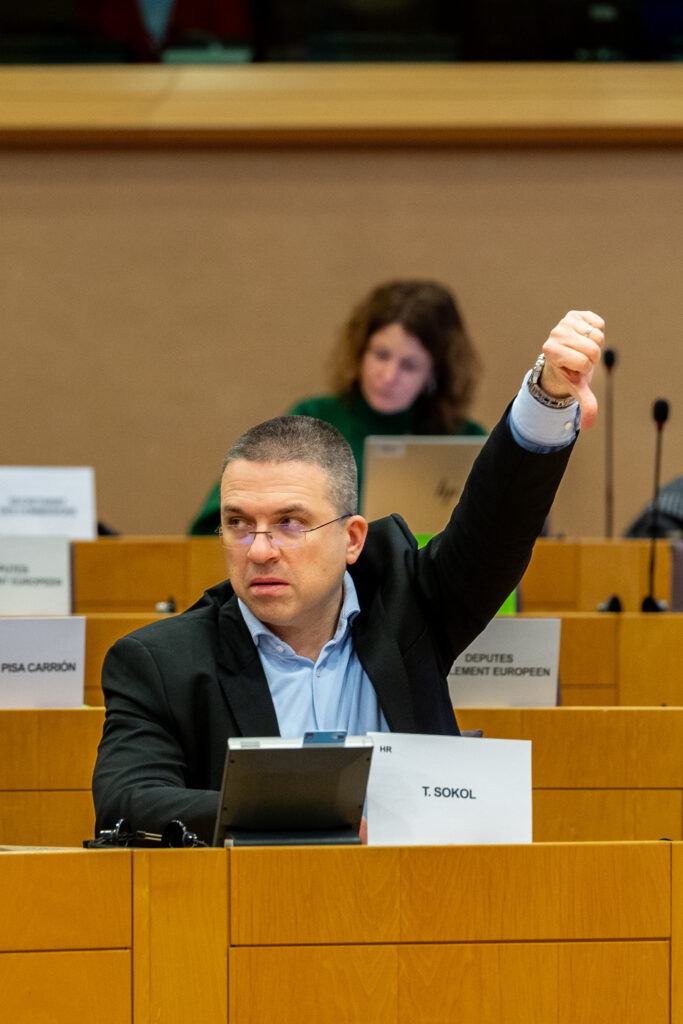
“While the EPP Group fully supports protection of Europe’s water resources, we remain seriously concerned about the way this framework is being translated into practice,” Mr Sokol told the committee. “Cost estimates continue to vary significantly. Product-level impacts, especially for critical and predominantly generic medicines, are still insufficiently assessed. And key questions related to practical implementation and enforcement remain unanswered,” he said.
Given regulated prices and structurally low margins, particularly in the generic industry, the Croatian Christian democrat warned of “a real risk of unintended consequences for the availability, affordability and security of supply of these medicines in Europe, as well as for the competitiveness of our pharmaceutical industry.” With that in mind, he said, the EPP has called for “a one-year stop-the-clock period, in combination with further in-depth and independent analysis before the EPR scheme applies in practise.”
MEP Ondřej Knotek (PfE/CZE) reinforced the warning, focusing explicitly on generics. “This is something extremely serious,” he added. “The generics production is in danger if we do not change it.”
What does the study (not) settle?
An updated cost analysis by the Commission’s Joint Research Centre finds that estimated EU-wide costs of quaternary wastewater treatment fall within the range assessed in the 2022 impact assessment. By full implementation in 2045, the study estimates annual costs in the range of €1.48bn to €1.8bn, compared with an inflation-adjusted baseline of €1.56bn.
“Such cost adaptation per se would not challenge the conclusions of the impact assessment concerning the aggregated impact of costs on the industry and consumers, all the rest being equal,” the study states.
The study notes that “the alternative estimates support higher treatment costs per population equivalent,” while “the recast UWWTD requires less widespread treatment of micropollutants than assumed in the impact assessment,” adding that such cost adaptation “would not challenge the conclusions of the impact assessment concerning the aggregated impact of costs.”
At the same time, the report is explicit about what it does not assess. “This check is necessary as a preliminary step before evaluating how the costs of quaternary treatment may affect the availability and affordability of medicines,” it notes.
Why the debate persists
While the updated cost study confirms that aggregate EU-wide costs fall within the range assessed in the 2022 impact assessment, it does not resolve the concerns raised repeatedly in the health committee. Notably, the analysis only deals with aggregated impacts. It does not assess effects at the level of specific medicines or medicine categories. It does not examine how additional costs might affect low-margin generic medicines, the core concern raised by several lawmakers.
(The directive poses) a real risk of unintended consequences for the availability, affordability and security of supply of these medicines in Europe, as well as for the competitiveness of our pharmaceutical industry. — MEP Tomislav Sokol
For critics of the current timetable, that gap matters more than the headline numbers. Their concern is whether implementation could trigger unintended consequences for medicines with little or no pricing flexibility. The commissioner’s remarks in the committee reflect that uncertainty.
While he stopped short of formally endorsing a pause, he acknowledged that a stop-the-clock could “create time and space for proper reflection” without calling the directive’s environmental targets into question. In doing so, he framed calls to pause implementation as an attempt to sequence it more carefully, rather than outright rejection of the directive.
A pause still on the table
The updated cost study closes one chapter of the debate. It confirms that the Commission did not miscalculate the overall EU-wide cost envelope. It does not close the question that dominated the health committee this week: whether the directive, as implemented, risks undermining access to essential medicines.
By acknowledging the need for “time and space for proper reflection,” the commissioner signalled that the stop-the-clock debate is no longer hypothetical. For now, the clock is still running. But the pause button remains firmly on the table.