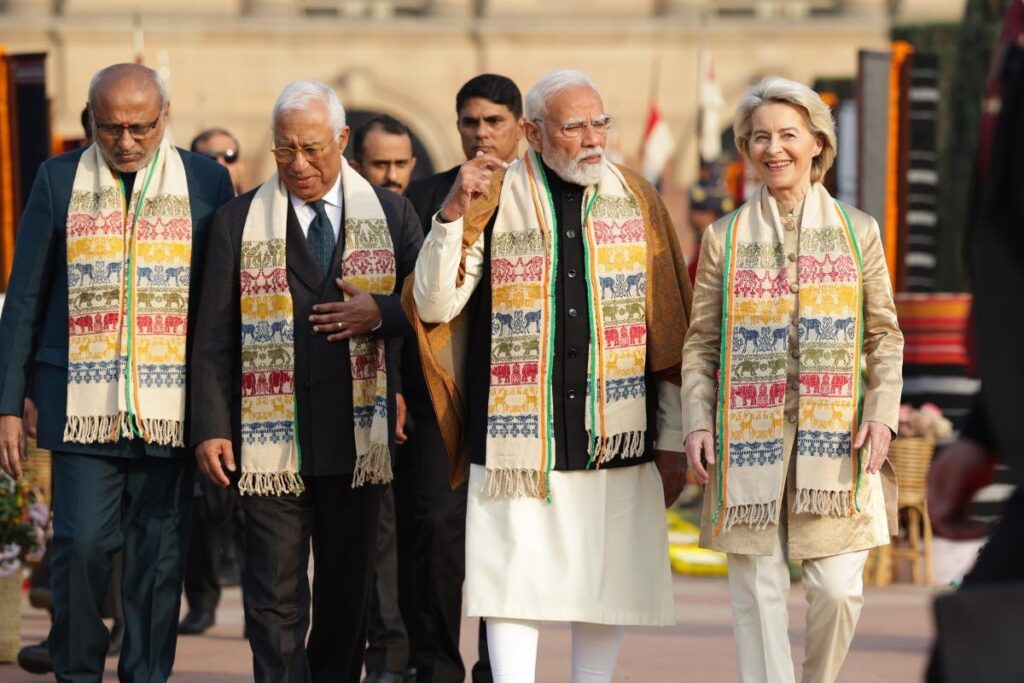
As Commission President Ursula von der Leyen celebrates reaching a trade deal with India, experts warn against too much optimism. With the deal still facing legal vetting, formal singning and ratification, and with the Mercosur legal battle ahead, the negotiations are far from over.
“We have concluded the mother of all deals,” stated Von der Leyen on Tuesday after striking a trade agreement with India. But “concluded” overstates the reality.
Dr. Fabian Zuleeg, Chief Executive and Chief Economist at the European Policy Centre, puts it bluntly: “What we are seeing in the trade field now is that everything is more risky than it used to be.”
Even in the best case, some express caution. “Observers shouldn’t rush to conclusions about the deal redirecting global trade, speeding up economic integration, or jump-starting economic growth,” warns Mark Linscott, a nonresident senior fellow at the Atlantic Council and former U.S. assistant trade representative for South and Central Asian affairs. “In the end, the India–EU free trade agreement may have only a modest impact,” he continued.
EU moving away from China and the US
The EU’s push to finalize both deals is seen by many as an effort to diversify away from China and, in response to the second Trump administration, the United States—exemplifying what Canadian Prime Minister Mark Carney called for at this year’s World Economic Forum: middle powers unite.
“The weaponization of interdependence means that the way to reduce the leverage from those who want to weaponize those interdependencies is to diversify,” explains Oscar Guinea, a director at the European Centre for International Political Economy. “These agreements are a tool to diversify the markets and the importers so that China and the US can have less leverage over them,” he continued.
What’s in the deal
The deal centers on providing duty-free or reduced-tariff access for India-made products like textiles, apparel, leather goods, footwear, chemicals, jewelry, and electronic machinery. Currently, EU tariffs on Indian goods average about 3.8 percent overall, but labor-intensive sectors face tariffs between 4 and 26 percent. India will reciprocate by cutting its average 9.3 percent tariff on EU goods, with particularly steep reductions on automobiles (currently 35.5 percent), machinery, chemicals, and pharmaceuticals.
Before becoming a reality, the deal still requires European Parliament ratification and EU Council approval—a process expected to take months, with implementation possible by early 2027—either of which can derail it. Because unlike EU policymakers’ desires to diversify, some European interest groups prefer protectionism.
Issues ahead
The Mercosur deal made it to the finish line only to stumble at the final moment. Beginning in 1999, the agreement passed Council approval on January 9 with a comfortable 21-5 vote, only for Parliament to vote 334-324 on January 21 to send it to the European Court of Justice—driven by the far right representing concerned farmers over Brazilian and Argentinian beef, and the far left’s environmental concerns about the Amazon.
Similar concerns exist for India. Though India has ring-fenced sensitive agricultural sectors including dairy, cereals, poultry, and soymeal, Italian and Spanish rice farmers—producing 50 and 30 percent of EU rice respectively—wield disproportionate influence. These heavily subsidized growers have mobilized against Asian imports before. The textile sector presents less competition given hollowed-out EU manufacturing, but labor standards and IP protection for luxury brands remain concerns.
Dr. Zuleeg believes the deal will pass more easily because of this: “I would assume that some of the most controversial issues are not going to be featured, which will make it much easier to get it through the system. This is a different class of agreement.”
What makes the India deal different
However, key differences favor India’s chances. “It’s probably one of the worst kept secrets in Brussels that there is a very strong political alignment that we should have an agreement with India, whatever the cost,” Hosuk Lee-Makiyama, director of the European Centre for International Political Economy told Euronews.
Stefania Benaglia, a Brussels-based EU foreign policy expert specializing in EU-Asia relations who previously led the Foreign Policy unit at CEPS, points to technology sovereignty: “The only two trade and technology councils that the EU has had are with the US and India. Now the US one is dead, even before Trump it was in decline, with little interest in reviving it, but India’s is very much at the core strategic interest with expectations of further scaling up.” With both sides seeking alternatives to US-China tech dependence, the geopolitical tech alignment runs deeper than trade flows alone.
The EU has long framed the India partnership as a strategic necessity for de-risking from China and balancing Indo-Pacific power dynamics—a geopolitical urgency absent from Mercosur. Modi’s India also lacks the toxic political baggage of Bolsonaro-era Amazon deforestation. Perhaps most importantly, the deal emphasizes services, digital trade, and investment rather than Mercosur’s contentious agricultural focus.
“We usually don’t think about it in this way, we think about it in terms of tariffs,” Guinea notes, “but it’s also about the deepening of exchange between countries and with companies. Companies trade, not countries. And it gives this legal certainty to companies.”
Remaining vulnerabilities
Bilateral trade between India and the EU in goods has already grown by nearly 90 percent over the past decade, reaching €120 billion in 2024, with services trade adding another €60 billion.
But the deal faces another vulnerability: the EU’s carbon border adjustment mechanism (CBAM). India hasn’t received an exemption from the tool, which adds costs to carbon-intensive exports like steel, cement, and fertilizer. Though it currently covers just six products, it’s designed to eventually expand to all industrial goods—potentially wiping out the tariff savings the deal promises, unless India aligns its carbon pricing with EU standards. This was a last-minute negotiating flashpoint and could become ammunition for opponents during ratification.
After the confidence with which the Commission negotiated Mercosur only for Parliament to shelve it days after signing, one has to ask: How reliable is the EU as a trade partner if interest groups can derail a deal no matter how carefully negotiations were conducted?
Guinea offers a defense: “Dealing with the EU is more like a fixed cost. It’s high, but once you have overcome those costs, when you have negotiated the agreement, when you have actually changed your product so it meets European standards and regulations, that’s it. You can feel a bit more confident.” The question is whether prospective partners still believe that confidence is warranted.