It took close to four years of brutal war at the EU‘s doorstep, a direct threat of aggression from an all-powerful former ally, and the demise of the global order, but it has arrived. Plans for a meaningful joint Europan force are tabled, despite opposition from friends and foes alike. Not a day too soon.
In Brussels Kortenberg building, the watch-floor of the European Joint Headquarters inside the Military Planning and Conduct Capability is humming 24 hours a day. Staff officers rotate through faraway bases, honing Arctic drills.
Meanwhile, permanent Maritime Patrol detachment has settled at Keflavík. Eurodrone flights circle the Baltic. Factories in Slovakia and Spain spit out standardised artillery shells. Procurement agencies crow that 42 per cent of contracts are now joint.
Proof of concept
Then the dreaded spark flies, and a hybrid flare-up in the Suwałki corridor triggers Article 42.7. The new European Security Council votes eleven to two to deploy the Rapid Deployment Capacity. Rail wagons squeal; fighters streak east. The operation lasts five tense weeks, deters a Russian probe and ends without fatalities. Critics deride the affair as theatre; supporters hail proof of concept.
This, of course, is all fiction—for now. The Russians haven’t gone through with an overt attack yet. European planners have only late 2028 in mind when it comes to the establishment of the joint headquarters. But in February 2026, the drive to create a meaningful European military force is further down the road than ever before.
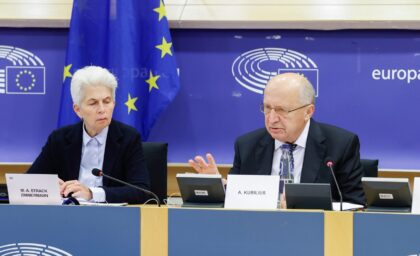
Meanwhile, reality is ony fractionally less exciting, even as it unfolds the Brussels tedious way. On 15 January, EU defence ministers were waiting in the Justus Lipsius building for Andrius Kubilius. The Lithuanian defence commissioner was to explain how Europe might fight without American help.
Bonsai armies
When the door swung open the commissioner spoke without preamble. “We need to start to invest our money in such a way that we would be able to fight as Europe, not just as collection of 27 national bonsai armies,” he declared, borrowing the expression from one-time chief EU diplomat Josep Borrell. Twitter-happy thumbs must have twitched.
Mr Kubilius had rehearsed the line two days earlier at Sweden’s annual Folk och Försvar jamboree. Journalists there heard his broader plan: “The European Security Council could be composed of key permanent members, along with several rotational members … and not only discussing, but also swiftly preparing important decisions.” In Brussels he repeated the phrase, sharpening a debate that has irritated European chancelleries for two decades but never broken the skin.
The European Security Council could be composed of key permanent members, along with several rotational members, not only discussing, but also swiftly preparing important decisions. — Andrius Kubilius, EU defence commissioner
Why now? Russia’s war on Ukraine drags into its fifth year; Donald Trump hints at not only shrinking America’s European garrison but also the takeover of Greenland; and Finland and Sweden have joined NATO, turning the Baltic into an almost-entirely allied lake. Yet calls for ‘strategic autonomy‘ still bounce off Brussels walls. Planners warn that aircraft fly, munitions explode and soldiers march—yet too often European institutions merely meet, adopt conclusions and publish communiqués.
Awkward arithmetic
Three fresh voices raise the stakes. First comes the commissioner’s own rallying cry: “Europe must ‘very rapidly’ build independence in defence.” Second is a chilly verdict from the Royal United Services Institute (RUSI), a British think-tank: “The fundamental strategic choice is straightforward: double down. … 2026 will reveal whether Europe has learned this lesson, or whether Putin’s collapsing window will succeed in breaking what his military invasion could not.” Third, analysts at the EU Institute for Security Studies strike an even blunter note: “A US-backed NATO still has deterrent power … but the EU is nowhere near able to replace US guarantees in the short term.”
Such bluntness stings, yet it also clarifies. In private, Council officials recall how French and German generals first sketched a joint corps in the late 1990s, only to watch it wither into a parade outfit. EU battlegroups followed, standing idle since 2007. The latest outfit—the Rapid Deployment Capacity—boasts 5,000 troops, hardly a match for the 100,000 American soldiers embedded from Rota to Rzeszów. Hence Mr Kubilius’s provocation: Europeans should plug that gap themselves.
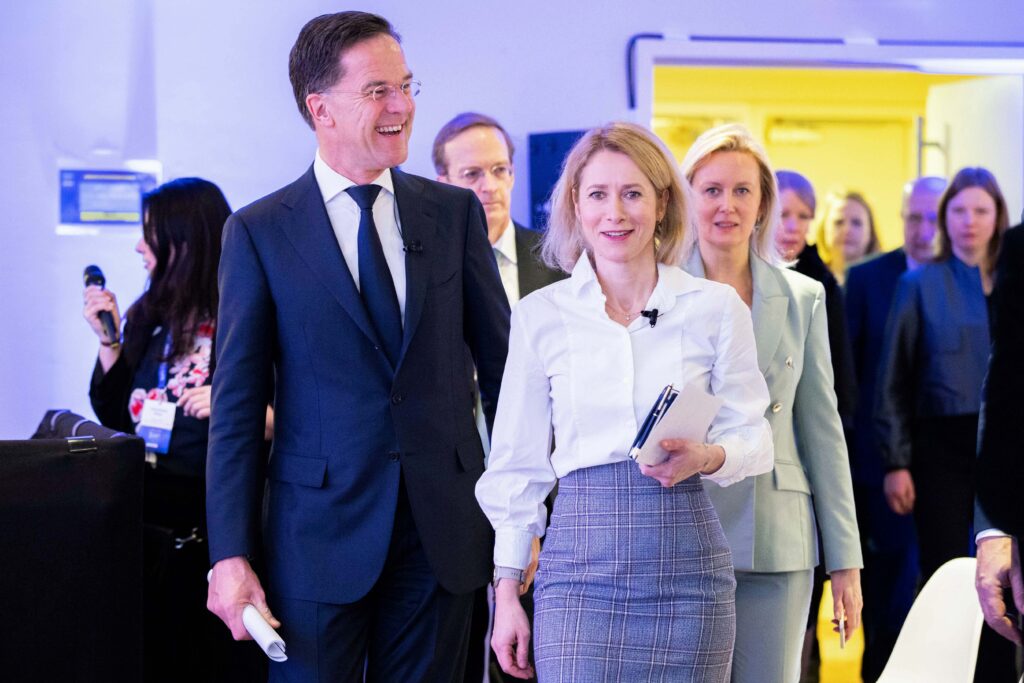
The idea is yet to gain universal acceptance. Kaja Kallas, EU top diplomat, favours Mr Kubilius’ line. Mark Rutte, NATO’s secretary general, has dismissed it outright: „If anyone here thinks that the EU or Europe can defend itself without the USA – dream on. You can’t!” he told the European Parliament in January. It did not go down well with many MEPs; yet in the short run, he may be perfectly correct.
This should be a standing EU force, not one made by rotating units from national forces. — Center for Strategic and International Studies
The potentially dangerous rift notwithstanding, the commissioner’s outline draws on two blueprints. One is EUFOR CROC, a flagship Permanent Structured Cooperation project that aims to weld 60,000 soldiers into a “full-spectrum force package”. The other, bolder, is his own. “Europeans should be able to replace the US presence in Europe at about 100,000 troops,” he told the Swedish audience. He added a second exhortation: “Member states should explore a standing European force of roughly 100,000 personnel.” Both sentences travelled swiftly through diplomatic cables.
How to forge steel
To move from rhetoric to regiments Brussels needs cash. Speaking to defence-industry grandees in March, Mr Kubilius warned: “Capabilities, not profits, matter most now and will matter in the coming years.” He waved the Commission’s Defence Readiness Roadmap, hot off the printers. One line barked orders: “Launch projects in all priority areas within the first half of 2026.” Another tightened the screw: “Organise at least 40 per cent of defence procurement as joint procurement — by end 2027.” Officials whispered of a €150 bn ReArm Europe loan pool, ready to funnel cheap money toward artillery, air-defence and transport aircraft.
Think-tankers supply intellectual scaffolding. The Centre for European Policy Studies reminds sceptics that “Policy innovation in CSDP happens through modular compositions of member states participating in PESCO projects.” Across the Atlantic, the Centre for Strategic and International Studies pushes harder: “This should be a standing EU force, however, not one made by rotating units from national forces.” The message lands: pooling budgets without pooling brigades will not impress Moscow.
Parliamentarians sniff a chance to matter. MEPs threaten to block the next seven-year budget unless the Council accepts a defence-bond facility. National capitals grumble but, after two years of pandemic-era borrowing and an energy crisis, joint debt looks less heretical. Bond syndicates already model issues backed by future customs revenues from frozen Russian assets, even as the idea is on the back burner of sorts for now.
Boots, guns and bandwidth
While money is the muscle, sinews lie in command. Nordic governments offer a prototype. Their defence-co-operation pact, NORDEFCO, signed a Vision 2030 pledging to align planning with NATO and to field a combined joint staff. Chiefs of defence have approved a Nordic Defence Concept that sketches a permanent headquarters able to plug into NATO’s Joint Force Command Norfolk and, if needed, take charge while bigger allies mobilise. Brussels eyes the model hungrily.
Yet acronyms alone cannot fire a shot. PESCO documents admit as much: “The project does not aim at providing new capabilities but to facilitate training and doctrine works.” That candour spurs others. The same CEPS study that celebrates modular innovation adds a warning: “Pioneering groups of member states could use PESCO to equip more sizeable force packages grafted onto the new Rapid Deployment Capacity.” Such packages would draw on Eurodrone squadrons, common artillery stocks and a military-mobility scheme meant to turn Europe’s roads and rails into a tank-friendly Schengen, as the plan is informally known.
Pioneering groups of member states could use PESCO to equip more sizeable force packages grafted onto the new Rapid Deployment Capacity. — Centre for European Policy Studies
On top floats the grey cloud of cyber-mischief. RUSI cautions: “Europe must … establish credible deterrence against hybrid warfare or watch Putin attempt to fracture Western unity through a thousand cuts.” Hybrid shields cost less than main battle tanks yet demand meticulous co-ordination of telecoms, energy grids and information policy—the stuff Brussels already regulates. Some officials hope that gives the Union an edge over Nato’s purely military toolkit.
Edges of empire
Geography still matters. Icelandic airfields guard the Greenland–Iceland–United Kingdom gap, the only deep-water exit for Russia’s northern submarines. Polish sappers drive piles for the East Shield, a line of obstacles along the Belarusian border. In Brussels planners group such tasks under three headings: deter in the east, patrol the High North, stabilise the south. Critics mutter that the menu already exceeds the kitchen’s capacity.
To square ambition with manpower, strategists resurrect the idea of tiered readiness. High-alert brigades would keep 95 per cent of soldiers on base, ready to deploy within five days. Follow-on units would mobilise in a fortnight; the rest would train or rest. Modelling by RAND, an American research group, shows that two heavy brigades, one amphibious brigade, 96 fighter aircraft and a small fleet of frigates could thwart a limited Russian thrust in the Baltics for thirty days. That equals roughly 50,000 troops—half the commissioner’s headline number but a credible point of departure.
Mr Kubilius insists on the bigger target nonetheless. He recalls how battlegroups never left barracks because capitals withheld political consent. His European Security Council would fix that, seating France, Germany, Poland and Italy permanently, with others rotating in. Decisions would pass by qualified majority; unanimity would return only when ordering troops into combat. National lawyers blanch at the thought, but the commissioner shrugs. “How will we replace the 100,000-strong American standing military force?” he asked in Stockholm. No one offered an answer.
Counting the cost
Joint procurement grabs headlines, yet industry lobbyists fear thin profits. They nod politely when Mr Kubilius scolds them, then count order books behind closed doors. But the commissioner holds leverage: a new European Defence Industry Programme promises grants for factories that retool for 155-millimetre shells, drones and air-defence missiles. Finance ministers, once tight-fisted, discover that voters now equate artillery with security. Bond markets, awash with liquidity, barely flinch.
Still, politics intrudes. Hungarian officials threaten to veto debt issuance unless linked to migration concessions. Dutch fiscal hawks balk at what they label “military mutualisation”. Gradually a compromise forms: the Council agrees to treat defence spending up to 1.5 per cent of GDP as exempt from deficit rules, provided half flows through joint channels. That nudges governments toward the 3.5 per cent NATO guideline without wrecking domestic ledgers.
Europe must establish credible deterrence against hybrid warfare or watch Putin attempt to fracture Western unity through a thousand cuts. — Royal United Services Institute
Command-and-control wiring consumes technicians. Federated Mission Networking, the alliance’s digital backbone, must stretch from Portuguese fighter wings to Estonian artillery. Engineers fuss over encryption, spectrum management and satellite bandwidth. Generals fret about who may read whose data.
Under the bonnet
Brussels offers a sweetener here: the European Space Programme can gift sovereign communications satellites, avoiding reliance on American systems. Cyber units, trained under the EU’s Permanent Structured Cooperation, practise offensive drills alongside NATO’s Cooperative Cyber Defence Centre in Tallinn.
All that gadgetry must move. Military Mobility, a humdrum PESCO dossier, becomes glamorous. Officials map bridges, tunnels and ferry slips, then fund upgrades through the dual-use transport budget. Bureaucrats boast that a German armoured brigade can now roll from Bavaria to Lithuania in four days. Logistics nerds beam; diplomats write talking points.
Time presses. The Commission’s own timeline demands initial projects this year. Parliament wants results before the 2029 elections. Analysts warn that Moscow’s war economy churns out shells faster than Europe can buy them. Ed Arnold of RUSI calls for “a sober analysis of when Europe could be at war with Russia,” grousing that public urgency remains scarce. Meanwhile, Greenlandic lawmakers lobby Brussels to deter any Kremlin mischief in the Arctic. MEPs insert a clause: any coercion in Greenland is “a major threat to EU strategic interests”.
Against the clock
Some capitals still flinch. Warsaw fears that an EU chain of command might dilute NATO guarantees. The Baltic states worry that larger allies could trade their security for gas deals. Berlin dreads new debt. The role of the UK remains unclear. Yet each objection meets a rejoinder: PESCO allows coalitions of the willing; Article 42.7 of the Union treaty binds members to mutual aid; London’s logistics and nuclear umbrella remain essential; and debt, deployed wisely, forestalls price hikes at the petrol pump.
We need to start to invest our money in such a way that we would be able to fight as Europe, not just as collection of 27 national bonsai armies. — Andrius Kubilius, EU defence commissioner
That said, NATO remains the sheriff; America still fields stealth bombers and carrier groups. EU officers concede that the Union cannot match those assets soon. The EUISS reminder of EU forces’s inability to replace American power rings true. The new force therefore complements rather than supplants the alliance. Yet mindsets shift. When Italian voters ask why their sons might defend Estonia, ministers might well answer: because Estonian drones shield Sicilian skies.
Obstacles abound. Lawyers still haggle over who pays pensions. Generals fear dual loyalties. Finance ministers sweat over debt ratios if interest rates rise. Nevertheless, the mood has shifted from abstraction to execution. As the commissioner likes to say, quoting himself with a grin, “Capabilities, not profits, matter most now and will matter in the coming years.” Air-bases, depots and fibre-optic cables obey that logic.
No guarantees
The think-tankers keep score. RUSI’s gloomy—yet oddly hopeful—warning about the EU’s fundamental strategic choices landed well. The bloc has chosen to double down, of sorts. Brussels bonsai armies may yet inch toward becoming a forest. As Mr Kubilius puts it: “Independence does not mean alone. Independence means together.” The slogan feels almost Churchillian. Not a day too soon. As of today, the Russia-provoked conflict from the beginning of this text is still far likelier than Europe’s textbook response.