The European Union‘s biggest asset is underperforming, is the main takeaway from the Commission‘s single market report. Over a half of the parameters measured show no change over the past year. When integration is the game, stagnation equals retreat.
The European Commission unveiled its sixth Annual Single Market and Competitiveness Report on 30 January. Brussels trumpeted the document as fresh proof of the bloc’s economic clout. “The report draws on 29 key performance indicators, covering areas such as market integration and barriers, electricity prices and investment trends, and identifies priority areas for action,” the press release proclaimed. It went on: “The report shows that six indicators have decreased, six have improved, and 15 remain broadly unchanged.” That neat symmetry sounded reassuring.
Yet the numbers tell a bleaker tale. Key metrics are flat-lining: integration has stalled, services remain shackled and digitalisation crawls. Single-market trade as a share of GDP is drifting down, while the conformity gap between EU rules and national practice widens. Brussels calls this a “plateau”. Businesses call it a wall.
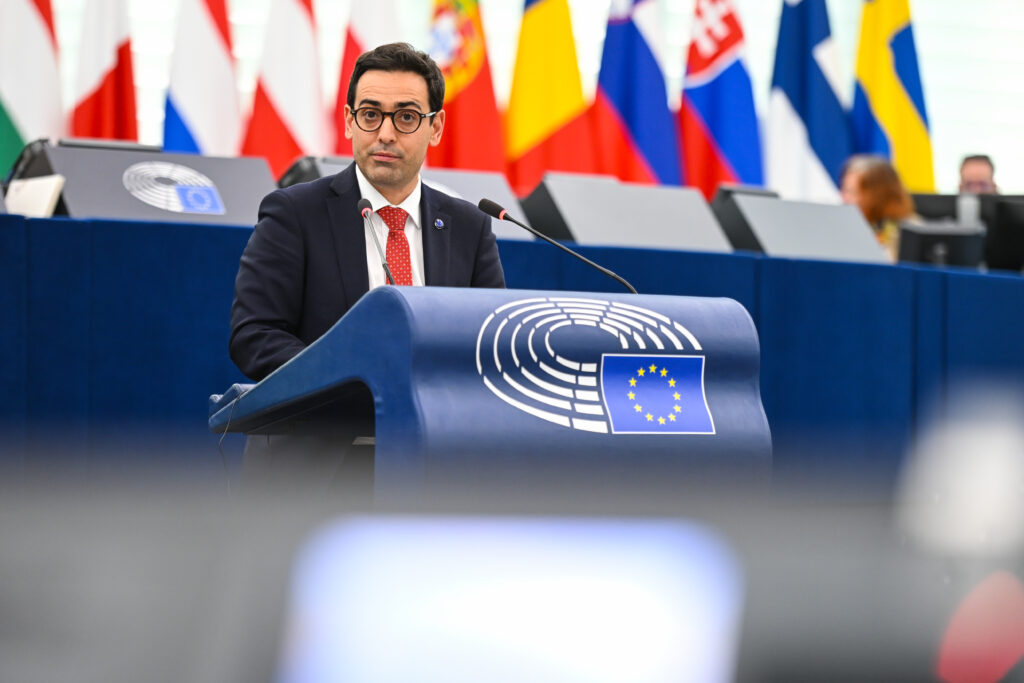
“The Annual Single Market and Competitiveness Report confirms that the single market is not only our main source of prosperity, but also a central pillar of Europe’s power in today’s geopolitical context,” declared Executive Vice-President for Prosperity and Industrial Strategy Stéphane Séjourné when presenting the findings. The tone was almost upbeat; investors must have wondered why.
Stuck at the border
Six headline indicators worsened over the past year. Trade between member states fell as a share of GDP. Labour shortages in green-transition occupations deepened. Private investment slid. Product-standardisation times lengthened. Schools’ PISA scores sagged, hinting at future skills gaps. Most damningly, new infringement cases against countries that neglect single-market directives ticked up. The Commission insists that “the share of transposed EU Single Market Directives for which infringement proceedings were launched” is only one datapoint. Firms see a pattern: rules exist on paper, but enforcement drags.
Underlying causes run deep. Companies must still re-identify, re-register and re-file in every member state. National company law is reapplied 27 times. Many procedures rely on paper forms or non-interoperable IT. Enforcement remains manual and ex-post. As the report concedes, the market is legally open, but operationally closed.
Digitalisation ought to help, but progress is glacial. Barely one-fifth of single-market administrative procedures are fully online. A new yard-stick shows simplification proposals could save €15bn, yet those savings remain hypothetical. “The Commission will publish clear explanations regarding the objectives pursued and the results achieved,” promises the press release. Stakeholders have heard that vow before.
A modest recovery plan
Brussels pins its hopes on three “fix vectors”. First comes the European Digital Identity (EUDI), a wallet that would let citizens and firms prove who they are across the bloc. Second is an Establishment Business Wallet (EBW), a gateway for once-only filing of compliance data. Third is a voluntary ‘28th regime‘ of EU-level company law, freeing firms from 27 overlapping national codes.
The Commission touts slick gains. Administrative costs could drop by €13.5 billion. Compliance would shift from lawsuits to machine-readable attestations. Services could scale across borders without opening extra subsidiaries. Productivity gaps between digital front-runners and laggards might narrow. In the language of the slide, cross-border activity would become “transactional, not establishment-heavy”.
To critics, the package sounds like the umpteenth attempt to wire Europe together. An earlier Services Directive promised a bonfire of barriers, only to sputter in the face of national protectionism. Standardisation reform has lurched for years. Even the internal slide labels the 2026 disappointments “execution failures”. Technology cannot fix political reluctance.
Power through persuasion
Mr Séjourné insists momentum is building. “We have already introduced a number of actions to address the challenges identified to unlock the single market’s full potential,” he told reporters. “Now, the EU and its member states must act decisively to tackle the ‘Terrible Tens’ and implement the single market strategy so that European citizens and companies can reap the benefits.” The nod to a catchy villain—the ten worst barriers—echoes Brussels’ old habit of renaming problems rather than removing them.
The Annual Single Market and Competitiveness Report confirms that the single market is not only our main source of prosperity, but also a central pillar of Europe’s power in today’s geopolitical context. — Stéphane Séjourné, European Commission Vice-President
Still, the scorecard is not all red. Recognition of professional qualifications improved. Market-surveillance authorities carried out more product checks. Artificial-intelligence and cloud adoption rose. Added renewable-power capacity climbed, and InvestEU money flowed into industrial transition. Those wins, however, sit alongside 15 indicators that “remain broadly unchanged” and six that slid.
The report also unveils two fresh metrics: projected administrative savings and the share of fully digital procedures. Neither shows concrete results yet. Both could backfire if future editions record zero movement. Then the Commission’s own dashboards would spotlight failure each January.
Waiting for wallets
Much depends on whether governments implement the digital tools quickly. EUDI legislation passed last year, yet national deployment timetables stretch well into 2027. The EBW remains a proposal. The 28th Regime, while conceptually elegant, faces pushback from lawyers and registries that profit from the status quo. Parliament has barely begun its scrutiny.
Business lobbies applaud the thrust. They also note that no digital wallet will erase local licensing quirks or language hurdles. Nor will it cure political resistance to foreign plumbers, architects or accountants. The Commission’s own data show services trade restrictiveness has not budged.
For now, Europe’s single market resembles a finely drawn map with missing roads and clogged tunnels. The Commission’s latest report paints the gaps in brighter colours, then frames them as proofs of strength. Investors can read between the lines. The single market remains the union’s crown jewel. It is also the biggest unfinished job in Brussels.