Medicine supply talks are under way and budget decisions loom not far ahead. Those are the first stress tests Europe’s health autonomy agenda faces under the six-month Cypriot presidency of the Council of the European Union.
Earlier this week, as Cyprus took over the presidency, Neophytos Charalambides, the health minister set out the country’s approach to health autonomy. Autonomy, he said, means “the ability of the Union to ensure access for its citizens to medicines, technology and care. Independent of external crises or threats”. That definition now underpins a series of live policy decisions.
Trilogue negotiations on the Critical Medicines Act (CMA) began this week. The Cyprus Presidency aims to secure a political agreement before the end of its six-month term. The regulation seeks to address supply vulnerabilities exposed by geopolitical disruption and repeated medicine shortages.
Critical medicines in trilogue
MEPs pressed the Council on whether autonomy would translate into binding measures. MEP Tomislav Sokol (EPP/HRV) asked whether joint procurement could give preference to medicines produced in the EU. And whether the bloc should establish a Union-coordinated mechanism for contingency stocks and redistribution during shortages. “The European Parliament got a very strong mandate on this, with more than 500 members voting in favour,” he said.
The rationale is geopolitical. “We must ensure that every citizen has reliable access to the medicines they need,” Mr Charalambides said, pointing to growing risks to supply. The minister acknowledged that Parliament and Council hold different positions. He said these “can be addressed during negotiations”, but he did not commit to specific instruments.
The same tension is emerging on funding. Lawmakers used the exchange to test whether health autonomy will be anchored in the next EU budget, with renewed calls for ring-fenced funding or a stand-alone health programme under the next Multiannual Financial Framework.
The limits of commitment
Former health commissioner, MEP Vytenis Andriukaitis (S&D/LTU) said the presidency had “a unique opportunity to leave a lasting legacy” by securing “a significantly larger share” of the EU budget for health. He asked whether the Council was ready to “defend a ring-fenced EU health budget or… a stand-alone programme dedicated to health issues”.
Mr Charalambides declined to prejudge the outcome, saying it was “too early really to make too many comments” while negotiations on the MFF are still under way. He said the Council nevertheless agrees that “The Union should be armed with the means it requires to act.” He expressed confidence that the debate would have “a positive outcome”.
The Union should be armed with the means it requires to act. — Neophytos Charalambides, Cypriot health minister
Rather than committing to a single funding instrument, he pointed to health financing spread across multiple EU budget lines, including EU4Health and the EU Civil Protection Mechanism, as well as other funding channels under the MFF. The aim, he said, is to ensure “adequate funding for health” that supports readiness, patient access, and the resilience and sustainability of national health systems.
Industry and manufacturing capacity
The autonomy debate extends beyond medicines supply and funding. Cyprus has placed industrial capacity at the centre of its health agenda, linking autonomy to the EU’s ability to develop and manufacture health technologies inside the bloc.
Mr Charalambides said the presidency will complete outstanding elements of the pharmaceutical package following a preliminary agreement reached in December. The aim is to improve access across member states “while maintaining the competitiveness of our industry”.
Targeted amendments to the Medical Devices Regulation and the In Vitro Diagnostic Medical Devices Regulation will also advance, he said. The aim is to address availability concerns and preserve “the attractiveness of the Union in terms of the development of such products”. The presidency expects to report substantial progress to EU health ministers in June.
Biotech as the corrective file
Industrial policy pressure is to intensify with work on the European Biotechnology Act. Mr Charalambides described the file as a strategic tool to strengthen innovation, research, competitiveness and resilience in the EU life sciences sector. Cyprus aims to reach a general approach on the directive and present a progress report on the regulation at the June EPSCO Council.
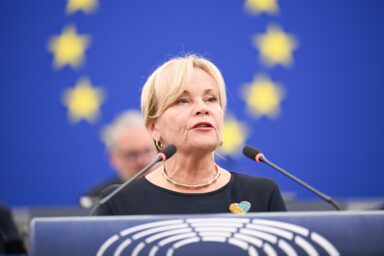
“What we didn’t get done with the pharmaceutical package, we now get done with the Biotech Act.” — MEP Stine Bosse (Renew/DNK)
MEP Stine Bosse (Renew/DNK) warned that “What we didn’t get done with the pharmaceutical package, we now get done with the Biotech Act.” She cautioned that otherwise “We will lose one of the last major industries in Europe.”
Mr Charalambides, once again, acknowledged the risk. He called biotech “an important driver for growth within the EU”, while noting that Europe faces “stiff competition from other regions”. While stressing the need for “the correct regulatory environment and incentives”, he did not outline specific measures. He said only that the presidency would “strive to make as much progress as possible” on the file.
Autonomy without isolation
Mr Charalambides stressed that autonomy, as defined by the Cyprus Presidency, is not about disengagement from global cooperation. Referring to the presidency’s motto of an “autonomous Union open to the world,” he said this approach involves “continuing discussions with third countries, international as well as regional organisations” to address emerging health threats. “The EU and its member states have a key role to play in strengthening international health,” he said. The exchange highlighted the core dilemma facing Europe’s health autonomy agenda.
Lawmakers broadly agree on the risks to medicine supply, industrial capacity and crisis preparedness. Where positions diverge is on how far the EU should go in centralising tools, enforcing coordination and locking in funding.
The immediate test will come by June. Health ministers are then expected to review progress on critical medicines, devices and biotech, against the backdrop of early negotiations on the next EU budget. Failure to translate autonomy into enforceable supply rules or dedicated funding would leave the agenda dependent on voluntary coordination. The model, lawmakers say, has already fallen short. The coming months will show whether Europe’s health autonomy agenda produces binding rules and predictable financing, or stops at definition.