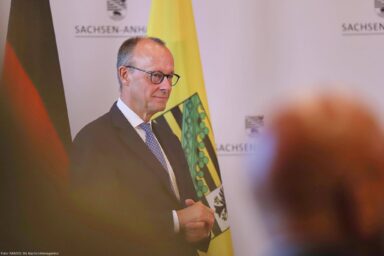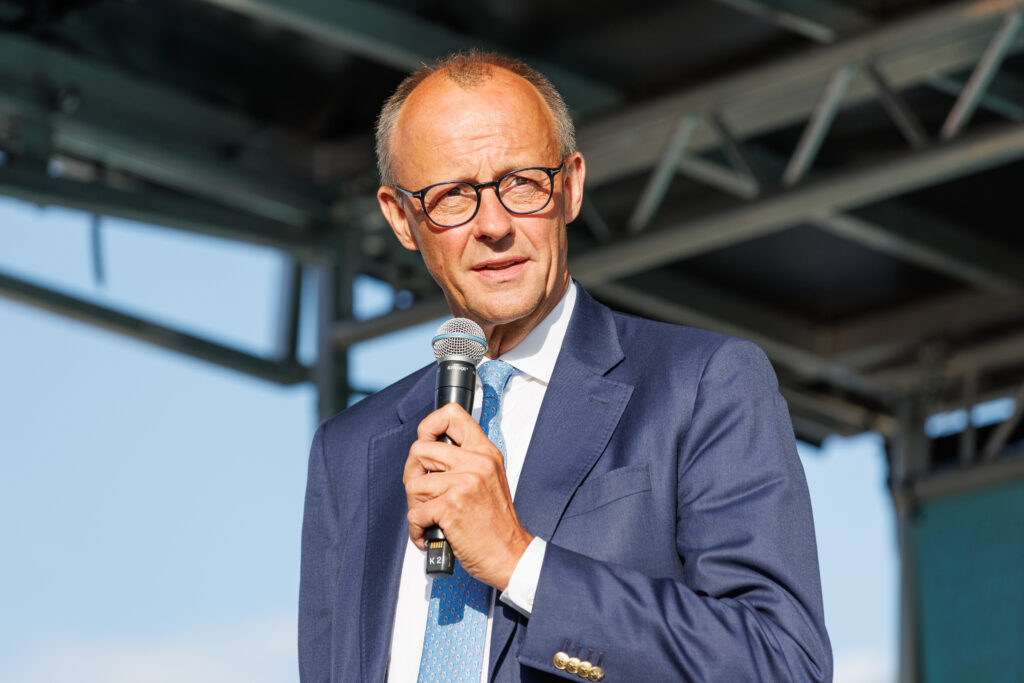
During his first trip to the Persian Gulf, Friedrich Merz hopes to strike new energy and business deals in Saudi Arabia, Qatar, and United Arab Emirates. Germany has largely replaced energy imports from Russia with imports from the United States over the past years, which many consider dangerous. Right groups, however, warn of the bleak human rights situation in the region.
Chancellor Merz’s trip to the Persian Gulf region was carefully prepared by two of his subordinates: Germany’s Economic Minister Katherina Reiche and Environment Minister Carsten Schneider visited the region in January. The aim was to expand economic relations and increase political cooperation between Germany on one side and Gulf states on the other side. Ms Reiche signed a memorandum to deepen the energy ties between Germany and Saudi Arabia.
Oil, gas and more
The focus is particularly on increasing imports of energy sources such as oil and natural gas to Germany. The region is exceptionally rich in these resources, while the trade has been rather modest so far.
Global geopolitical shifts are behind all this. Under Donald Trump’s leadership, the United States is no longer considered a stable and predictable partner in Germany. And the German political elite keeps holding open discussions on this sensitive topic.
“When partnerships that we have relied on for decades start to become a little fragile, we have to look for new partners,” Minister Reiche said in Riyadh in January. Especially Germany’s excessive dependence on liquefied natural gas (LNG) is a frequently discussed topic. Currently, virtually all LNG imports to Germany come from the United States. Although LNG accounts for only about one tenth of total gas consumption, this share is expected to grow significantly. Qatar and the United Arab Emirates are among the world’s largest producers of this commodity.
Regional stability, security, defence
However, the import of raw materials is not the only topic of Chancellor Merz’s visit. Germany also hopes to strengthen its strategic partnership with Saudi Arabia, which it views as an influential regional power. Berlin is seeking “to expand bilateral strategic ties and deepen strategic dialogue with Riyadh,” German Government sources cited.
Meetings in Riyadh are also expected to focus on military cooperation. Germany has recently amended its arms export rules for Saudi Arabia and removed earlier restrictions. A German government spokesperson said Saudi Arabia is “a key player in regional stability and security.”
“Do not make the same mistake”
However, not everyone in Germany is enthusiastic about the shift toward the Persian Gulf. “We must not abandon the people in the Middle East and the Gulf states to their fate. Saudi Arabia is a party to the conflict in Yemen, and Qatar supports Islamists in Syria (…) Our security will not be stabilised by new dependencies and silence, but by value-based and diverse partnerships in the region,” said Max Lucks, Green Party spokesperson.
German government should not support those governments that systematically violate universal human rights. – Katja Müller-Fahlbusch, Amnesty International
Amnesty International also issued a warning. “German government should not keep making the same mistake and, in order to promote supposed stability, support those governments that systematically violate universal human rights,” said Katja Müller-Fahlbusch, expert on the Middle East and North Africa at Amnesty International in Germany.