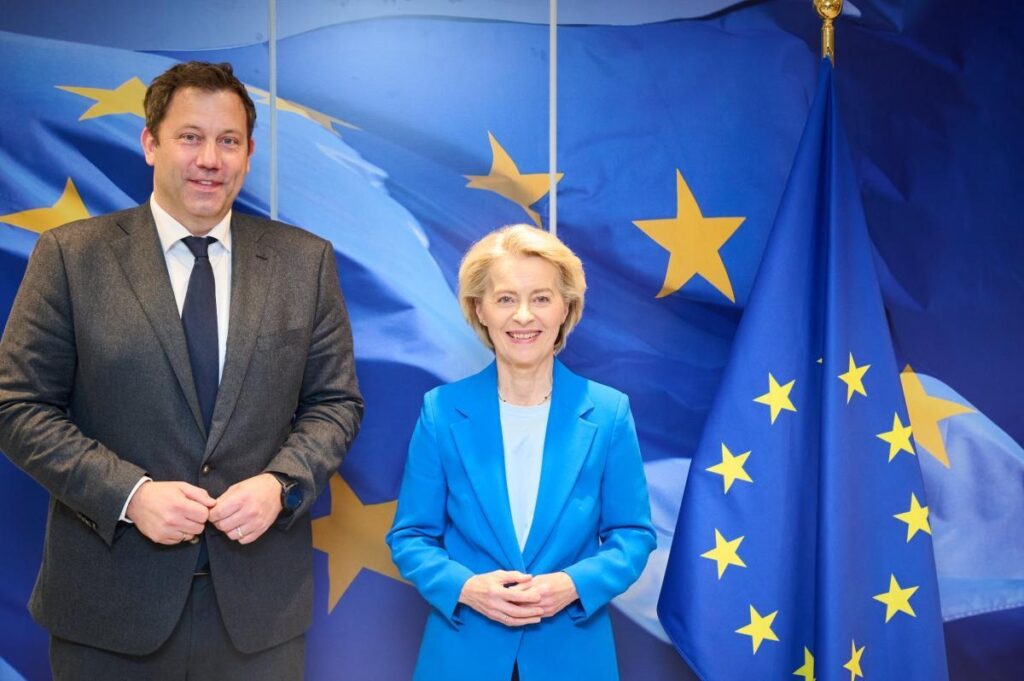
By convening the “E6” to push defence spending and industrial policy, German finance minister Lars Klingbeil has acknowledged what many in Brussels already suspect: the EU’s consensus model can no longer keep pace with Europe’s competitiveness and security demands.
“Now is the time for a Europe of two speeds,” Mr Klingbeil declared at an event ahead of the 28 January 28 meeting, framing the initiative as essential for European resilience. His four-point agenda for an event attended only by Germany, France, Poland, Spain, Italy, and the Netherlands, prioritises defence spending alongside a Savings and Investment Union, strengthening the euro, and securing critical raw materials. “Continuing as before is not an option,” he wrote to his counterparts.
Mission impossible
Experts see this as reflecting the EU’s 27 members unable to come together on key decisions. “The idea that we can achieve ambitious progress with all countries on board is becoming less and less likely,” says Fabian Zuleeg, Chief Executive and Chief Economist at the European Policy Centre. “We simply cannot make progress if we always have to have the 27 on board,” he continued.
Still, the initiative risks triggering concern from excluded member states, particularly those on Europe’s eastern flank who have been among the most committed to defense spending and Ukraine support. While the bold initiative has sparked debate, the mechanisms at work aren’t revolutionary. From military aid packages to energy policy, the bloc has already been running variable-speed coalitions in recent years.
The unanimity illusion
Fabian Zuleeg points to the coalitions of the willing that emerged around Ukraine support, where three countries—Czechia, Slovakia, and Hungary—opted out of the EU’s €90bn loan package for 2026-2027 while the rest moved forward. The same pattern appeared in energy procurement and sanctions enforcement.
But Mr Zuleeg warns against the language being used. “What I don’t think is realistic is this idea that we have a two-tier Europe because that implies that some countries are advancing in a group whereas others are not,” he argues. “The geography changes issue by issue. It is not a two tier. It is actually a multiple-tier geography,” he said.
Other experts think Europe is already operating at various speeds. “I think the way to think about it is very similar to the euro,” said Oscar Guinea, a director at the European Centre for International Political Economy. “Poland is part of the broader European Central Bank structure, but it is excluded from the decision-making boards that set interest rates and manage the currency for the Eurozone. And when the Eurozone’s finance ministers meet as the Eurogroup, Poland isn’t at the table. In that sense, similar things can be created,” he continued.
An open precedent
The Eurozone established a precedent for formal institutional differentiation within the EU, where some member states exercise decision-making authority others don’t possess. Mr Guinea argues the same cost-benefit logic that led Bulgaria to adopt the euro this year can apply to defense cooperation or capital markets integration. “It’s an imperfect approach, but it’s a way forward,” he acknowledges: “What is the phrase, perfect is the enemy of the good?”
Where Oscar Guinea sees real potential is in flexibility beyond EU membership itself. “On defense, for instance, it might actually be more flexible than the EU, but might also include the UK,” he suggests. “Slovakia or Hungary might want out, but the UK wants in,” he continued. He described it as “circles within circles rather than circles rather than disconnected circles outside.” A perspective that implies the possibility of security arrangements that could bring London back into European defense structures while accommodating members uncomfortable with deeper military integration.
Already in the treaties
MEP Lukas Sieper (NI/DEU) provides the institutional answer to why multi-speed Europe shouldn’t be controversial: it’s written into the treaties. Enhanced Cooperation mechanisms allow member states “who want to progress the European project, but know that they cannot get the majority on board, to do it with a smaller group as long as it does not contradict the general trajectory of the Union,” MEP Sieper said. When Germany’s proposal emerged, Sieper was happy, thinking to himself, “They are capable, actually, they are capable of reading the room.”
MEP Brando Benifei (S&D/ITA) is less impressed. Where Sieper sees belated recognition, Mr Benifei sees a long policy debate that has needed to come to fruition for some time. “They always say that…Do it,” he says bluntly. “It’s already been 20 years since we talked about the capital markets union. Why don’t we do something with the two-tier Europe, looking at how late we are?” he said.
Brando Benifei’s frustration captures a deeper problem: the European Parliament has approved positions supporting differentiated integration for years, but implementation requires member state action. “I have been saying this for years. I’ve done what I could,” he says. “But I am not the prime minister of Italy or Spain. And they need to do it and not just have these finance ministers meetings.”
If the E6 format becomes another venue for communiqués without follow-through, it will reinforce rather than overcome European paralysis.
The real test
Germany’s push comes as Berlin allocates €82.69bn for the Bundeswehr in 2026, with an additional €25.5bn from a special defense fund—lending credibility to Klingbeil’s insistence that Berlin is serious. But the proposal carries risks. Smaller EU members already wary of Franco-German dominance may see the E6 as institutionalizing their second-tier status.
Mr Zuleeg warns: “If this is an attempt to create a core EU which moves forward, whereas the rest is more reluctant, I think that will fail because the differences are too big.”
Mr Guinea counters that necessity will drive action: “It’s part of becoming a more complex organisation with different sensitivities and also the difficulty to pass a new treaty. The countries need to move. And those who are willing to move, I think they will find a way to do it.”
The E6’s success will depend on whether it produces actual decisions rather than more meetings. Lars Klingbeil has already scheduled a follow-up at the next Eurogroup gathering, but if finance ministers convene repeatedly without committing resources, the format will join the long list of European initiatives that died quietly. If the E6 delivers—joint procurement, accelerated capital markets integration, coordinated defense investments—it could become the template for how Europe navigates an era where global threats move faster than consensus allows. The question isn’t whether Europe will be multi-speed: it already is. The question is whether it will manage that reality competently or pretend it doesn’t exist until the fiction becomes unsustainable.