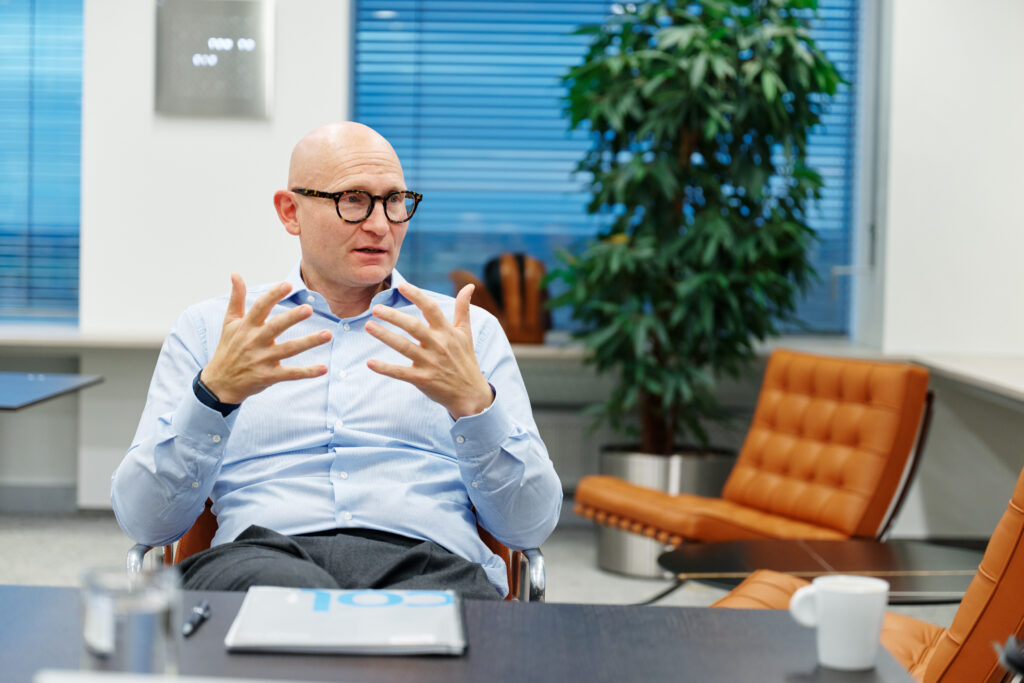
As the new head of Medicines for Europe, Zentiva CEO Steffen Saltofte says he will fight for a more competitive generics sector and better access to medicines. He identifies the EU’s Urban Wastewater Directive as the biggest threat to the industry, calling the legislation “flawed” and warning that it must be stopped.
Having won the election, what are your priorities in this new role?
I look at four main priorities. First, strengthening resilience and competitiveness through high-quality medicines production, including manufacturing and biomanufacturing, in Europe. Second, access and affordability for the patients we serve. This is absolutely a cornerstone of what we do and where we want to be. Third, a more technical point: creating a modern, harmonised, and simple regulatory framework that works across all member states. And finally, sustainability with responsibility. Balancing economic considerations with environmental ones.
I’ll ask later about specific legislations that have recently been agreed or are currently being negotiated. But to start from the other side, what would you say are the one or two biggest challenges the pharmaceutical sector is facing right now?
One issue that really stands out is the Urban Wastewater Treatment Directive (Editor’s note: The UWWTD mandates pharmaceutical and cosmetic sectors to fund at least 80 per cent of costs for advanced wastewater treatment to remove micro-pollutants. Industry argues this would lead to higher prices and medicine shortages). For us, this is a clear call to action.
Based on the data we’re seeing, we believe the underlying analysis (Editor’s note: Original impact assessment done by the European Commission and underlying feasibility study) is heavily flawed. The Commission suggests just four pharmaceuticals represent 58 per cent load, whereas when we test the same molecules in our labs, we see less than one per cent. This has a huge potential impact on the patient access and the industry and, in our view, could lead to medicine shortages.
What we need now is balance: bringing the right stakeholders to the table, working with the correct data, and setting ourselves up properly for the future. We absolutely want to contribute, sustainability is one of our priorities, but it must build on the right foundation. Otherwise, we risk losing medicines from the market and, ultimately, patients losing access.

New study recently released by the Commission’s Joint Research Center basically confirmed the original data from the impact assessment. It claims that the directive will cost the industry between €1.48bn and €1.8bn per year. That is way lower than the estimates presented by the industry. How do you explain this difference?
I think it’s hard for us to confirm that. But there seem to have been conservative assumptions on the potential number of wastewater treatment plants. Their scope does not necessarily correspond to the wording of the directive nor the indications from certain member states. A fee of 1.5 billion would still render some important essential or critical medicines economically unviable. That is, even with the new cost analysis. The study unfortunately, did not analyse the specific impact on generic medicines as required by the European parliament.
As I said before, when we look at the data, we look at certain molecules and the toxic load that they had estimated was 58 per cent. When we do it in labs, we’re talking less than one per cent. So I think it’s fair to say that we disagree with their calculation and the data that they have provided. That’s why I think it’s very important for us to pause and have real data and the right conversations to make sure that we have the right starting point and foundation to move on.
When talking about the Wastewater Directive, the health Commissioner Olivér Várhelyi just this week hinted at possibly pausing the implementation of the legislation. Is this the outcome you were hoping for?
I think we would support that — to pause and make sure that we have the right conversation around the right numbers. I think when we look at data, it’s obvious that the legislation is flawed and we need to stop it. So I think that would be the right first step.
In your experience, is the Commission open to a dialogue?
We’ve been trying a lot and it has been a little bit difficult to enter into dialogue. We also received no invitation to debate about the amendment you mentioned, we only commented on this after the fact. But we are open to collaboration, to sit with all the stakeholders. I think there could be a bit more of that.
Danger and opportunity in trade deals
Moving on, the approval of the EU-US trade deal has stalled due to US President Trump’s comments about Greenland. How does this unpredictability about tariffs affect the pharmaceutical industry?
The situation is very volatile and it will have consequences on out members. Not only the tariffs, there’s also been talks about the US’s Most Favored Nation Drug Pricing policy (Editor’s note: policy idea to cap what the US pays for certain prescription drugs at the lowest price that other comparable countries pay), and I think we will need to see all the details to fully understand what it means for us, as well as how it changes over time. As you know, we have seen the tariffs go up and down.
But I think there have been positives as well. Not when it comes to the US, but a trade deal with India seems to have materialised. That could be positive for business. Let’s see what comes out of it.
So, is it too soon to say right now?
Yes, I think that’s correct. We don’t know the final trade deal, so it would be a bit unfair to comment on something that is not set in stone.
What type of support would you like to see from politicians in this situation?
We want to ensure that everyone has access to medicines. Health is a right, it’s not a privilege. So, politicians should do what they can to ensure that patients get the right medicines at the right time.
One thing I would mention is the solidarity principle within the EU in relation to medicine stockpiling. When it comes to larger versus smaller countries, I think there should be continued support to make sure that stockpiling requirements are set up across Europe in a way that prevents shortages.
Other thing, I would return to the Urban Wastewater Directive, because for me, that is the one bigger ticket item. If you continue to force these taxes on the industry, there is a high risk that you will see medicines leave the the market. And as this tax is designed to affect one product, you can have medicines like Metamisole or Metforming affected. If these products leave the market, the tax just shifts to a different product. So you get a sort of a “downward staircase” of taxes just rolling through. It’s a bit of a domino effect. So let me be very clear on that — we need to pause and reassess. Otherwise, we might not be able to provide essential medicines to European patience.
All in all, a lot of good things have happened, but there are also key activities we need to continue to drive forward.

Needed in one state, thrown out in another
The European Parliament has recently voted on its position to the Critical Medicines Act. Is it a good one?
I alluded to it before, but I think (Members of the European Parliament) made some good progress. I think there’s been some meaningful market reforms to address shortages, to allocate targeted EU funds, and that’s fantastic.
However, we still call for a much stronger partnership in terms of stockpiling. If you look at stockpiling, essentially what it is, is you commit to keeping certain stock in the country for the patients. However, you could also end up in a situation where this medicine is not used. And you end up with a huge amount waste — you produce the cartons, you produce the aluminium, you produce medicine. You also end up destroying it all if it doesn’t sell before it runs its lifetime. And that’s just a waste. Even worse, you can end up in a situation where one country experiences a shortage, while other country has too much of the same medicine, without the option to move it around. So there the framework needs some changes.
There was also recently an agreement between the Council and the Parliament on the pharma package. Are you satisfied with the final deal?
The legislation includes some important provisions for the predictability of the sector. However, we would have liked to see a little bit more ambition when it comes to access, aspecially in Eastern European markets and smaller member states, where there are still some gaps to close, when it comes to accessibility of medicines.
I would also mention the so-called Bolar exemption (Editor’s note: The Bolar exemption is intellectual property exemption allowing manufacturers to take the necessary steps to ensure that generic versions of a medicine can be made available on day one after the intellectual property rights have expired). I think there could have been more harmonisation. It is very important for us to prevent artificial delays.
I think it’s important to remind ourselves how the generics industry contributes to the economy. Seventy per cent of the volume of medicines in Europe is coming from generics. Making sure that you have quick access to medicines is important for patients, but it’s also healthy for the economy.
Potential in digitalisation
Late last year, the Commission has unveiled the long awaited Biotech Act. How happy are you with the proposal?
We definitely welcome the Commission’s recognition of the importance of the field and I think they’re taking on a good role. However, I will mention some numbers: with the proposed one year SPC extension (Editor’s note: the Act proposes a 12‑month extension to the existing Supplementary Protection Certificate for biotech medicinal products and advanced therapy medicinal products that meet several conditions, meaning a longer period during which no generics or biosimilars can enter the market), if you’re looking at cancer molecules, then we’re talking about more than eight billion in additional cost per year. These are funds that could have been saved, where we could have a positive economic impact.
So, this is just one example of things that I think could be improved. We still need to see some modernisation work on the regulation to make sure we expand patient access to biological treatments at affordable prices.
Good starting point. But there’s more work to be done.

Last topic that I want to touch upon: The next long-term Multiannual Financial Framework. We have years of budget talks ahead of us, so what kind of financial support does the pharmaceutical industry need?
I think this brings us back to the first priority I mentioned earlier: competitiveness in the EU. It is crucial to maintain and strengthen pharmaceutical manufacturing in Europe, and supporting that should be a key focus. There need to be clear incentives. If you produce in the EU, tangible benefits should come with that.
At the same time, we have to be mindful of measures that significantly add to costs. Additional charges, such as those linked to urban wastewater treatment, risk ultimately reducing access to medicines. The intention behind the Urban Wastewater Treatment Directive is a good one, and we fully support its objectives, but it is essential that the downstream consequences are properly understood and addressed. This is a major issue for us.
The second element relates to our core mission: ensuring that patients everywhere have access to medicines. For that, the free movement of medicines across the EU is critical. One area with real potential is digitalisation. Today, we have 27 member states, each with different package leaflets and regulatory setups. If these processes were digitalised, we could significantly improve the speed and flexibility with which medicines move across the EU.
That would help ensure availability not only in large markets, but also in smaller ones. What we want to avoid is a situation where supply planning in larger member states inadvertently limits access in smaller markets — a dynamic that risks reinforcing the shortages we are already seeing. Addressing these structural issues is therefore essential.
Finally, it is important to give the industry sufficient flexibility to bring products to market faster. That benefits patients first and foremost, but it also allows healthcare systems, economies, and public budgets to realise the value of innovation more quickly. These are the key points we would bring to the table in the MFF discussions.