The reform of the European Union’s Electoral Act, approved in 2018 by unanimity in the Council and by a large majority in the European Parliament, has not yet entered into force. Despite broad political support at EU level—voiced in the last Plenary—the ratification process remains incomplete due to the opposition of a single member state: Spain.
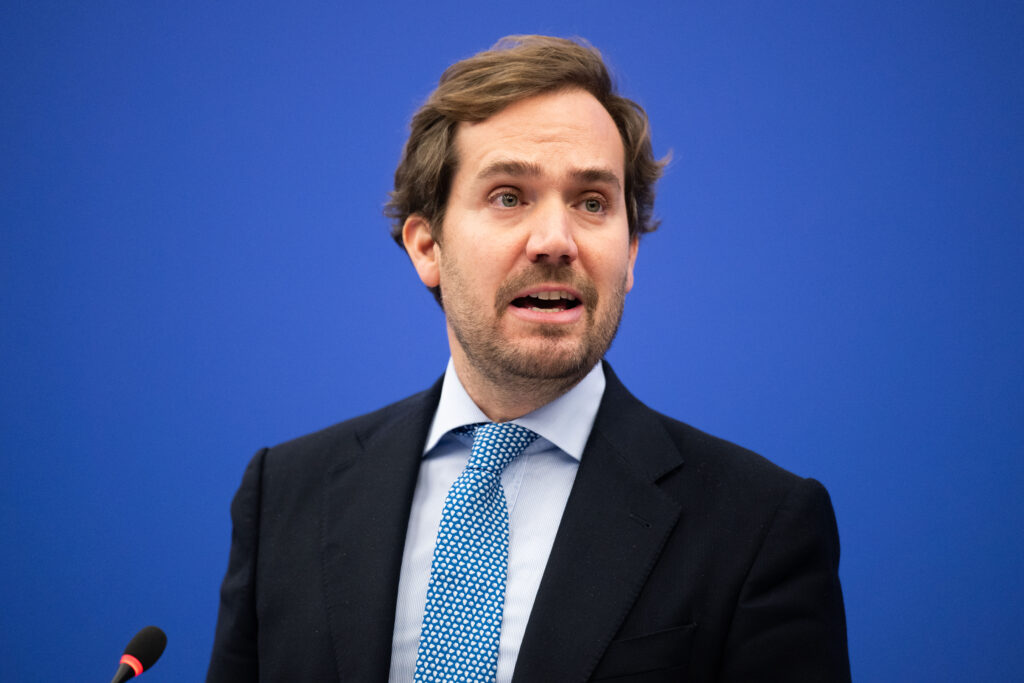
In this interview with EU Perspectives, MEP and rapporteur of the Reform file Borja Giménez Larraz (EPP/ESP) explains the political reasons behind the Spanish blockage and the broader implications for the legitimacy and functioning of European democracy.
What is the state of play of the EU Electoral Act?
The proposal was approved in 2018 by unanimity in the Council and also by a large majority in the European Parliament. However, after this approval, all member states must ratify the reform for it to enter into force. The problem is that during this ratification process we have encountered several obstacles.
First, there was an issue with Germany, which needed to verify the compatibility of the reform with its Constitution. That issue has now been resolved. At present, however, the reform remains blocked due to the lack of ratification by Spain. Over the past year, we carried out a mission to Madrid to understand the reasons behind this blockage. What emerged clearly is that there are political reasons behind it, not legal ones. There are no legal obstacles to ratification.
For now I would like to explain more about the proposal that was approved. It establishes a minimum level of harmonisation of electoral rules across the EU. These include mandatory measures such as: a deadline for the submission of candidacies at least three weeks before election day; the implementation of measures to prevent double voting; the designation of a contact authority; and the introduction of a minimum 2 per cent electoral threshold in constituencies with more than 35 seats.
More ambitious reform on the horizon
These mandatory measures are not particularly ambitious, but they represent an important step towards harmonisation and towards strengthening the legitimacy of our institutions, especially the European Parliament. There are also optional measures, such as the preferential voting system, a threshold not exceeding 5 per cent, and the inclusion on ballot papers of the name or logo of European political parties.
If we look at the broader picture of EU electoral law, we should also recall that in 2022 a new and much more ambitious reform was approved by the European Parliament. That proposal is currently blocked in the Council due to insufficient support. Our argument throughout this process has been very clear: if we are not even able to ratify and implement the 2018 reform, how can we realistically expect to make the 2022 reform a reality? Right now, Germany is no longer an issue. That problem has been resolved. At this point, 26 member states have already ratified the reform. Everything is now in the hands of Spain.
What exactly is happening in Spain?
The issue is that the current Spanish Prime Minister, Pedro Sánchez, signed a coalition agreement with the Basque Nationalist Party in which he committed not to amend Spain’s national electoral law without the consent of that party. This is the core reason for the blockage. We have the document, and it clearly states that reforming the national electoral law is not possible without the consent of the Basque Nationalist Party. Pedro Sánchez and the Socialist Party depend on the support of small nationalist parties to remain in government. These parties will never accept such a reform.
As a result, the entire European Union is being blocked because of a purely national political interest. This is why we wanted to increase political pressure on the Spanish government. This is not a national issue: Spain is blocking the electoral law of the entire European Union and, therefore, the rights of all European citizens. In our report, especially in the final section, we underline that ratification by all Member States remains mandatory for the Council decision to enter into force. The report explicitly calls on the remaining member state, Spain, to complete the ratification process. This is a direct political message to the Spanish government.
Move in the right direction
What happened during the vote in European Parliament?
The vote was quite revealing. I decided to negotiate this report with pro-European forces, because from my perspective it is impossible to reach an agreement with Patriots or the ECR. They do not believe in the existence of a common electoral law, nor in political integration. I therefore negotiated with S&D, Renew, the Greens, and even the Left, as long as they were willing to engage in a pro-European manner. S&D supported the proposal and the only delegation that voted against it was the Spanish one. This is visible in the roll-call vote.
It is regrettable, because the 2018 reform, although not very ambitious, moves clearly in the right direction. Yet it is still not a reality because of a national political issue. This creates significant political pressure. Spain should listen to what the European Parliament and European institutions are saying. However, there is no legal instrument to force ratification. If a member state chooses not to ratify, it has that power. That said, such behaviour is not compatible with the image of a pro-European government.
What will be the next step?
Only a change of government in Spain could potentially change the situation. What is paradoxical is that the rapporteur of the 2022 reform is a member of the Spanish delegation. Spain is advocating for a more ambitious reform while failing to ratify the existing one. This situation undermines the principle of sincere and loyal cooperation between member states. If the 2018 reform remains blocked, there will be no reform in 2022. That is absolutely clear.
At this stage, political pressure is the only available tool. Eight years have passed since the approval of the reform. This is dramatic. The media should also put pressure on the Spanish government. I am in the opposition, and I acknowledge that political interests are involved. But from a pro-European perspective, this situation is unacceptable. Even within the S&D group, the Spanish delegation is completely isolated. Many colleagues are angry about this situation.
Spain is blocking the reform purely to preserve its internal political balance. Perhaps sending a letter to the Council could be considered, but the reality is that the Council will not move. We are blocked. Potentially, a change of government in Spain could improve the situation.