Fulfilling a longstanding promise to stop indirectly fuelling Putin’s war chest, the EU is determined to end all imports of Russian natural gas by 2027. But as one dependency is decreasing, it appears to be replaced by another.
The EU now imports more than a quarter of its gas from the United States, up from just 5 percent in 2021, and new contracts could push that share even higher by 2030. What began as an emergency solution has increasingly become a structural reliance. In response, some MEPs are calling for a broader approach to energy independence—one that goes beyond ending Russian imports.
Strategic autonomy first
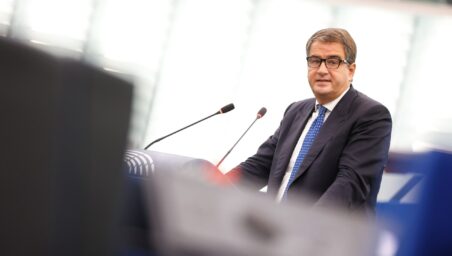
This persistent dependence on third actors leaves European households, industries and democracies exposed to price shocks, geopolitical blackmail and supply disruptions. Last week, the Renew Europe group in Parliament released its plan to address this challenge. As MEP Brigitte van den Berg (Renew/NLD) puts it, “a dependent Union is a weak Union.”
Investing in our industrial and technological capacity, research, and talent is key to reducing dependence on external powers. – MEP Elena Donazzan (ECR/ITA)
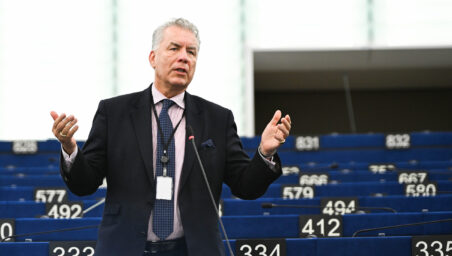
That understanding is widely echoed across the political spectrum. Energy policy is no longer just about climate targets or the cost of living—it is about strategic autonomy. As MEP Elena Donazzan (ECR/ITA) warned: “Investing in our industrial and technological capacity, research, and talent is key to reducing dependence on external powers.”
Green transition as a way to independence: NGOs
Beyond the missed opportunity for competitiveness, NGOs warn of a missed opportunity for the green transition. The rush to reduce dependencies, they argue, risks negative climate consequences if it is not carefully managed. In theory, breaking free from imported gas presents a major opportunity for a renewable economy. “With the right planning, Europe could completely phase out fossil gas in the next ten years, and replace this dirty energy system with one that’s independent, democratic and fully based on renewables,” Greenpeace states.
The answer, many argue, lies in electrification. MEP Seán Kelly (EPP/IRL) said: “We need to put a plug on everything we can put a plug on.”
Sustainability, integration are main pillars
In its released plan, Renew Europe argues that true energy independence must rest on two pillars: sustainability and integration. Europe must rapidly phase out fossil fuels and invest at scale in domestic clean energy. Renewables are not only better for the climate; they can be produced at home, creating jobs and keeping billions of euros within the European economy instead of exporting them abroad.
We must pursue a coherent energy policy: making clean energy cheaper, more attractive, and widely available through electrification, smarter taxation and strong financial incentives for consumers. – MEP Christophe Grudler (Renew/FRA)
Renew’s energy coordinator in the Committee on Industry, Research and Energy, MEP Christophe Grudler, has repeatedly stressed the urgency of this shift: “High energy prices are undermining both Europeans’ purchasing power and the competitiveness of our economy,” he said. “For Renew Europe, this is not only a cost-of-living issue, but also a question of strategic autonomy. Europe still spends over €350bn every year importing fossil fuels, money that flows out of our economy instead of being invested in our renewables, our grids and our clean technologies. If we are serious about phasing out fossil fuels, we must pursue a coherent energy policy: making clean energy cheaper, more attractive, and widely available through electrification, smarter taxation and strong financial incentives for consumers. This is how we lower bills, strengthen our industry and regain control over our energy future.”
Complete the Energy Union
MEPs also call for a completion of Europe’s Energy Union. National energy systems remain fragmented, preventing efficient sharing of electricity and driving up prices. The commission recently presented its Grids Package aims to address this. It proposes faster permitting, cross-border planning, and modernisation of ageing infrastructure. “Europe’s energy security and competitiveness require strong electricity grids,” said Giles Dickson, CEO of WindEurope. “Without decisive action on grids, Europe risks missing its energy security and competitiveness goals.”
The package also tackles local obstacles, such as nitrogen permitting and community participation, which have delayed renewable projects in countries like the Netherlands. Faster approvals and coordinated planning are expected to unlock hundreds of energy projects, allowing renewable electricity to flow more freely and reduce dependence on imported gas.
For Renew, this proposal is a step in the right direction, but they are worried it does not include sufficient enforcement to ensure networks are effectively connected across borders—which might not be of direct economic interest for some member states. The group wants Brussels to gain a special authority: if a member state delays critical interconnectors, the EU should have the authority to step in.
Nuclear taboo shaken?
Energy independence also means confronting long-standing taboos. For Renew Europe, this includes nuclear energy. While not a silver bullet, it believes nuclear power can play a complementary role in ensuring stable, low-carbon baseload capacity.
On the right of the political spectrum, that call has found support. “Nuclear power offers a unique solution that ensures both energy security and carbon emissions reduction,” MEPs Alvise Pérez (NI/ESP), Diego Solier (ECR/ESP) and Nora Junco García (ECR/ESP) have previously argued.
On the left, however, concerns persist over the environmental risks of relying on nuclear power, with many rejecting the idea that it should be considered a sustainable energy source. “By labelling gas and nuclear as sustainable in the taxonomy, the conservatives have shamefully betrayed EU climate ambitions,” the S&D group said, for example, during the early phases of the EU’s move away from Russian gas.