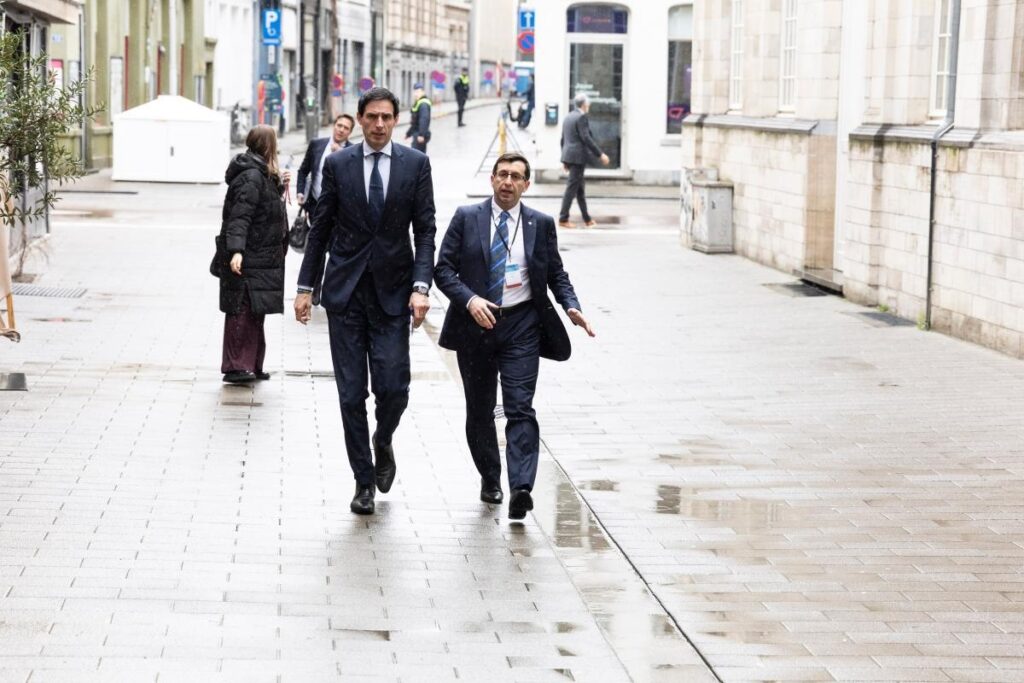
Europe’s industrial chiefs arrived in Antwerp for the European Industry Summit with a blunt warning. High energy prices, rising carbon costs and policy uncertainty are draining investment. EU climate action Commissioner Wopke Hoekstra, untypically for a member of the EU executive arm, acknowledged various shortcomings.
The 11 February summit‘s timing, marking the first anniversary of the EU’s Clean Industrial Deal, helped set the agenda: competitiveness, decarbonisation and autonomy. Mr Hoekstra‘s on-stage dialogue with executives provided the highlight of the day.
The comissioner spoke without fanfare. “A lot has been done, but much more is needed. And frankly speaking, I think much more is needed also at considerably higher speeds. I’m not going to say it’s all a disaster… but the delivery needs to go up.” Heads of European megacompanies nodded in agreement.
Keeping the promise alive
Mr Hoekstra insisted the EU must match climate ambition with hard-edged economics. “We don’t just have climate policy, but we do manage to make sure they go hand in hand with competitiveness and independence,” he said. That formula—green but profitable—set the tone for every exchange that followed.
The commisisoner sketched the scorecard. Simplified permitting rules, bigger battery plants and faster grid connections top the list of achievements. Lead markets for green steel and the launch of the Carbon Border Adjustment Mechanism (CBAM) round out the first-year ledger. Yet he refused to sound pleased. “This is urgent. Much more needs to be done,” he told the audience, warning that global rivals move quicker.
Speed, not new slogans, is what he now demands. “What we need to have is a programmematic approach that stays with us for years to come, that delivers in the short, the medium, and the long term.” In Brussels that means pushing capital-markets union, upgrading the single market and coaxing bolder reforms from national capitals. Without higher growth, he argued, Europe will lack the fiscal room to finance its green re-tooling.
Faltering execution
The difficulty is execution, not direction. “Many of the elements that we have put on the table are actually the right ones,” he maintained. The gap lies in delivery timetables that lag behind geopolitical shocks from Washington and Beijing.
Executives asked for clearer investment cues. When pressed for a take-home message, Mr Hoekstra was blunt. “I’m biased, so of course I’m going to tell you, invest it here,” he said. But he tempered the pitch with a warning. American incentives can vanish with an election cycle, and Chinese rules remain asymmetric. “Is that really the bet you want to make?” he asked.
There’s no perfect policy tool. — Wopke Hoekstra, EU climate Commissioner
Geert van Poelvoorde of ArcelorMittal welcomed EU trade defences but fretted about CBAM loopholes. “How are you going to detect this? Because circumvention and resource shuffling will happen,” he said. The steelmaker has just pledged €1.3bn for a low-carbon furnace in France and wants certainty that cheap imports will not undermine the project.
ETS money on the table
Mr Hoekstra listed four CBAM tweaks. “First, radical simplification… I’ve taken 90% of companies out of the scope, while keeping 99 per cent of emissions within scope. Secondly, making sure we help those who are exporting so that they don’t face an unfair competitive disadvantage. Third… scope, so not just look at the raw product, but also look at the proverbial washing machine. And the fourth element is exactly what you are alluding to. Let’s make sure that we don’t get fooled.” If gaming persists, default carbon values at country level will apply “immediately”.
Fertiliser firms voiced parallel worries. CBAM took years to plan, said a Yara International executive, yet “significant confusion” arose within a week of launch when the Commission hinted at a pause for the sector. Mr Hoekstra admitted the stumble and called for a “more fundamental conversation” to fix a market that runs at “30 per cent under-capacity” even as Europe imports dirtier product from Russia.
The wider carbon market drew fire too. One lobbyist, who began working on the Emissions Trading System (ETS) in 2000, warned that plants may close because delayed grid upgrades leave no escape from rising carbon costs. Mr Hoekstra defended the scheme. “There’s no perfect policy tool. But the ETS is precisely the type of market-based system that many in this audience and I myself would have argued for if it weren’t there.” He reminded delegates that auctions have generated roughly €250-260bn, yet “less than 10 per cent” has gone into industrial decarbonisation.
Demand that lasts a decade
Ursula von der Leyen, the Commission president, delivered a separate address. “Channelling more ETS revenues back to industry will therefore be a core focus of the upcoming reform of the Emissions Trading System. Because these resources come from the industry and they must be reinvested in the industry.” Since 2005 the ETS has cut emissions by 39 per cent, but member states still spend barely five per cent of proceeds on factories, she said, echoing Mr Hoekstra’s figures.
Start-ups want predictability too. Alex Hogan, CEO of the fossil-free plastics producer Vioneo asked how to secure ten-year take-or-pay contracts when customers cannot read the policy horizon. Mr Hoekstra sympathised. “You will, all of you, will continue to be disappointed by the level of predictability politicians all over the world will deliver,” he said. Even so, firms must keep “banging the table” for stable rules. He plans to leverage public procurement—equal to about 15 per cent of EU GDP—to create markets for cleaner products, copying the template already applied in steel.
I’m not going to say it’s all a disaster… but the delivery needs to go up. — Wopke Hoekstra
Chemicals stand next in line. Ageing assets, high energy prices and global over-capacity weigh on margins. The commissioner wants a fact-based review before prescribing cures but left no doubt that Europe should host the sector’s clean-tech upgrade.
Power prices: the litmus test
Here lies the summit’s sorest point. A declaration signed by more than 100 organisations demands that electricity fall to €50/MWh “across all member states” if low-carbon steel is to flourish. Chemical chiefs dream of the pre-2021 level of €44/MWh. “Europe is losing industrial capacity at a speed we have never seen before,” Markus Kamieth, president of Cefic and boss of BASF, was quoted as saying.
Veteran MEP Peter Liese (EPP/DEU) added political realism. “It is completely unrealistic for cement plants, the chemical industry and the aviation sector to have zero emissions by 2039,” he told reporters, blaming technology gaps rather than the ETS itself. Climate campaigners counter that a “stable and ambitious” ETS gives industry the certainty to innovate.
Industry’s declaration will travel to an informal EUCO summit in Alden Biesen on 12 February. “We urge you to move from diagnosis to delivery, and from plans to results with a single objective: Save our industry,” it says, calling for emergency measures that show results by 2026. It is up to Brussels and the capitals to make Mr Hoekstra’s advice to invest in Europe credible. Without cheaper power, faster permits and clearer rules, Europe may watch its next generation of factories rise elsewhere.