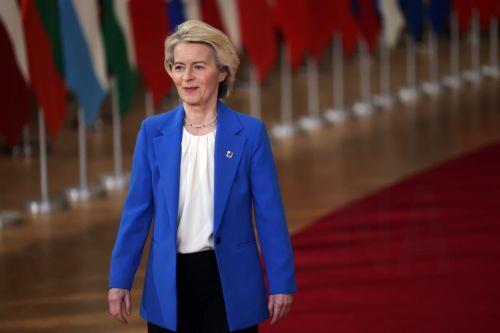
Commission President Ursula von der Leyen signaled this week that smaller groups of member states should pursue cooperation when unanimity blocks progress, leveraging existing treaty provisions rather than formal EU reform. It is a statement that lends political momentum to Germany’s E6 proposal and suggests Brussels may be ready to work around gridlock rather than wait for treaty change.
“Our ambition should always be to reach agreement among all 27 member states,” Ms von der Leyen wrote in a letter addressed to EU leaders on Monday. “However, where a lack of progress or ambition risks undermining Europe’s competitiveness or capacity to act, we should not shy away from using the possibilities foreseen in the treaties under enhanced cooperation,” Commission President continued.
This comes ahead of the EUCO competitiveness retreat today focused on bolstering the European economy under the dual pressures of the US and China.
Building on Germany’s E6 proposal
Ms von der Leyen’s statement adds indirect institutional backing to Germany’s recent push for multi-speed cooperation. Germany’s Finance Minister Lars Klingbeil convened the so-called E6 group—Germany, France, Poland, Spain, Italy, and the Netherlands—on January 28th to accelerate defence spending and industrial policy. “Now is the time for a Europe of two speeds,” Minister Klingbeil declared.
Now is the time for a Europe of two speeds. – Lars Klingbeil, Germany’s Finance Minister
The Commission President’s endorsement signals Brussels is ready to work with ’coalitions of the willing’ rather than wait for bloc-wide consensus that may never materialize.
Enhanced cooperation: already in the treaties
The mechanism von der Leyen referenced is not new. Enhanced Cooperation, embedded in the EU treaties since the Amsterdam Treaty (1997), allows at least nine member states to pursue deeper integration on specific policy areas without requiring unanimous support. The provision explicitly permits ’willing countries’ to advance European objectives when broader agreement proves elusive, provided the initiative doesn’t contradict the Union’s general trajectory.
What is notable is Ms von der Leyen’s willingness to invoke it explicitly—a political signal that Commission leadership will not let holdouts block progress on competitiveness.
Variable-speed already in play
Europe has already been operating this way for years, even if leaders were not always willing to acknowledge it publicly. When three countries—Czechia, Slovakia, and Hungary—opted out of the EU’s €90bn Ukraine loan package for 2026–2027, the remaining members moved forward without them.
Similar coalitions emerged around energy procurement and sanctions enforcement. The eurozone itself represents the most established example. Non-euro members have no representation at the European Central Bank or eurozone finance minister meetings, creating formal institutional differentiation within the Union that has become a precedent for differentiated integration.
Debate unfolding
Commission President’s letter sets the stage for informal European Council meeting taking place at Belgium’s Alden Biesen Castle, where former European Central Bank President Mario Draghi and ex-Italian Prime Minister Enrico Letta present their landmark competitiveness reports.
As leaders convene to debate the future of a competitive EU, with new institutional support for differentiated integration, the retreat could build momentum for broader coalitions of the willing rather than continued reliance on unanimous consensus.