“2025 was the year when old certainties collapsed — 2026 is the year we face reality,” European Commission President Ursula von der Leyen wrote on X ahead of the Munich Security Conference. The event will serve as a test of Europe’s ability to present a more unified position on security and defence.
The opening messages from Ursula von der Leyen and NATO Secretary General Mark Rutte before the official start of the conference echoed familiar lines: Europe’s security is tied to Ukraine, the United States remains a key ally, NATO grows stronger if the EU invests more, and Russia continues its slow advance. Yet on the sidelines, it is other actors — including the United Kingdom and Lebanon, both present in Munich — that seem to be generating the conference’s real news. The debate is increasingly shifting toward rearmament, defence funding and the role of nuclear powers.
A new debate on the future of European security
In recent years, the conference has recorded stable participation of around 40-50 heads of state and governments, more than one hundred ministers, and several hundred official delegates from over one hundred countries. Similar figures are expected in 2026, with a strong emphasis on the Euro-Atlantic dimension but a growing presence of actors from the Global South. The Munich Conference thus confirms itself not only as a platform for political dialogue, but also as a venue for parallel diplomacy, bilateral meetings, and the definition of common agendas on security and defence.
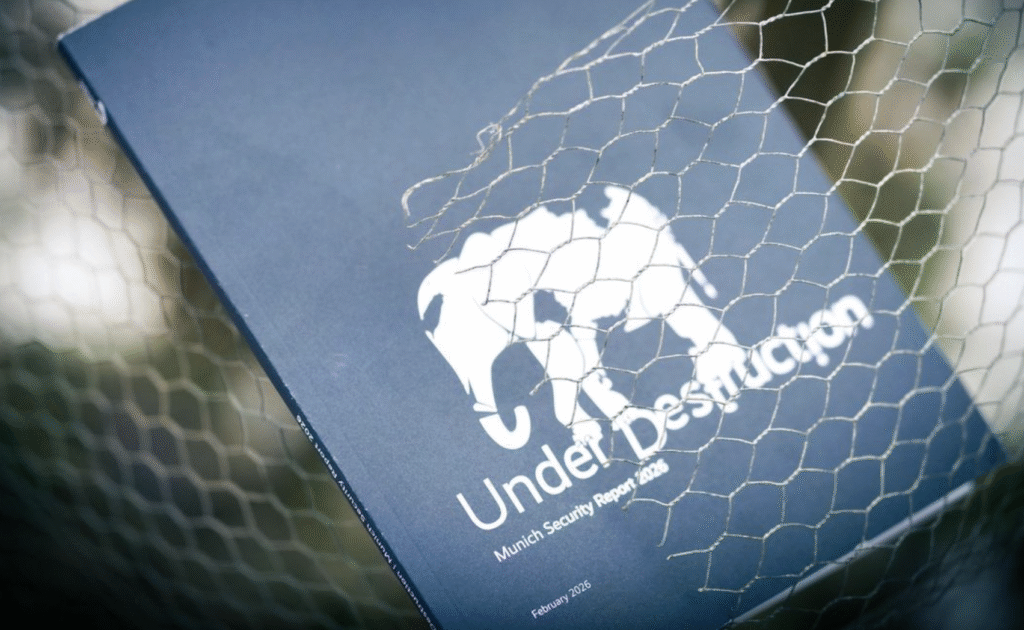
The “Munich Security Report“, traditionally published a few days before the conference opens, sets the analytical tone — and this year’s edition is no exception. It depicts an increasingly fragmented international system marked by the erosion of multilateral norms, the return of conventional deterrence, the growing militarisation of economic interdependence, and intensifying technological competition over semiconductors, artificial intelligence and space. It also points to democratic vulnerabilities and the spread of disinformation.
The report highlights how energy security is being reshaped into a geopolitical tool and stresses the need to integrate climate policy with national security. In this view, the green transition is no longer merely an environmental objective but a core arena of global strategic competition, particularly in relations between the West and China. It also draws attention to the role of so-called “global swing states” — countries that avoid rigid alignment with rival blocs and can influence the global balance.
The conclusion is a call for Europe to adopt a more pragmatic approach toward Africa, South Asia and Latin America, moving beyond purely ideological readings of international relations.
UK launches idea of a ‘collective Western rearmament fund’
This is solid reporting — it just needs tightening, fewer stacked clauses, and a more decisive news tone. Here’s a polished version that keeps all your information but reads more like a finished dispatch:
UK Chancellor of the Exchequer Rachel Reeves had already signalled this week that London intends to work with European and Western allies to identify “new instruments” to reduce the financial burden of rearmament, defence-industry production and military equipment supplies — more effectively than SAFE.
A broad multilateral initiative among Western allies to finance rearmament through a common defence fund — and to contain the multi-billion-euro costs linked to sharply higher military spending commitments by NATO countries under pressure from Donald Trump’s United States, against the backdrop of the war in Ukraine and other global crises.
This is the proposal British Prime Minister Keir Starmer is preparing to present at the Munich Security Conference, according to informed sources.
The idea builds on Mr Starmer’s earlier interest, as part of his government’s post-Brexit reset with Brussels, in a possible UK accession to the EU’s collective rearmament scheme, known as SAFE. That option stalled at the end of 2025 after negotiations hit a deadlock over London’s refusal to accept the substantial financial contribution requested by the Union.
Lebanon seeks bigger role
As non-European and non-Western actors gain visibility at the Munich Security Conference, Lebanon is also seeking a more prominent role, linking nuclear issues to its broader engagement with Europe.
Amid rising tensions between the United States and Iran, Lebanese Prime Minister Nawaf Salam called for the creation of a Middle East zone free of nuclear weapons and other weapons of mass destruction. The appeal followed his meeting on the sidelines of the conference with Melissa Parke, executive director of the International Campaign to Abolish Nuclear Weapons (ICAN).
Salam praised the organisation’s leadership in promoting nuclear disarmament and global peace, reiterating Lebanon’s position at a time of ongoing conflicts, rising military spending and a growing number of nuclear warheads worldwide. He also reaffirmed Beirut’s commitment to the Treaty on the Prohibition of Nuclear Weapons, noting that Lebanon was among the first countries to vote in favour of its adoption at the UN General Assembly in 2016.
The prime minister added that Lebanon will continue to support UN resolutions urging all states to join the treaty.