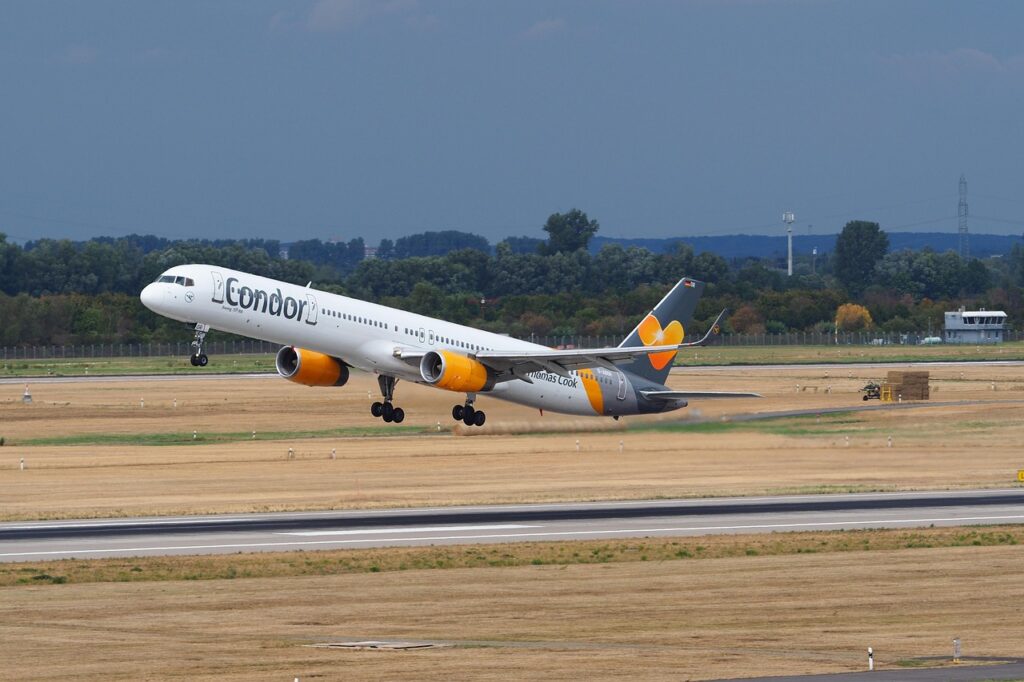
Court of Justice of the European Union has delivered its judgment clarifying that airlines can not rely on so-called ’extraordinary circumstances’ if these had affected an earlier flight in a flight rotation. In such cases, air companies can not avoid paying compensations for delay on a subsequent flight. A complex case concerned flights between Düsseldorf and Varna and vice versa.
The case arose after two passengers sought compensation of €400 each for a delay of more than three hours on a flight operated by European Air Charter from Düsseldorf (Germany) to Varna (Bulgaria). The delay occurred in the context of a flight rotation involving an earlier flight affected by unusually long security check waiting times at Cologne-Bonn Airport.
Autonomous decision of the air carrier
The ruling is based on the Article 5 of Regulation No 261/2004 of the European Parliament and of the Council of 11 February 2004 establishing common rules on compensation and assistance to passengers in the event of denied boarding and of cancellation or long delay of flights.
The autonomous decision of an air carrier to wait for the passengers of a flight who have not yet cleared security is not an ’extraordinary circumstance’. – Court of Justice of the European Union’s ruling
Court of Justice of the European Union (CJEU) ruled that “the autonomous decision of the operating air carrier to wait for the passengers of a flight who have not yet cleared security, due to shortcomings in the security checks, breaks the direct causal link between the extraordinary circumstance of those shortcomings and the delay of at least three hours in the arrival of a subsequent flight.”
In other words, in such a case, passengers are eligible for compensation.
What ’extraordinary circumstances’ mean
The CJEU’s ruling also cites the nature of ’extraordinary circumstances’ as defined in the above mentioned regulation. These are events which could not have been avoided even if all reasonable measures had been taken. Such circumstances may, in particular, occur in cases of political instability, meteorological conditions incompatible with the operation of the flight concerned, security risks, unexpected flight safety shortcomings and strikes that affect the operation of an operating air carrier.
However, in CJEU’s opinion, ’extraordinary circumstances’ do not include cases when an air company voluntarily waits for passengers stuck at the security control—which happenned in the relevant case. Not even cases of later flights in a rotating manner.