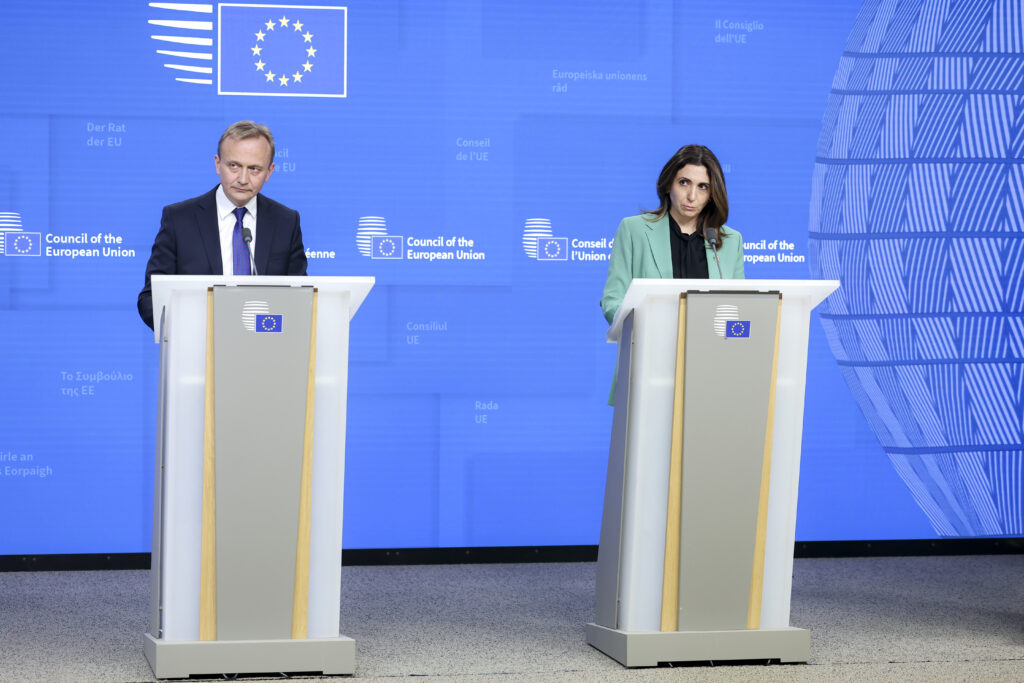
The European Union used Tuesday’s General Affairs Council to prepare leaders for a pivotal summit shaped as much by war as by the question of how to pay for Europe’s response to it. While ministers reaffirmed support for Ukraine and enlargement, much of the substance centered on the EU’s next long-term budget — and how it must evolve to match a more volatile geopolitical environment.
Speaking after the meeting, Cyprus’ Deputy Minister for European Affairs, Ms Marilena Raouna, said ministers had reviewed reform progress in Ukraine and Moldova, stressing that “Ukraine and Moldova are progressing decisively on their European path and their future lies within the European Union.” Despite the strain of war and instability, she added, both countries continue to advance under “very challenging circumstances”.
But the meeting — formally tasked with preparing the European Council — also made clear that the union’s political priorities are increasingly constrained, and shaped, by its financial framework.
Ukraine support holds, but focus widens
Support for Ukraine remains a central political anchor for the EU, even as attention is pulled towards crises in the Middle East and the Gulf. “In the deteriorating geopolitical environment, it is important to reaffirm the European Union’s full support to Ukraine, which remains a top priority,” Ms Raouna said, pointing to the “rapidly evolving and deeply concerning situation” in the wider region.
The overlap of these crises is forcing EU leaders to think beyond individual conflicts and towards a broader question: how to sustain multiple priorities simultaneously.
Budget reform moves to centre stage
That question is now increasingly being addressed through the negotiations on the EU’s next Multiannual Financial Framework (MFF), where early political lines are beginning to emerge. Commissioner for Budget, Mr Piotr Serafin, framed the debate in stark terms, describing governance of the budget as “in practise a debate about who should be deciding on how the European Union budgets are going to be spent.”
He argued that the current system — in which more than 90 per cent of spending is fixed over seven years — no longer reflects the realities the Union faces. “We should have more flexibility to decide annually how to spend the EU budget money… how to react to the changing context,” he said.
We need to have a debate in parallel, not only on how to spend the money from the EU budget, but also how to finance it. — Piotr Serafin, European Commissioner for Budget
The push for flexibility signals a shift towards a more political, and potentially more contested, budget process — one in which annual decisions could carry greater weight.
Institutional balance under scrutiny
At the same time, both member states and the European Parliament have raised concerns about how such changes could affect the balance of power. Mr Serafin sought to address those concerns directly, insisting that “we are not going to change through the MFF the rules that we have on the treaty, on the inter-institutional balance,” and stressing that new mechanisms would guide rather than override decision-making.
Still, the shift towards a more flexible system implies more frequent political negotiation. When asked whether this could lead to greater conflict, he reframed the issue, saying “what you see as bickering and infighting I see as a broader space for the political negotiations.”
Paying for ambition
If flexibility defines how the budget is spent, the more difficult question remains how it is financed. Here, too, the discussion is only beginning. Mr Serafin acknowledged that “every candidate for a new own resource… has its weaknesses,” but argued that agreement would depend on viewing the system as a whole. “We need to look at the whole package,” he said.
Ms Rauna echoed the point, linking the EU’s political ambitions directly to its financial capacity. “If we want an ambitious budget, which we do, then we need to find the means to fund it,” she said, adding that the issue will be taken up by leaders later this week.
If we want an ambitious budget, which we do, then we need to find the means to fund it. — Marilena Raouna, Cyprus Deputy Minister for European Affairs
Early consensus, harder choices ahead
Despite the sensitivity of the file, both speakers pointed to a constructive start to negotiations. Ms Rauna described discussions as “open, transparent, very productive,” while Mr Serafin said the atmosphere had been “surprisingly good” — a notable assessment given the scale of the decisions ahead.
But both also acknowledged that the negotiations remain at an early stage, with key political choices still to come — not least at the level of leaders.
A bloc adjusting to a more demanding reality
Beyond individual agenda items, the meeting reflected a broader shift in how the EU is positioning itself.
“In the current geopolitical environment, it is more important than ever for the European Union to continue to deliver,” Ms Raouna said, arguing that European autonomy must be matched by continued openness. “Europe’s strength lies in its ability to remain open, engage globally, and act independently when necessary.”
As leaders prepare to meet, the underlying message from ministers is clear: the EU’s ambitions — from Ukraine to security and competitiveness — are no longer just political questions. They are financial ones.