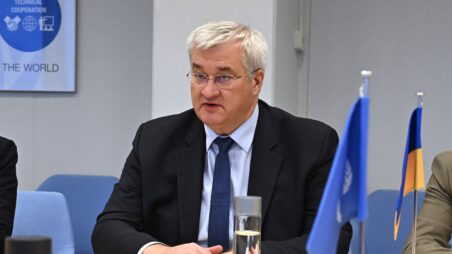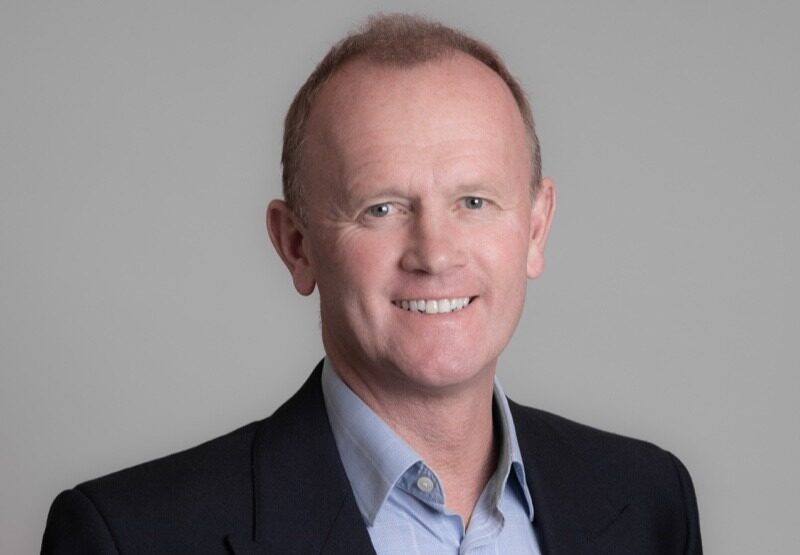
Brussels has spent the winter rewriting its rule-book on defence production. General Gary Deakin, a British strategic planner who once shaped NATO campaigns from Naples, gave EU legislators plenty to ponder when he spoke at the Digital Defence Series 2.0 debate.
“Somebody said to me at a conference, there are things that need to be learned from Ukraine, and there are things that need to be just digested,” Maj Gen Gary Deakin kicked off his debate contribution. His message suited the times: learn fast, discard illusions and legislate for mass.
Mr Deakin, an ex- British army leader is an internationally recognised strategic planner. He held senior positions at NATO headquarters and the NATO command structure; his last post was Deputy Chief of Staff Plans in NATO Joint Force Command Naples in Iraq.
Both sides of the Channel
Currently, Mr Deakin is head of defense and security of Malton PR, a prominent London-based crisis management company. He also sits on the Advisory Council of the French think tank European Institute of War, which informs his views. Thus, he brought an amalgam of operational planning and leadership experience on both sides of the English Channel to the Coges-hosted debate.
It is no wonder, then, that EU strategists see the same problem that worries Mr Deakin. Russia absorbs punishment, factories roar and the front line still moves. The general warned that cheap drones alone change little. “If you tried to confront the Russian armies that were advancing on Kyiv just with unmanned, like, uncrewed aerial systems, you probably would have lost because there was a lot of firepower, there’s a lot of armour, a lot of personnel.” Brussels eyes its new AGILE fund—€115m of rapid grants—as one way to put steel as well as silicon into European arsenals.
The Briton’s core lesson aligns with that cash. “And so whether that mass that you have is cheap or not, you need the mass more than the exquisite.” Commission officials drafting rules on joint procurement of ammunition repeat the line almost word for word. Their goal is to make bulk orders routine rather than heroic.
Mr Deakin devoted most heat to air defences. “We really need to work on our suppression of enemy air defence capabilities.” He insisted that dominance still rests on fast jets roaming freely, not on platoon-sized drone swarms. “For me personally, battlefield dominance looks a lot like F-16s and Typhoons freely ranging over a front line with targeting pods.” Europeans drafting capability targets nod: the proposed legislation would let member states pool budgets for hard-kill weapons that silence radars and batteries.
Tools to break shields
The general’s scepticism of boutique gadgets flatters France and Germany, which lobby the Commission to steer funds to manned aircraft upgrades and joint missile stocks. That reading also shapes Brussels’s push to relax state-aid limits for air-defence production. Cheaper loitering munitions still matter, but legislators want clauses that oblige buyers to match every drone tranche with interceptors.
No comms, no bombs. — UK Maj Gen Gary Deakin
War demands output, not slide decks. “So I think this is quite a difficult one because fundamentally, NATO’s not at war at the moment,” Mr Deakin noted. History offers clues. Before the second world war Britain built shadow factories in the Midlands. The lesson, he said, is to lock civilian lines into military plans early. “If you know what it is you’re going to need, which is a challenge at the moment, especially as we don’t know what we’re going to get, you can at least begin to establish those relationships and identify those synergies with existing industry where you might be able to increase production.”
Factories before firefights
Brussels may like that tale. A draft regulation circulating in the Council would pay firms to keep idle capacity. Mr Deakin recalled how Royal Ordnance contracts once mandated slack: “They were contractually paid to maintain those capabilities and they were required to actually test the ability to stand those additional staff and that production capacity up at like a semi regular basis.” Commissioners may try to copy the clause at EU level for shells and interceptors alike.
Drones, he added, pose a different puzzle. Europe has many start-ups but few motor plants. “A lot of them say that they are, but actually realising that the Chinese actually make really good motors and that’s the problem because they can produce them much cheaper than a European equivalent and they’ve got a lot of experience producing them.” The AGILE fund offers grants only for fully European supply chains — an incentive that echoes his warning.
For me personally, battlefield dominance looks a lot like F-16s and Typhoons freely ranging over a front line with targeting pods. — Gary Deakin
Logistics count for little if radios fail. Mr Deakin’s mantra is blunt. “No comms, no bombs.” Brussels knows this, too; its new space strategy hinges on resilient links. He argued that a glamorous AI dashboard means nothing when forward scouts cannot pass a grid reference. “If they can’t get target coordinates back, it doesn’t really matter.” The Commission’s proposed secure-comms regulation would hard-wire redundancy, funding fibre and high-frequency backups alongside satellites.
Hard choices ahead
Russia already hunts emitters. “We really need to understand that the Russians will target a HQ based on its radio signature.” That thought fuels European interest in low-probability-of-intercept networks and obliges the forthcoming act to bankroll buried cables as eagerly as broadband.
The audience finally asked for quick takeaways. Mr Deakin did not mince words. “A war between NATO and Russia would look very different to the war between Russia and Ukraine.” Brussels legislators treat the sentence as a reminder to future-proof laws, not just plug today’s holes. He pressed two vulnerabilities. “The capabilities that would win or lose NATO a war are probably its anti-submarine warfare capabilities and its suppression of enemy air defence.” The proposed maritime-security clause and the air-defence funding stream address both risks.
Governance rounded off his list. “There needs to be sort of a re-establishment of the position of SACEUR as the Supreme Allied Commander Europe for the defence of Europe.” The EU cannot rewrite NATO’s charter, yet its laws can reinforce unity by tying subsidies to pooled command structures. It may not sound like much, but might just tip the balance when crunch time comes.