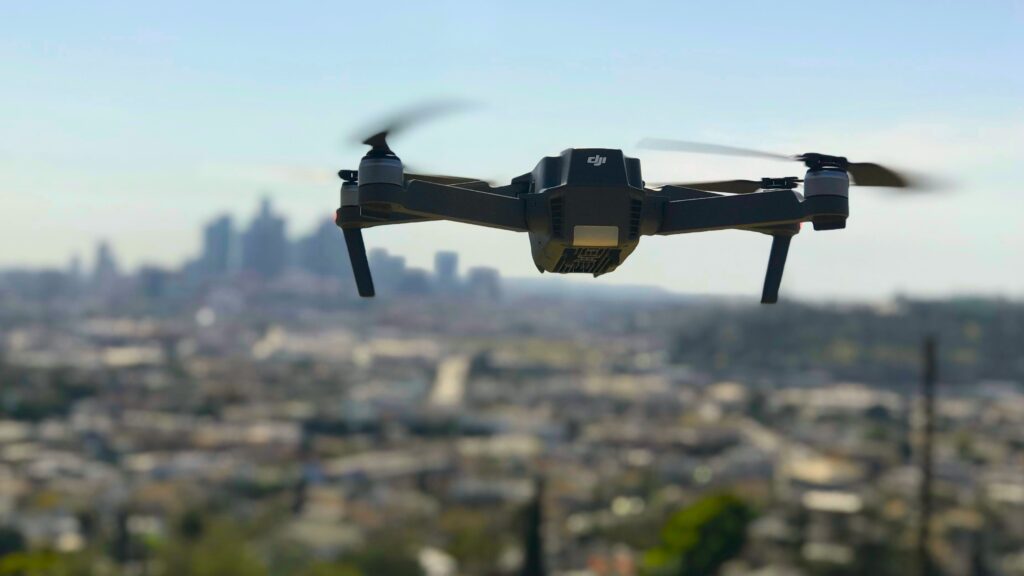
From critical infrastructure to major events, the risk posed by rogue drones is growing. Private companies are increasingly stepping in to help detect and monitor these threats. “We can track the drone’s route in real time and pinpoint the pilot’s location,” says Nassima Auvray from Orange Business, which has just launched a new system for detecting and tracking drones over sensitive sites.
In recent weeks, Estonia, Latvia and Finland have all reported drone incursion into their airspace. In February the European Commission presented an action plan on Drone and Counter Drone Security for a united approach against these threats. As the number of civilian drones continues to grow, malicious uses multiply. The problem is now faced by both member states as well as private companies.
Orange Business has launched Europe’s first anti-drone as-a-service product. Orange Drone Guardian is aimed at customers who want to protect sensitive sites from so-called Unmanned Aircraft System (UAS) incursions.
The service can detect, identify and classify intrusive drones in low-altitude airspace across France, with the plan to extend coverage to other European countries. Nassima Auvray, Director of Defense & Security, spoke to EU Perspectives about how the system will work in practice.
How big a problem are intrusive drones?
Intrusive drones are becoming a significant and fast‑growing issue, driven first by the sheer expansion of the civilian drone market. According to a Xerfi study published in September 2025, the number of registered civilian drones in France is expected to rise sharply by 2030, reaching 682,000—up from 387,260 in 2024 (+76%).
Our service does not ‘take down’ drones. It is designed to ensure the customer is informed instantly and has reliable, actionable information to share with the authorities.
This rapid growth mechanically increases the likelihood of drones flying where they should not be. It is already translating into a very real threat: drones are increasingly overflying sensitive sites, creating risks that range from security breaches to disruption for critical activities.
The system promises to detect, identify and classify drones. How does it work?
Orange Drone Guardian works like a permanent, remote ‘watchtower’ for low‑altitude airspace. Detection sensors are installed on one of the 19,700 sites operated by TOTEM, Orange’s TowerCo, which provides its rooftop and tower assets as strategic high points for detection sensors.
The system spot drones typically within a 6km to 20km radius, depending on the environment. When a drone is detected, the system reads its electronic identification beacon and uses that ID to identify the drone.
All detections are monitored by 24/7 supervision centre, which can follow the drone route in real time and check whether it is flying in line with its declared flight plan, which is a legal requirement.
If the drone deviates from that plan and enters an area being monitored for a customer, the customer is immediately notified on their mobile. From there, they can track the drone’s progression, see its identification information, and pinpoint the pilot’s location.
Once detected, is there any deterrent—can the system actually prevent drones from flying?
Under the current regulatory framework in France, only some entities—like law‑enforcement authorities—are authorised to neutralise a drone. Our service does not ‘take down’ drones. It is designed to ensure the customer is informed instantly and has reliable, actionable information to share with the authorities.
The system can monitor a fairly wide area. How do you ensure customers only track what is relevant to them, and not activity beyond their own sites?
It is designed to be both wide‑area and adaptable. Because the detection sensors are installed on highpoints, the system can typically detect drones over a several‑kilometre radius. In practice, performance depends on the local environment. That wide coverage is intentional: it helps spot an approaching drone early, rather than only when it is already above a sensitive site.
The system is primarily aimed at organisations that have to protect sensitive sites and ensure business continuity. In practical terms, the main target customers are critical infrastructure operators as well as sensitive industrial sites.
For customers, however, the service is not about ‘watching everything’ around them. The operational set‑up allows drawing different supervision areas to focus on the specific areas the customer wants to protect.
Alerts are then triggered when a drone trajectory becomes relevant for the monitored zone — not simply because a drone exists somewhere in the broader detection footprint. As a result, customers receive notifications based on the protection perimeter that has been defined for them, while Orange Business supervises the overall detection picture.
From a public perspective, there are often concerns about counter-drone systems — for example fears of drones ‘falling from the sky’. Are those concerns justified in this case?
From a public‑safety perspective, it is important to be clear about what Orange Drone Guardian does — and what it does not do. The service is a detection, identification and classification solution designed to provide real‑time situational awareness and early warning. It is not a ‘drone take‑down’ system as mentioned previously.
Who are the main target customers?
The system is primarily aimed at organisations that have to protect sensitive sites and ensure business continuity. In practical terms, the main target customers are critical infrastructure operators as well as sensitive industrial sites. It is also designed for sovereign public-sector actors such as defence and homeland security organisations, and for major event organisers looking to secure perimeters, VIP areas and crowds.
Are there any regulatory issues – particularly as this could be seen as a national security matter under private company control?
There are no regulatory issues. Each public or private entity willing to secure its infrastructures against UAS’ intrusions has sole discretion over which measures to implement.
Concerning data privacy, the service has been designed to minimise data exposure. The customer only receives the drone’s identification number. If the customer reports the incident, only the security authorities are able to link that identifier back to an individual. That access is reserved to them, and the service does not provide customers with personal identity data.
Currently the service is envisaged in France. What are the plans to roll it out to the rest of the EU?
Today, Orange Drone Guardian is designed first and foremost for deployment across France, leveraging Orange’s national telecom and digital infrastructures. The immediate objective is practical and phased: we aim to cover several sensitive sites in France within the next three years.
From there, plans are to extend the service elsewhere in Europe over time, starting with the countries where Orange already operates as a telecom operator—Belgium, Luxembourg, Poland, Spain, Romania, Moldova and Slovakia. The offer has been conceived as a scalable ‘as-a-service’ model, leveraging Orange Business’ end‑to‑end control of connectivity, cloud and operations, and a broad network of highpoints.
That said, availability in other countries will depend on two very practical factors: local regulations, which shape what is permitted in terms of detection and operational use, and the availability of suitable highpoint infrastructure to host sensors.