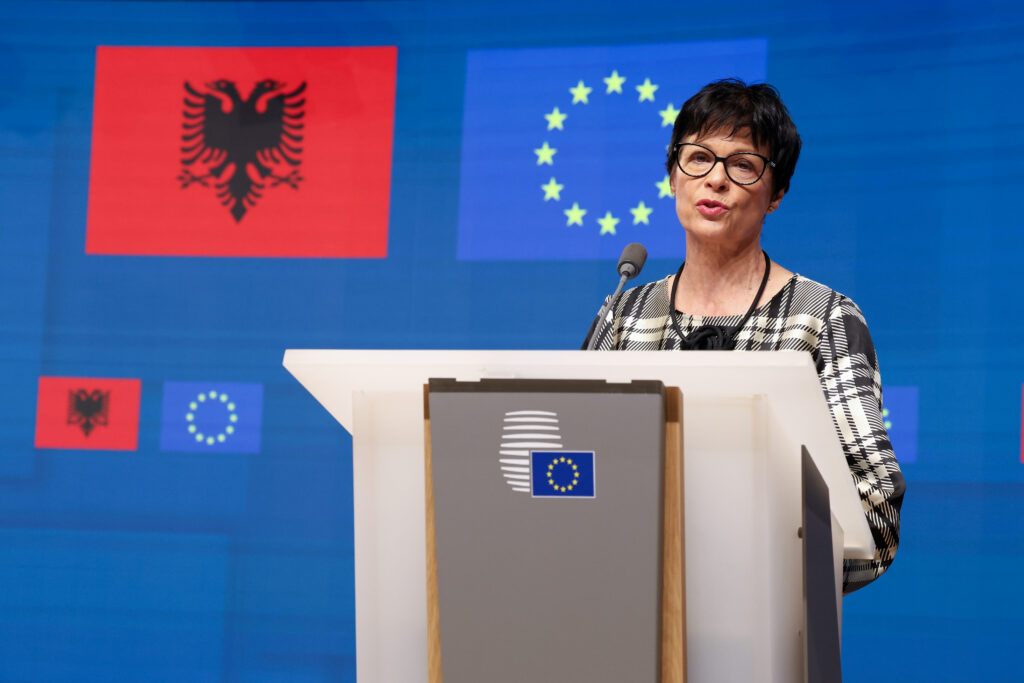
The Accession Conference with Albania, organised in the framework of General Affairs Council roundtable in Brussels on Tuesday, 16 September, discussed the next steps on Albania’s path to the European Union. While many participants praised the progress Albania has made in the accession talks, criticism was also voiced during the meeting regarding the rule of law in some candidate countries.
The sixth meeting of the Accession Conference with Albania marked the opening of negotiations on the so-called cluster 4. That covers transport, energy, and environment and climate change policies.
Enlargement is at the top of our priorities as a geopolitical necessity for the EU. — Marie Bjerre, Denmark’s Minister for European Affairs
“Enlargement is at the top of our priorities as a geopolitical necessity for the EU. Today’s meeting is another clear proof of the Albania’s path towards European integration,” said Marie Bjerre, Denmark’s Minister for European Affairs ahead of the meeting. “Albania has shown clearly that it sees its future in Europe. You are delivering and you deserve recognition”, Ms Bjerre later added.
“First time in history we are choosing our path”
Albania’s Prime Minister Edi Rama stated during the conference that, for the first time in its history, Albania can choose freely “which empire it wants to be part of”. Mr Rama underlined that “this is the empire (European Union) that we want to be a part of—the empire of rights, values, safety, and security.”
Marta Kos, Commissioner for Enlargement, noted that Albania’s ambition is to close all chapters by the end of 2027. Together with Montenegro, Albania is is now closest to joining the EU.
Rule of law: still a long way to go
Within the framework of General Affairs Council, ministers also exchanged views on the general trend of the rule of law situation in four candidate countries (Albania, Montenegro, North Macedonia, and Serbia). In this regard, however, Commissioner Kos did not paint a very optimistic picture during the closing press conference.
“Our democracies rely on the rule of law and the standards are the same for all. Every candidate must ensure an independent juduciary, media that can operate freely, and an electorate system that guarantees the will of the people (…) While we see a tangible progress in many areas (regarding Albania, Montenegro, North Macedonia, and Serbia), serious concerns remain inluding interference into judicial proceedings and pressure on officials investigating corruption,” Ms Kos stated.
Without the candidate countries really respecting the rule of law, no country will be able to become an EU member. — Marta Kos, European Commissioner for Enlargement
Commissioner Kos stressed that on the fundamentals ther can not be and will not be any compromise. “Without the candidate countries really respecting the rule of law, no country will be able to become an EU member,” Ms Kos warned.
Nine candidate countries
At present there are nine official candidate countries for membership of the European Union: Albania, Bosnia and Herzegovina, Georgie, Montenegro, Moldova, North Macedonia, Serbia, Turkey, and Ukraine. In addition, Kosovo is a potential candidate; however candidate country status has not yet been granted.
Accession negotiations with individual countries are at various stages. The countries of the Western Balkans—namely Albania and Montenegro—are currently closest to joining the EU. On the other hand, negotiations with Turkey have been at a standstill for a number of years.
The accession process follows a series of formal steps, from a pre-accession agreement to the ratification of the final accession treaty. These steps are primarily presided over by the European Commission (Enlargement Commissioner and DG for Neighbourhood and Enlargement).
Following the introduction of the revised methodology for the accession negotiations in 2020, negotiating chapters are divided into six thematic clusters. These are fundamentals, internal market, competitiveness and inclusive growth, green agenda and sustainable connectivity, resources, agriculture and cohesion, and external relations.