The European Parliament has thrown its support behind new EU-wide transparency rules designed to force into the open any lobbying carried out for non-EU governments—a long-delayed attempt to plug some of the biggest holes in Europe’s defences against foreign interference.
MEPs adopted their position on Thursday with a solid majority — 392 to 88, with 133 abstentions — putting Parliament out in front of EU governments on one of the most politically important files in the “Defence of Democracy” package. The message from lawmakers was clear: the EU has been too slow to confront how foreign state actors can exploit the system. Waiting any longer was not an option.
Shield and deflect
The directive, known in Brussels shorthand as “the shield,” dates back to 2023, when a series of influence scandals jolted EU institutions and several national governments. Public anxiety was already rising; a Eurobarometer survey found 81 per cent of Europeans considered foreign meddling in democratic life a serious threat. The EU designed the shield as its answer: a straightforward rule that forces anyone paid to push a foreign government’s agenda to show who they are and who they work for.
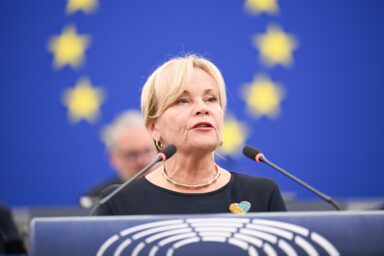
Transparency is not an ideological issue, it is a basic condition for democratic trust. – Adina Vălean, rapporteur (EPP/ROU)
Parliament’s version spells out matters in plain terms: anyone lobbying — whether drafting amendments, organising events, meeting officials or running public campaigns — for payment on behalf of a non-EU government may soon have to register in new national databases connected to a single EU portal. Upon registering they would receive a European Interest Representation Number valid across the 27-member bloc. The goal is to scrap today’s uneven patchwork and build a system that foreign state actors can’t game so easily.
Can’t touch this
Meanwhile, MEPs also spent considerable energy drawing red lines around where the law does not extend, so that diplomats, academics, journalists and lawyers are, nor surprisingly, beyond its scope. NGOs — many of which receive some funding from abroad — get clear protection under the Parliament’s plan. Foreign grants that have nothing to do with lobbying won’t count as paid influence. Lawmakers draw that line firmly to stop the EU drifting toward any “foreign agent”-style law that could be used to harass or intimidate civil society. Rapporteur Adina Vălean drove that point home.
“Transparency is not an ideological issue, it is a basic condition for democratic trust,” she said. “Anyone seeking to influence decisions in EU countries on behalf of a foreign government will have to register and be visible. It establishes clear, uniform rules across Europe, without labelling or burdening legitimate organisations.”
Lobbyists unfettered no longer?
For proponents, the case the need is clear: only sixteen member states regulate lobbying at all, leaving a continent-wide maze of loopholes. Officials admit the gaps have allowed foreign state-linked actors to hop between capitals in search of the weakest oversight. They argue that only a common standard can shut down those routes—and reassure voters that decisions are being shaped in daylight rather than in backrooms.
The timing of Parliament’s vote also matters. Foreign interference has become a constant feature of Europe’s political landscape, from coordinated disinformation to cyberattacks and increasingly bold attempts to sway policy debates from the shadows. Governments across the bloc have been warning of a steady uptick in pressure from state-backed actors — a trend that has arguably only sharpened the appetite for new rules.
With Parliament now locked in, the spotlight shifts to the Council. EU governments must agree on their own mandate before talks can begin. Some members will want still tougher rules; others will worry about red tape or the politics of tracing foreign funding. Those arguments may well shape how ambitious the final “shield” will be. Until they dig into the details and maybe dig in their heels, how tough and protective it will end up being, will not be fully clear.