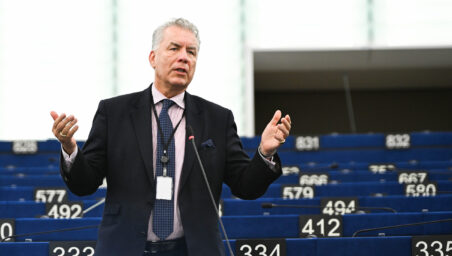
The European Parliament has once again attempted to draw a line in the sand, adopting a boldly-worded resolution on Ukraine’s peace. The text amounts—in theory—to a direct challenge to American negotiators and a reassertion of European authority over the continent’s future.
The timing matters. The vote took place in Strasbourg on 27 November. Just days earlier, US President Donald Trump announced plans to broker a deal between Russia and Ukraine, enlisting his advisers to “finalise the terms” of a proposed settlement. The European establishment was not amused and tried, with mixed success, to get seat at the negotiating table.
The resolution’s most striking element is its insistence on European primacy. Parliament demands that the EU assume greater responsibility for continental security. It rejected the notion that outsiders—however powerful—should decide Ukraine’s fate without European input.
Beyond past statements
The MEPs adopted a simple but pointed formula: “Nothing about Ukraine should be decided without Ukraine, and nothing about Europe without Europe.” This was no mere rhetorical flourish. It represented Parliament’s determination to prevent what it fears could be a soft American settlement that neglects European security interests.
The resolution prescribes tough conditions for any agreement. Parliament insists that any peace must be preceded by an effective ceasefire and backed by security guarantees “equivalent to Article 5 of the Washington Treaty and Article 42.7 of the Treaty on European Union.” This demand goes beyond previous EU statements.
It essentially tells Ukraine that the EU itself—not just NATO—will underwrite its security. Parliament also made clear that “EU and its member states will not recognise any temporarily occupied Ukrainian territory as Russian territory,” ruling out any post-hoc legitimisation of territorial conquest.
Fearing Trump
Money matters too. The resolution calls for a “reparation loan” backed by frozen Russian assets, with the crucial proviso that “the fate and conditions of investment of these assets are not subject to negotiation without the EU.” This shift from discussing reparations as a post-war issue to making them a precondition of peace reflects Parliament’s hardening stance. Russia must pay during negotiations, not after.
Accountability looms large. Parliament demands “full accountability under international law for the crime of aggression and war crimes committed by Russia, its allies and its proxy forces against Ukraine,” with prosecutions before the International Criminal Court and a special tribunal. This aims to rule out any amnesty arrangements that American negotiators might wish to offer as a sweetener.
Nothing about Ukraine should be decided without Ukraine, and nothing about Europe without Europe. — the European Parliament’s resolution
Yet the resolution’s most revealing element may be its warning about American intentions. Parliament expressed concern about “US policy ambivalence towards Ukraine” and questioned Washington’s “commitment to international law.” This anxiety suggests MEPs fear that Trump’s team might accept Russian demands—whether on territorial freezes, NATO membership restrictions, or sanctions relief—that European governments consider unacceptable.
Boots on the ground “unlikely“
To reinforce its message, Parliament insisted that no EU sanctions be lifted until a peace agreement is fully implemented. Should Russia refuse serious negotiations, the resolution calls for additional sanctions. This, in theory, removes any possibility of sanctions relief as a bargaining chip.
The resolution carried with 401 votes in favour, 70 against and 90 abstentions—a solid, not overwhelming, majority. Nonetheless, Parliament has signalled clearly that it will resist any peace settlement that treats Europe as an afterthought.
Whether the EU’s executives and member states prove as steadfast remains unclear. At the end of the day, any political proclamation is as good as its enforcement. As the lawmakers cast their votes for the resolution, Bloomberg ran an opinion piece under the sceptical headline ‘European boots on the ground? Unlikely’.