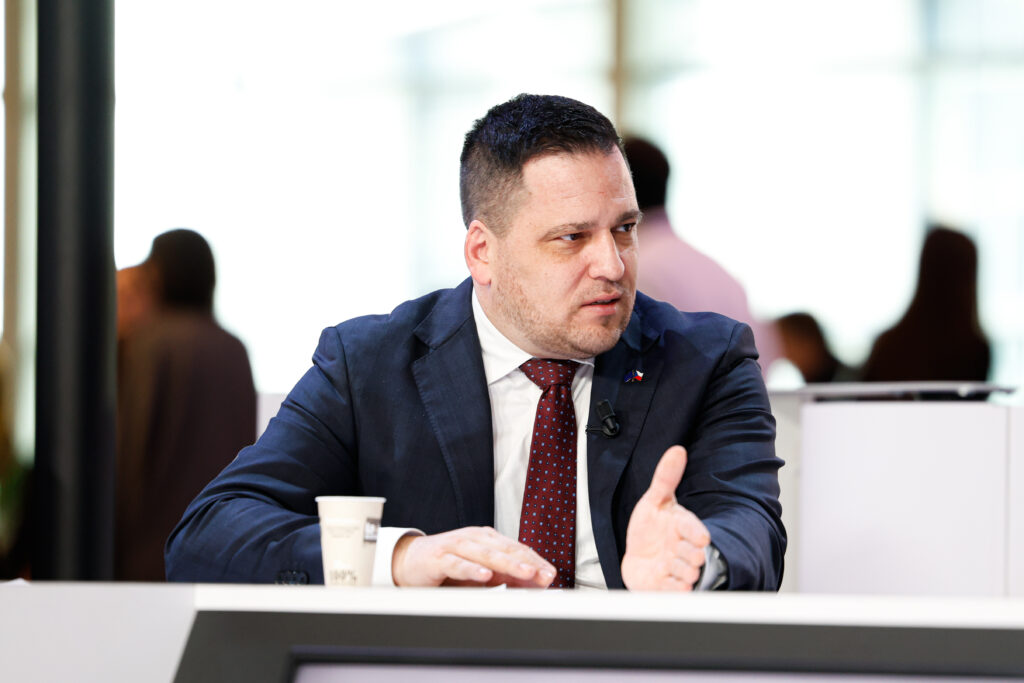
As the EU prepares its 2028–2034 financial framework, MEP Tomáš Zdechovský (EPP/CZE) argues that the Commission‘s poor communication risks derailing support for a more flexible budget. Disputes over farm payments, cohesion funds, and new revenue sources portend an exceptionally contentious negotiation round. “In the past, ministers even cried during Council meetings,” Mr Zdechovský recalls.
“I agree that we should simplify budgetary policy and have greater flexibility. On the other hand, it needs to be said that we are not taking money away from anyone. The funds will stay there. But if Europe were, for example, attacked, we would be able to shift resources from one envelope to another,” Mr Zdechovský said in an interview on the future of the EU’s long-term budget.
The Christian Democrats recently raised major objections to the Commission’s proposed budget. MEPs said they are missing more communication from the Commission and its president, Ursula von der Leyen. Rejecting part of the proposal was even on the table. After promises were made to European Parliament President Roberta Metsola, a “ceasefire” has now taken effect — the Commission president promised to revise the proposal.
Lack of detailed explanation
“I think that the original proposal was not worked out in great detail, and I think there was a slight lack of communication and explanation on the part of the Commission,” Mr Zdechovský argues. This, he says, is what Ms Metsola told Ms von der Leyen.
Other than that, the MEP thinks, the general structure is an improvement. “The budget is set up well, in my opinion,” Mr Zdechovský said, adding that EU countries have not yet agreed on introducing new own resources to increase the EU budget’s revenue.
The strongest criticism comes from farmers. “They fear that direct payments will no longer be guaranteed and will be redirected to other priorities,” the MEP explained. “We’ll see what emerges after the revisions. To secure support, you need a majority in Parliament — that’s 361 MEPs,” Mr Zdechovský noted.
Support for regions at stake
The change to regional funding within the bloc’s cohesion policy provides another flashpoint. “Personally, I think the member states should decide whether they want to focus EU spending in their regions on agriculture, environmental protection, or infrastructure. I would leave it to the countries to negotiate this with their regions,” the Czech member said, supporting greater flexibility.
The Commission is also newly proposing so-called national plans — merging funds for farmers and regions into unified funds managed by the governments of all 27 member states. But reaching an agreement will require approval from all countries. “I think the negotiations will be very tough this time as well. In the past, during EU Council meetings, finance ministers cried or shouted that the European Union was finished,” the MEP recalled.
If we don’t have security, and if there’s a war anywhere in the EU, we won’t have economic prosperity. — MEP Tomáš Zdechovský (EPP/CZE)
Critics argue that the overall budget is too small, even though it reaches a record amount of nearly €2tn. “I think the budget is set up well,” Mr Zdechovský reiterated. Member states, however, have yet to agree new own resources to boost EU revenues. “If anything is successfully negotiated, it will be a huge success,” he said. He also considers raising the national contributions to the EU budget to be politically unfeasible.
Security must be a priority
Two-thirds of the current EU budget goes to the Common Agricultural Policy and cohesion policy. The Commission’s proposal allocates more funding to continental defense and support for the competitiveness of European companies.
The Czech MEP welcomes the shift in priorities. “If we don’t have security, and if there’s a war anywhere in the EU, we won’t have economic prosperity. We must acknowledge that security is a priority and do everything possible,” Mr Zdechovský said.
He also reminded that some EU funds get “stolen” in member states, noting cases of misuse of EU money by local politicians, for example in Slovakia or Hungary.
Technological sovereignty
Given the pressure from the US, the concept of digital sovereignty and cybersecurity is frequently discussed. “Yes, these are key issues. We saw this when Elon Musk switched off (SpaceX’s Starlink) satellite internet access for the Ukrainian army. At that moment, we understood how crucial cyber security is. It is essential to have our own European satellite systems, such as Galileo or Copernicus. These are some of the most advanced systems. European navigation services are far more accurate than the US GPS system,” he emphasised.
He also agreed that funding to countries violating the rule of law should be tightened. “It’s the right thing to do. Why would you give money to someone who is introducing a dictatorial regime or supporting such regimes and their practices — like spying on journalists? I think internal pressure must be created within the Union against these states. This restriction has already partly affected Hungary in the past,” the Czech Christian Democrat said.