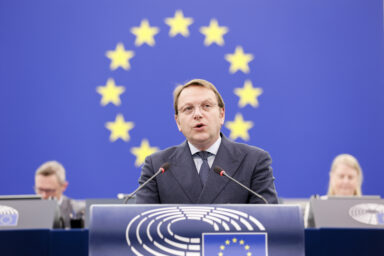
The Union’s investment engine revves at full throttle, the European Parliament’s defence and security committee heard on Tuesday. Last year, the EIB quadrupled its defence activity over 2024, and each euro it invests is likely to attract multiples in private money.
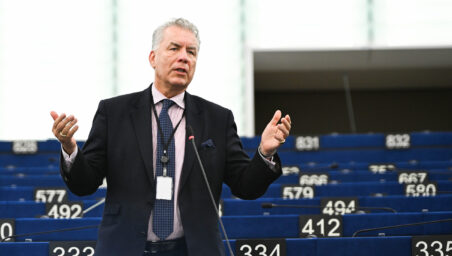
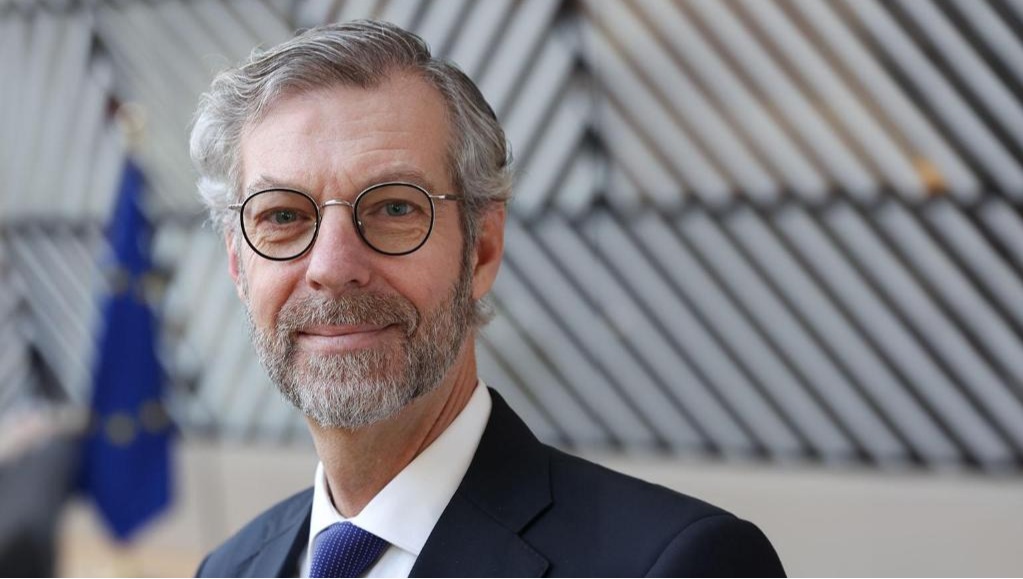
Defence matters rarely invite cross-party concord but when Vice-President Robert de Groot of the European Investment Bank arrived to the 14 April SEDE committee session, that was the case. Mr de Groot carried himself like someone who has done his homework. He had numbers at hand to provide evidence.
The Dutch banker carries a new mandate, written in March 2025, that lets the EIB finance pure military projects. The MEPs liked his supremely confident, yet always courteous demeanour. Open praise of the Banks’s performance, the equivalent of a theatre’s standing ovation, sounded with unusual frequency.
Fast, simple, accessible
MEP Marie-Agnes Strack-Zimmermann (Renew/DEU), who chairs SEDE, set the tone. Financing must become “faster, simpler and easier to access, especially for SMEs, startups and innovation”, she declared, before asking whether the Bank was ready to match Europe’s worsening security environment. Her guest spent the next hour convincing most of those present that it is.
Mr de Groot pulled his thick binder from a briefcase and started with last year’s numbers. “It has been very, very strong. We multiplied by four our achievements over 2024,” he told the committee. Then he sharpened the point: “We went well beyond €4bn and we outperformed our target and have already reached five per cent of the group’s annual business volume inside the EU.” For 2026, the internal target stands at €4.5bn—again five per cent of EU lending—with a mid-term review in June that could lift the ceiling.
Those figures carry a lot of weight. Defence now ranks as one of eight priorities in the EIB’s operational plan for 2026-2028. The Bank also hosts a one-stop Security and Defence Office, has a joint mechanism with the European Defence Agency and claims more than €4bn of signed projects in its 2025 pipeline. Mr de Groot insisted that “Security and defence is now a permanent cross cutting policy goal across all projects and sectors within the EIB group.”
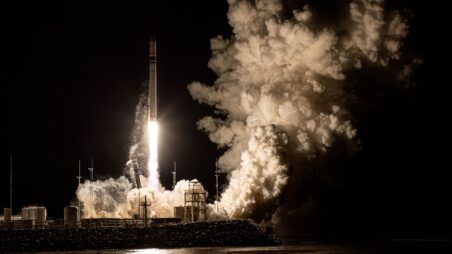
Later the vice-president had sketched an institution that finances much more than guns. The first of five pillars concerns industrial capabilities. Optical ground stations, drone assembly lines, satellite-launch equipment and vehicle-repair hubs all receive loans. “We went into some venture debt operations, both in Germany and only two weeks ago in Spain,” he said, hinting at Europe’s wish for cheap, low-orbit launch systems that can loft shoebox-sized satellites over a battlefield.
A broader portfolio
The second pillar covers research and development for large contractors. Protective optics and acoustic sensors for seabed cables already sit in the portfolio.
The third plank—SMEs—proved delicate. Cash now flows through Deutsche Bank, Banco Santander, Piraeus Bank and others, yet local subsidiaries still baulk at smaller borrowers. Mr de Groot conceded the gap. Workshops in member states teach entrepreneurs how to nudge house banks past lingering qualms. That matters because, as MEP Pierre-Romain Thionnet (PfE/FRA) observed, reputational fears once kept many lenders away from defence. The vice-president nonetheless judged that “I do not hear very often anymore of large obstacles.”
Venture capital forms the fourth column. “The Defence Equity Facility 1.0 was a huge success,” he told MEPs. Its €175m has run dry. A second vehicle will raise at least €1bn and “preferably go to more than one and a half at a later moment in time”. Twenty-five to thirty VC and private-equity funds should benefit, with Norway, Iceland, Switzerland and Liechtenstein joining the circle. The EIB sees itself as anchor investor and hopes to crowd in pension funds once rulebooks soften.
Aligning policy tools
The final priority is future-proofing, from anti-drone shields to military-mobility corridors. Here the Bank depends on national planners. Yet a new memorandum among Greece, Bulgaria and Romania to upgrade roads and rails from the Aegean to the Danube shows how loans, Commission grants and national funds can align.
ESG does not stand in the way of investing into security and defence, because we are here to protect our own people.
—Robert de Groot, vice-president of European Investment Bank
When MEP Elena Donazzan (ECR/ITA) praised joint work on EDIP, the defence industry programme, Mr de Groot offered another example: “I am extremely pleased with the memorandum of understanding… to really collectively invest in the physical infrastructure, road rail from the ports in northern Greece all the way through Bulgaria and Romania.”
Coordination with Brussels has improved. Mr de Groot told MEP Nicolás Pascual de la Parte (EPP/ESP) that weekly calls with Commissioner Andrius Kubilius keep the Bank’s pipeline complementary to SAFE, EDIP and the European Defence Fund. Complementarity also extends to NATO planning cells. The idea is simple. If subsidy schemes handle grants and joint procurement, the EIB can take on market failures—project-finance risk, venture scale-up gaps—without crowding out private capital.
Guardrails and green tape
MEP Christoph Gommart (EPP/FRA) pressed the banker on munitions and lethal kit. The answer was blunt. “We have not seen demand from ammunition because they all have huge order books,” said Mr de Groot. SAFE grants cover restocking shells. The Bank steps in only when commercial banks back away. In many niches—missile casings, powder, fuses—no such reluctance exists.
ESG filters still apply, insisted Mr de Groot. “ESG does not stand in the way of investing into security and defence, because we are here to protect our own people.” Contracts oblige borrowers to follow EU law. That satisfied most deputies, though MEP Marc Botenga (The Left/BEL) remained sceptical, citing an internal review of three Israeli projects. The vice-president deflected, noting that the portfolio finances only EU production and spares lethal exports.
Geopolitics crept in elsewhere. American venture funds now court European start-ups. “I am now also increasingly called for meetings by venture capital funds from the US who are very interested in establishing a European foothold,” Mr de Groot said. He framed the trend as proof that returns look healthy. Yet some MEPs wondered whether cash from allies could one day buy technology Europe would rather keep.
Next steps in space
Supply chains form a further fault-line. “We really try in our due diligence and in our discussions with the private sector to maximise the European content and to maximise the European control,” the banker said. That standard soothes fears about Chinese leverage. It also underpins a wider industrial doctrine: Europe must own the intellectual property that secures its public-service backbone.
Financing must become faster, simpler and easier to access, especially for SMEs, startups and innovation.
—MEP Marie-Agnes Stack-Zimmermann (Renew/DEU)
Debate turned technical when low-orbit launchers came up. France’s Kourou base can loft heavy satellites, but the emerging demand is different. Defence ministries want swarms of tiny platforms that can be replenished quickly. Mr de Groot argued that Europe needs “another type of rocket”. The Bank now backs start-ups designing micro-launch vehicles and scouts for a European coast where they might fire. French Guiana remains a fallback, yet travel time and cost erode competitiveness.
MEP Villy Søvndal (Greens-EFA/DNK) asked whether co-production with Ukraine could fit. The vice-president replied that “There is no restriction on financing companies which are joint ventures with Ukrainian companies if and when they manufacture inside the EU.” Inside Ukraine itself the EIB already lends more than €1.5bn a year to rail, energy and housing. That sum may climb once reconstruction accelerates.
A wider market
Cross-border projects continue to lag. Most EIB defence loans still go to national champions. Mr de Groot confessed as much: “Up to this moment it is still mostly national.” Planning for pan-European ventures, especially along the eastern flank, takes time. SEDE members urged speed. Without aggregated demand neither scale economies nor integrated supply chains will appear.
Long-term demand shapes investment. Europe still imports three-quarters of the weapons it uses. War in Ukraine emptied stockpiles and has rekindled talk of common procurement. From a financier’s angle the logic is brutal. Predictable orders unlock private debt, which in turn frees scarce public subsidies for bleeding-edge research. Mr de Groot framed the issue in industrial terms: Europe must build ecosystems, from ground stations to launch pads, if it wants control.
Defence Equity Facility 2.0 aims to address the notorious scale-up cliff. Venture rounds of €60m-€80m remain rare west of the Atlantic. The Bank hopes that its anchor role will lure insurance pools and pension funds once regulatory tweaks come through. Progress on the omnibus simplification, praised by MEP Petras Auštrevičius (Renew/LTU), has already coaxed several big lenders back into the field.
Governance questions
The Bank’s risk appetite, though bolder than before, remains tied to the absence of commercial alternatives. That boundary limits political controversy, yet it could also blunt impact. Defence spending in the next EU budget may crest €30bn a year through multiple instruments, dwarfing EIB loans. For Mr de Groot the answer lies in leverage. Each EIB euro can entice three or four more from private sources.
Rapid growth carries supervisory risks. Portfolio concentration in a single volatile sector can upset rating agencies. The Bank’s Security and Defence Task Force screens projects, while the EIB-EDA mechanism checks military relevance. Parliament wants more clarity on impact metrics, modelled on the climate reporting that now punctuates annual reports. The vice-president nodded. Transparent indicators help ministries and investors alike.
We want innovation, which originates from Europe and from the Union, to stay here and not move off elsewhere.
—Robert de Groot
Geography will draw scrutiny. France, Italy and Spain top the 2025 beneficiary table. Smaller states fret about capacity to prepare bankable dossiers. The Commission’s technical-assistance funds help, yet SEDE members asked for simpler templates and digital portals. Mr de Groot offered workshops, but acknowledged that bottlenecks persist in finance ministries and procurement offices.
Testing the ambition
SEDE finished as it began, on urgency. Ms Strack-Zimmermann told the banker that the key question is whether the EIB can match the security environment. The reply relied on numbers. “For 2026, we have approved and increased share of the security and defence financing up to four and a half billion at this moment in time.” If the mid-term review raises that ceiling and Defence Equity Facility 2.0 hits its €1 bn target, the Bank will channel roughly €6bn into the sector next year. Add advisory grants and crowd-in effects and total financing could reach €15bn.
The next test comes in June when shareholder governments meet in Luxembourg. Hawks will argue for a higher share than five per cent. Doves may worry about balance-sheet strain. Parliament’s message is already filed: the EIB has permission—indeed a duty—to move faster.
Mr de Groot closed on a strategic note. “We want innovation, which originates from Europe and from the Union, to stay here and not move off elsewhere,” he told the committee. It is not his job to figure out how to turn billions into brigades. The Bank can lend. Europe must still decide what to buy.