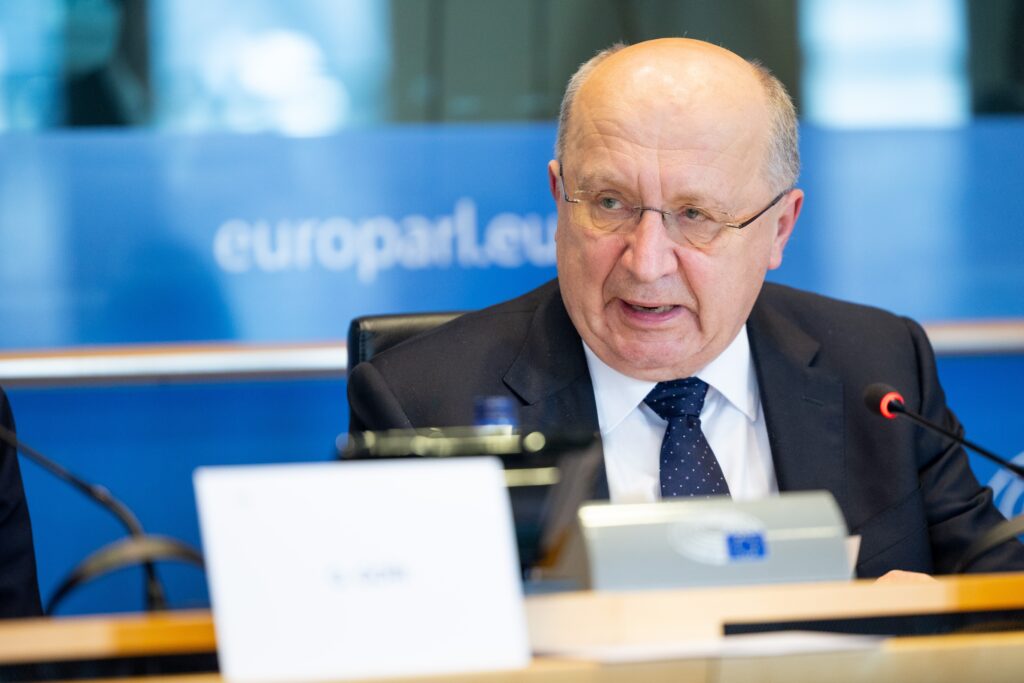
Defence Commissioner Andrius Kubilius urged lawmakers on Monday to work in overdrive. The goal is to pass the critical multi-pronged defence procurement legislation before the next long-term budget.
Commissioner Kubilius’ 20 April structured dialogue with the parliamentary research and industry committee (ITRE) felt like the wartime briefing it was. The commissioner insisted that parliamentarians hold the key: cash, law and urgency. “We need to outproduce Russia first of all.”
Mr Kubilius presented the same numbers to ITRE as he did last week to the security and defence committee (SEDE). “Russia is still outproducing us. Last year annual production of cruise missiles: Russia 1100, European Union 300. Annual production of ballistic missiles: Russia 900, European Union zero. Annual production of artillery ammunition: Russia four million, European Union two million.” The gap, he argued, is wide enough to tempt the Kremlin. Europe must match output as it matches rhetoric.
Europe’s clogged arteries
The first obstacle, said Mr Kubilius, is home-made. National authorities still take years to clear new assembly lines, and components hop borders with permits that belong to a bygone peace. “We need a swift agreement on the defence readiness omnibus. We cannot afford to slow it down or water it down.” Two more sentences hammered the point home. “We are asking industry to speed up. We must ourselves also step up.”
MEPs across the spectrum more or less agreed. MEP Wouter Beke (EPP/BEL) demanded updates on supply-chain mapping and joint procurement. The commissioner replied that 40 per cent of European orders still travel to America, but that the Pentagon will now prioritise replenishing its own missile stocks. “On both sides of the Atlantic Ocean there is a shortage of production capabilities,” he cautioned.
Money, however, still speaks loudest. Brussels proposes a €125bn European Competitiveness Fund (ECF) to run until 2035, and the Parliament’s budget committee wants to add €30bn. Mr Kubilius told ITRE to keep its nerve: “Accept no dilution, no compromise.” The fund links cheques to collaboration: miss the joint call and miss the grant. It also folds in space projects, because surveillance, navigation and secure links are now military commodities. “Our number one goal is to maintain, expand and improve our space flagships.”
Yet even €155bn cannot plug every hole, so the Commission has designed a micro-scheme for rapid innovation. “AGILE is fast through simplified processes and governance, delivering funding support in four months,” the commissioner said. The pilot carries only €115m, but officials hope its pace—grants in months, not years—will shape the next seven-year budget. “Time is of the essence,” he repeated the oft-used quip.
Eyes on the skies
Startups and small suppliers pepper the defence food chain, providing sensors, software and specialist alloys. The commissioner reminded MEPs that 43 per cent of participants in the existing European Defence Fund are small and medium enterprises (SME), spread across every member state. He promised to keep that balance. “SMEs can be included into real chains of supply for big primes.”
Our number one goal is to maintain, expand and improve our space flagships. — EU Defence and Space Commissioner Andrius Kubilius
Being the wily old fox of a politician he is, Mr Kubilius deftly handled half-hearted opponents. MEP Yannis Maniatis (S&D/GRE) worried about making sure that production remains in European hands. Another leftist member, MEP Nicolae Ștefănuță (Greens-EFA/ROU) used the occasion to insist on his favourite—albeit only tangentially related—topic of green energy transformation. Yet another, MEP Marc Botenga (The Left/BEL) was troubled by the lack of audits accompanying the spending surge.
Mr Kubilius answered the latter concern: “OLAF is one of those institutions which is doing a proper job.” He added that the Court of Auditors stands ready to pounce and that regular grant audits are routine. Still, he conceded that finance sometimes runs ahead of factories, inflating share prices before shells roll off the line. He wants longer contracts and clearer demand signals to align incentives.
A strategic asset in the works
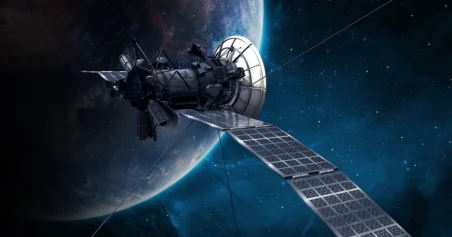
The hearing then switched from shell-stocks to satellites. Debris crowds orbits, private rockets reshape launch economics and hostile actors test jammers. ITRE is writing the European Space Act, meant to clear regulatory clutter and keep insurers calm. Mr Kubilius called the file a strategic asset. “We need to develop and build them or to procure them without delay.” He backed an industry board to keep rules realistic but did not want the law diluted by rival capitals.
Access to space worries the committee almost as much as access to artillery. Europe’s heavy Ariane 6 has not yet flown, and micro-launch pads inside the Union remain sketches. The commissioner suggested a twin track: squeeze more throughput from Kourou in French Guiana and build small pads on the continent for quick-reaction lifts. He wants reusable European rockets and better competition inside the launch market.
Security of data completed the triangle of land, air and space. MEP Michał Szczerba (EPP/POL) pressed for sovereign clouds to store battlefield maps and logistics manifests. Mr Kubilius agreed. “Some of them chief of staff, high ranking militaries are saying server and cloud now is the biggest issue and biggest challenge for them where to put the data.” He hinted that secure European clouds could become critical infrastructure under forthcoming legislation.
Bigger shields
Eligibility rules also stirred debate. AGILE funds may flow only to firms incorporated in the EU, Norway or Ukraine, with random checks on ownership. MEPs asked whether subsidiaries of non-European parents could sneak in. The commissioner replied that relocation to the Union is mandatory and that parliament can tighten wording.
Missiles do not respect borders, and neither do satellites. Mr Kubilius promised a communication on the European Space Shield later this year, an umbrella concept knitting together intelligence, navigation and secure links for both civil and defence use. The project will sit atop Galileo, Copernicus and IRIS², reinforcing autonomy from American feeds. Parliament wants to see draft governance before writing cheques, but most members back the goal.
Accept no dilution, no compromise. — Andrius Kubilius
MEP Eero Heinäluoma (S&D/FIN) relayed Volodymyr Zelenskyy’s plea for a continental anti-missile net. The commissioner ducked technical details—industrial capacity is not yet clear—but hinted that the Space Shield could host early-warning layers.
Then MEP Giorgio Gori (S&D/ITA), who chaired the debate, then drew the gavel. The commissioner closed with a reminder. “Somebody said that during the first year we did more for European defence than was done during the previous ten years.” He accepted the compliment but added a warning. “The challenges ahead are much bigger than those we managed to overcome till now.” The arithmetic of deterrence remains cruel.
When will the omnibus arrive
The EU’s Defence Readiness Omnibus is scheduled to complete the ordinary legislative procedure and be formally adopted by the end of 2026. The European Commission released the proposal on 17 June 2025 and sent it to the Parliament and Council to start the ordinary legislative process.
The Council reached a general approach on the package last November, clearing the way for trilogue negotiations in 2026. The European Parliamentary Research Service’s January briefing on the Defence Readiness Roadmap lists “legislative adoption of the Defence Readiness Omnibus (…) by the end of 2026” as an explicit milestone in the roadmap’s timeline.
For that to happen, lead committees in the Parliament (SEDE, IMCO, ITRE, ENVI) must first finalise their reports, followed by a plenary vote. Trilogues between Parliament, Council and Commission are then to reach a political deal. Formal adoption, likely to arrive during this year’s final quarter will mean the regulation can enter into force before the new multi-annual financial framework (2028–2034) kicks in.