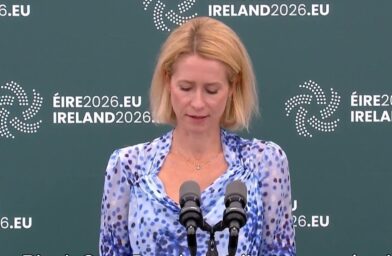
“The security of our staff members is an utmost priority.” With these words, the European Commission backed its spokeswoman Anitta Hipper responsible for foreign affairs and security on Monday after reports of Russian threats.
“If you look at Article 24 of the Staff Regulation, you can see that they are prepared for such scenarios and we have the duty to provide assistance to staff members affected by such threats,” Commission spokesperson and Hipper’s colleague Balazs Ujvari said on Monday.
The statement comes after the Russian Ministry of Defence published via Telegram last week a list of drone factory locations across Europe. The list named addresses in nine EU member states: Czechia, Germany, Latvia, Lithuania, the Netherlands, Denmark, Poland, Spain, and Italy. “European citizens should know addresses of ‘Ukrainian’ enterprises on their soil,” the ministry wrote.
Moreover, Dmitry Medvedev, former Russian president and current deputy chair of the Security Council, amplified the list on X — calling it a list of potential targets.
“Sleep well, European partners,” he wrote.
Sloppy intelligence
However, the list was not without errors. One address in Munich turned out to be a residential building, casting doubt on the quality of Russian intelligence behind it.
This shows once more that Russia is not at all interested in peace.
—Anitta Hipper, European Commission spokeswoman
Hipper, the Commission’s foreign affairs and security spokeswoman, responded the following day. The European Commission confirmed it takes the security of its staff seriously. Under Article 24 of the Staff Regulations, it has a duty to protect its people from both physical and psychological pressure.
The move fits a broader pattern. Russia has repeatedly tried to frame EU member states as active participants in the war in Ukraine, rather than external supporters. At Monday’s midday briefing, the Commission pushed back directly, reaffirming there is no evidence Ukraine has used EU member state airspace to attack Russia — the statement that originally prompted Moscow’s response.