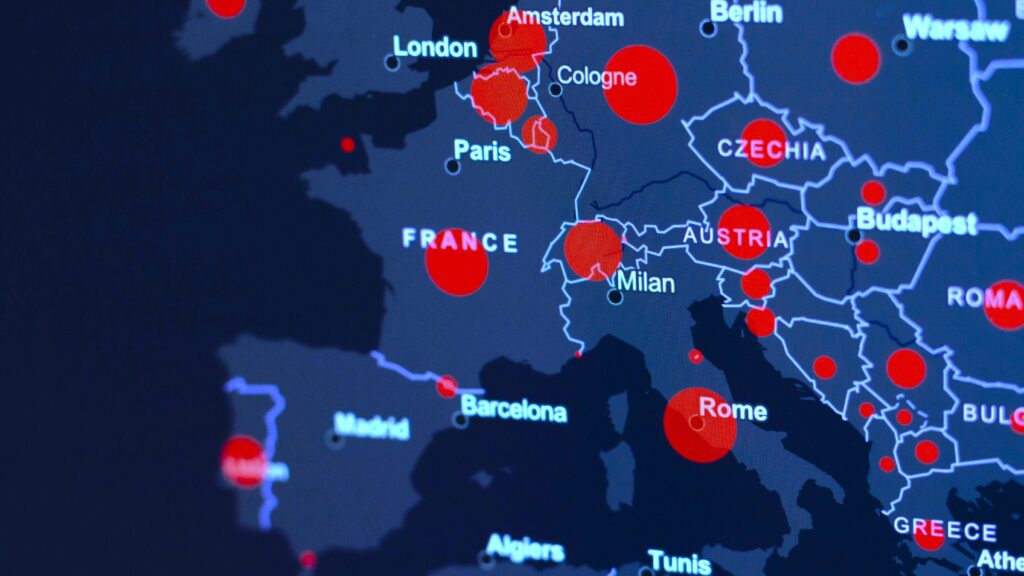
Tracking and profiling people, analysing detailed personal data or monitoring religious communities. Palantir’s software is deeply embedded in the architecture of modern surveillance. The EU spent years promising “digital sovereignty” and less reliance on foreign technology, yet some of its most sensitive systems increasingly depend on the controversial US company with deep ties to Washington.
Palantir develops tools that can analyse massive amounts of data. They are used by governments, police forces, and militaries. The company drew fresh attention after publishing a manifesto where its CEO, Alex Karp, frames artificial intelligence as the foundation of a new era of military power. Which critics described as “technofascism”.
The business was founded in 2003 with the CIA to support the US “war on terror”. Since then it is reportedly expanding its presence in European police and military.
What Palantir actually does?
Some of Palantir’s most famous products, Gotham and Foundry, are designed to process vast amounts of data, connect databases, identify patterns, and support decision-making. The two platforms serve in different contexts. Gotham is used with defence, intelligence, and policing. Foundry is directed to healthcare and public administration. “Palantir — and similar automated data analysis companies — do not just process data; they restructure how institutions think about people, reducing individuals to data points to be scored, flagged, and acted upon without ever knowing it happened”, said Kilian Vieth-Ditlmann, Head of Policy at AlgorithmWatch, an NGO focusing on fundamental rights in the digital space.
The FBI has bought geolocation data from the private market that was collected for targeting advertising originally. They could see through the geolocation who is going into mosques and how often.
— Jan Penfrat, European Digital Rights
Jan Penfrat, senior policy advisor at European Digital Rights (EDRi), explained to EU Perspectives how the system works. “Among other things, Palantir offers analysis capabilities. You feed the data that you have into the software. Government agencies of all kinds purchase information from the private market, which means they have access to huge amounts of personal data without a warrant. Palantir allows you to take all the databases you have and feed them into the software.”
That can include data gathered for targeting people with advertising. Once merged with police or intelligence files, they can create detailed profiles.
Penfrat pointed to examples from the United States where authorities purchased geolocation data to identify who was regularly visiting mosques. “The FBI has bought geolocation data from the private market that was collected for targeting advertising originally. They fed it into a huge database, combined it with existing data, and then they could see through the geolocation who is going into mosques and how often,” he said. “They wouldn’t even need to know who these people are, because they could just use the geolocation data and follow them home.”
Tracking migrants
For the expert, the danger lies in reversing the traditional logic of policing. “You do not need to have a suspicion about anyone. You can just filter out people and then build suspicion based on that,” he said. “Assuming the entire population is under suspicion all the time ends democracy and human rights.”
In the United States, Palantir faced criticism for its work with Immigration and Customs Enforcement (ICE). Its software has reportedly been used to track targeted populations. An example is ICE’s ‘ImmigrationOS’, a platform designed to analyze vast amounts of data, recognise patterns, and identify migrants.
Penfrat shared a hypothetical situation of how the data analysis can be put in place. “Imagine that US authorities learnt that people who buy large quantities of groceries may be hiding migrants at home. They could start to track people to supermarkets,” he explained.
For human rights organizations, like Amnesty International, these systems enable mass surveillance and threaten migrants’ rights and privacy.
European footprint
“We see an increased use of Palantir products in Europe. German regional police in several states is using it. Last year the French intelligence service continued its cooperation with Palantir by using its services,” MEP Raquel García Hermida-van der Walle (Renew/NLD) told EU Perspectives. “Palantir has been expanding by opening offices in multiple European capitals and actively marketing their products to government bodies and security agencies across the continent”, added Vieth-Ditlmann. “Palantir lobbied Swiss federal authorities and the military for years, with the Palantir CEO personally meeting the Swiss Federal Chancellor. Importantly, Switzerland ultimately still declined to adopt the software.”
Reports show that in Germany, police forces in states including Bavaria, Hesse, and North Rhine-Westphalia have used versions of Palantir. Nevertheless, as of April 2026, the national army has cut ties with the company.
France has relied on Palantir since 2015. The country’s domestic intelligence service, DGSI, renewed a multi-year contract with the company in late 2025, extending cooperation first established after the 2015 Paris terrorist attacks.
Penfrat pointed out the irony: “France is one of the countries that are loudest about digital sovereignty. And Germany is the same thing.” During the COVID-19 pandemic, other countries, including Greece and the Netherlands, used Foundry to analyse the spread of the virus and manage public health data.
They come and offer this amazing product for one pound. That one-pound contract became a 1 million-pound contract when it got renewed. And then it became a 6 million-pound contract.
— Duncan McCann, Good Law
According to Walle, European financial institutions are also expanding their investment in the company. “At the end of 2025, more than 100 European private financial institutions increased the aggregate number of Palantir shares they held by almost 70 per cent compared to 2024. The investment in Palantir is thus increasing,” she said.
Previous analysis points to the same trend. It estimates the total value of European financial institutions’ stake in Palantir Technologies at at least $27 billion. Some of the banks involved were Deutsche Bank, BNP Paribas, and Barclays.
This reflects Palantir’s rapid rise. The company reported more than $4.6 billion in revenue in 2025, representing an 56 per cent growth compared to 2024. This year, the business is anticipating over $7 billion in revenue.
Little to no oversight
Also, Europol used Palantir software between 2016 and 2021. In 2020, the European Commission confirmed that the agency had relied on customised Gotham software for counter-terrorism investigations.
According to the Commission, the platform was used for the “operational analysis, in particular for the visualisation of data sets and to identify new lines of investigation in support of the competent authorities in EU member states and beyond”. They added that at the moment, “to our knowledge, no other agencies use Palantir software”. In 2025, NATO acquired Palantir’s Maven Smart System for use within Allied Command Operations.
MEP Walle asked the European Commission last month if the Commission or any of its agencies and bodies currently use any Palantir technology. At the moment, no answer has been given. According to Penfrat, it is difficult to know exactly where, how, and under what conditions Palantir technology is being used in Europe. “It’s possible that many police forces in the EU use it. But there is very little to no oversight as to where,” he said.
UK wants Palantir out of the NHS
In the United Kingdom, Palantir secured a £330 million National Health Service (NHS) contract in 2023, triggering backlash from civil society groups. One of the most vocal critics is the Good Law Project, which launched the campaign “Stop Palantir in the NHS”, arguing that a company associated with military surveillance, ICE deportation operations in the United States, and increasingly authoritarian rhetoric should not be embedded inside public healthcare infrastructure.
Duncan McCann, tech lead at the Good Law, told EU Perspectives that Palantir entered the NHS during the COVID-19 pandemic by offering its software for a symbolic £1 contract. At that time, health systems urgently needed to understand hospital capacity, infection spread, and available resources. “They come to the NHS, and they offer this amazing product for one pound,” he said. “That one-pound contract became a 1 million-pound contract when it got renewed. And then it became a 6 million-pound contract.”
McCann said the pandemic also matched the personal preoccupations of Palantir’s CEO. “Alex Karp is an absolute germaphobe. He was terrified of COVID.”
Exercise in non-transparency
According to McCann, Karp saw the same data problem Palantir had tried to solve in defence: fragmented information from different sources, appearing inside public health systems. The NHS uses Foundry, Palantir’s data integration platform. “What Foundry is doing is basically just allowing all of this data to come together so that the NHS can properly understand what staff is available, what hospital facilities are available, and when people are available,” he said.
Palantir has contributed repeatedly and actively to human rights abuses. Its CEO has made no secret that he views the technology as a weapon for the US against their enemies, real or imaginary. One of those enemies is the EU, according to the Trump administration.
— MEP Raquel García Hermida-van der Walle (Renew/NLD)
“There is something deeply wrong about public money that is supposed to be used in a health being given to a company like Palantir, which then uses that money to invest in its products and services to deliver either what they’re doing for ICE in the US or how they’re supporting (prime minister Benjamin) Netanyahu in Israel.”
The campaign has also accused the government of excessive secrecy around the contract. “When the government ended up publishing the Palantir contract, 500 of the 600 pages were just completely blanked out,” McCann said. “This wasn’t a redacted process. This was an exercise in non-transparency.”
Is Palantir anti-European?
Palantir was founded in 2003 by Alex Karp and Peter Thiel. Its name comes from The Lord of the Rings, where the palantíri are “seeing stones” capable of observing distant events. The Tolkien book reference is a recurring symbol among parts of the nationalist and conservative right. Italian Prime Minister Giorgia Meloni, for example, has frequently spoken about the political influence Tolkien’s work had on her worldview.
Thiel, Palantir’s chairman, is an outspoken supporter of Trump and part of the so-called “PayPal Mafia”, the network of former PayPal founders and executives that included Elon Musk. In April, the company published a 22-point manifesto summarising The Technological Republic, the book by CEO Alex Karp and Nicholas Zamiska.
The document argues that Silicon Valley has a “moral debt to the United States”. The “hard power in this century will be built on software”, and the question is not whether AI weapons will be built, but who will build them and for what purpose.
For García Hermida-van der Walle, the text confirms that the company sees technology as part of a broader geopolitical project. “Palantir has contributed repeatedly and actively to human rights abuses. Its CEO has made no secret of his views with regards to technology as a weapon for the US against their enemies, internal and external, real or imaginary,” she said.
“One of those enemies, or at least adversaries, is the European Union, according to the Trump administration. It is frightening that our governments and private investors are so willing to contract and finance such a company.”
Would a “European Palantir” solve the problem?
German Digital Minister Karsten Wildberger recently argued that Europe should eventually build its own alternatives to Palantir. However, for digital rights groups, replacing Palantir with a European-made version would not protect citizens.
Penfrat argues that the central problem is not the company being American but how this type of technology expands surveillance. “The harms that the kind of software does, when it’s used or abused by police forces in Europe, would appear just in the same way if the company were Europe-based, or Brazil-based, or South Africa-based, or Japan-based,” he said.
According to Penfrat, Europe’s digital sovereignty debate often misunderstands sovereignty itself — as the sovereignty of nations. “What we really should be discussing is the sovereignty of people, of users, including institutional users,” he said. According to him it’s important to make sure that the technology we use is “compatible with democracy, fundamental rights and our values”. Building an “European Palantir”, wouldn’t change much, AlgorithmWatch argues. “On the contrary, it might even make things worse by giving the illusion of democratic legitimacy to the same surveillance logic”, argued the Head of Policy.
Also, Walle agrees that the debate cannot stop at the origin of the company. “It all comes down to us as citizens having our government under control, and not the other way around,” she said.
But the MEP fears that dependence on US security technology could eventually become a form of political leverage. The US is pressuring individual member states to sign agreements for access to national biometric databases.
“If they don’t, they are kicked out of the Visa Waiver Programme by the end of this year. I could imagine a situation where a member state does not want US grabbing biometric data of its citizens, the US could easily withdraw Palantir from a member state, on which the country’s intelligence services or police became dependent,” she concluded.