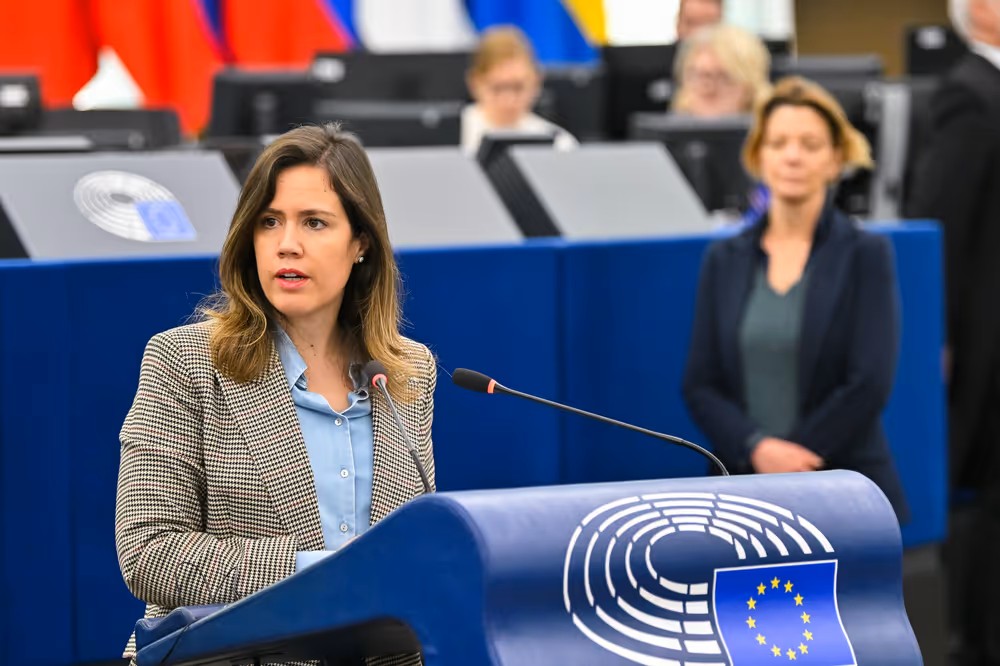
The person advising you where to invest may have no qualifications, no oversight, and an AI-generated face. Nearly half of EU adults cannot cover three months of basic expenses, yet millions are learning to invest from social media creators. MEP Lídia Pereira tells EU Perspectives why Brussels is finally moving to act.
The European Parliament recently backed a new resolution setting out rules for financial influencers across the EU. Pereira, a Portuguese MEP from the European People’s Party, led the work on the report.
The phenomenon of finfluencers has existed for several years. Why is this the right moment for the European Parliament to step in?
The phenomenon is not new, but several trends have converged and made action both urgent and possible. The first is a problem of scale and audience. Recent data show that only around 18% of EU citizens display a high level of financial literacy, and that nearly half of European adults do not have the savings they would need to cover three months of basic expenses. At the same time, social media has become the dominant source of financial information for younger age groups. Generation Z, in particular, learns about investing primarily through online platforms rather than from banks, advisors or schools. When the information environment of millions of new retail investors is shaped by content creators, Parliament cannot remain on the sidelines.
We are no longer talking only about misleading promotions; we are talking about industrial-scale scams that exploit the trust people place in familiar online faces.
— Lídia Pereira, MEP (EPP/PRT)
The second factor is technological. The rapid spread of generative AI, deepfakes and increasingly sophisticated online fraud has changed the nature of the risk. We are no longer talking only about misleading promotions; we are talking about industrial-scale scams that exploit the trust people place in familiar online faces.
The third factor is political and legislative. The Commission presented its Financial Literacy Strategy in September 2025, the Retail Investment Strategy is being finalised, and Savings and Investment Accounts are on the way. The savings and investments union will only deliver if citizens have the knowledge and the protection to participate in capital markets with confidence.
Are existing EU digital rules, such as the Digital Services Act, insufficient to address the risks associated with finfluencers? What are the main gaps?
The Digital Services Act, the Audiovisual Media Services Directive and the Market Abuse Regulation are essential tools, and a large part of the resolution insists on their full and effective enforcement. The problem is not that the rules do not exist. The problem is that they were not designed with finfluencers in mind, and they leave a structural grey zone.
The clearest gap concerns the status of the finfluencer themselves. A licensed financial advisor is subject to strict suitability, conduct and disclosure rules. A finfluencer with hundreds of thousands of followers, who in practice influences investment decisions every day, may fall entirely outside that perimeter, particularly when they are not engaged by an authorised financial institution and do not promote authorised products. They may de facto act as financial advisors without any of the corresponding obligations, and supervisors have very limited tools to reach them.
A second gap is cross-border enforcement. Finfluencer content travels across the single market instantly; supervision does not. A third gap concerns the qualification of certain content under the Market Abuse Regulation: when a creator publicly recommends an investment strategy or comments on the price of a financial instrument, this can amount to an investment recommendation, with all the disclosure duties that follow and very few creators are aware of this.
Finally, there are emerging gaps the existing framework does not yet address adequately: AI-generated financial content, deepfakes of executives and public figures used in scams, and the use of direct messaging and closed groups to push speculative or fraudulent products outside the reach of platform moderation. The DSA gives us the architecture; the resolution asks the Commission to make sure it is used to its full potential and complemented where necessary.
The report calls for greater transparency and risk warnings. How do you balance that with freedom of expression and creativity on social media?
This balance is at the heart of the resolution, and the starting point is very clear: the aim is not to silence anyone or to put creators in a regulatory straitjacket. Social media has democratised access to financial information for an entire generation, including people who would never have set foot in a bank’s investment department. We want to preserve that creativity and that reach. What we do not want is for the lack of rules to be exploited by bad actors who use financial education as a smokescreen for fraud, pyramid schemes or the promotion of unsuitable speculative products.
For these, the answer is enforcement, not dialogue.
— Lídia Pereira, MEP (EPP/PRT)
That is why the report draws a sharp distinction between two very different worlds. On one side, finfluencers who operate transparently, who declare conflicts of interest, who are clear when content is sponsored, who provide genuine educational value. These creators have nothing to fear and a great deal to gain from a clearer framework. On the other side, actors who give unqualified advice, push unauthorised products or operate in clear breach of consumer protection law. For these, the answer is enforcement, not dialogue.
In practical terms, the proportionate path runs through three instruments. First, transparency tools that are minimally intrusive: clear labelling of commercial content, risk warnings on higher-risk products, and disclosure of AI origin where relevant. Second, a voluntary European code of conduct, with a seal for compliant creators, so that the audience can recognise quality content at a glance. Third, training: the resolution asks Member States to offer finfluencers accessible training on legal obligations and the basics of financial education, so that compliance becomes a tool rather than a barrier.
Following the plenary vote, what concrete measures do you expect from the European Commission?
The resolution is detailed precisely so that it translates into concrete follow-up. I would highlight five expectations.
First, the full delivery of the Financial Literacy Strategy presented in September 2025, with a clear monitoring mechanism. The resolution asks the Commission to report by the end of 2027 on the uptake and effectiveness of the strategy including the ambassadors’ network, the code of conduct and the EU-wide communication campaign, and to publish a progress report every three years thereafter, ideally accompanied by a Eurobarometer survey. Without measurement there is no accountability.
Second, the announced EU action plan on online financial fraud, which must complement the enforcement of the Digital Services Act and address AI-generated scams and deepfakes head-on. Citizens cannot defend themselves from threats they do not understand.
Third, the European code of conduct for finfluencers, with a voluntary seal for compliant creators, and a clear framework on transparency, conflicts of interest and the quality of information provided. Together with the Retail Investment Strategy provisions, this would close most of the practical gaps we identified.
Fourth, the operational instruments that make the savings and investments union real for citizens: the rollout of Savings and Investment Accounts in all Member States. Financial literacy without accessible products is theory; accessible products without literacy is a risk. Both must advance together.
Fifth, the searchable EU repository of national initiatives, an annual European Financial Education Day, dedicated work on pension literacy, a Commission report on the role of AI in financial education, and the integration of crypto-assets into financial education content. These are not symbolic: they are the daily infrastructure of a functioning European financial literacy ecosystem.
Financial literacy is a shared responsibility. How can the EU avoid fragmentation, given the significant differences between Member States?
Shared responsibility is a strength, but only if it is coordinated. Fragmentation is a real risk, and the resolution tackles it on three levels.
The first level is common standards. We are calling on the Council to issue a recommendation establishing common principles and minimum standards for financial education. The point is not to impose a single curriculum from Brussels (Member States have different starting points and different needs) but to make sure everyone is working towards comparable outcomes.
The second level is shared infrastructure. The EU repository of financial education initiatives, with a dedicated section on cybersecurity and scam prevention, allows good practice from one Member State to be picked up by another without reinventing the wheel. Participation in the OECD’s PISA financial literacy tests for youth and regular adult surveys, using the OECD/INFE Toolkit, gives us comparable data. Without comparable data, we cannot identify what works and where the gaps are.
The third level is the principle of “common standards, tailored delivery”. The resolution explicitly rejects a one-size-fits-all approach. Initiatives must be community-focused and reflect the specific situation of women, young people, older people, persons with disabilities, people from rural areas and other vulnerable groups. They should also be aligned with key life milestones, like finishing school, buying a home, approaching retirement, because that is when financial decisions actually happen.
In short, fragmentation is avoided not by central uniformity but by shared outcomes, common measurement and active mutual learning. That is how the savings and investments union becomes a project that delivers for citizens in every Member State, not only those who are already well served.