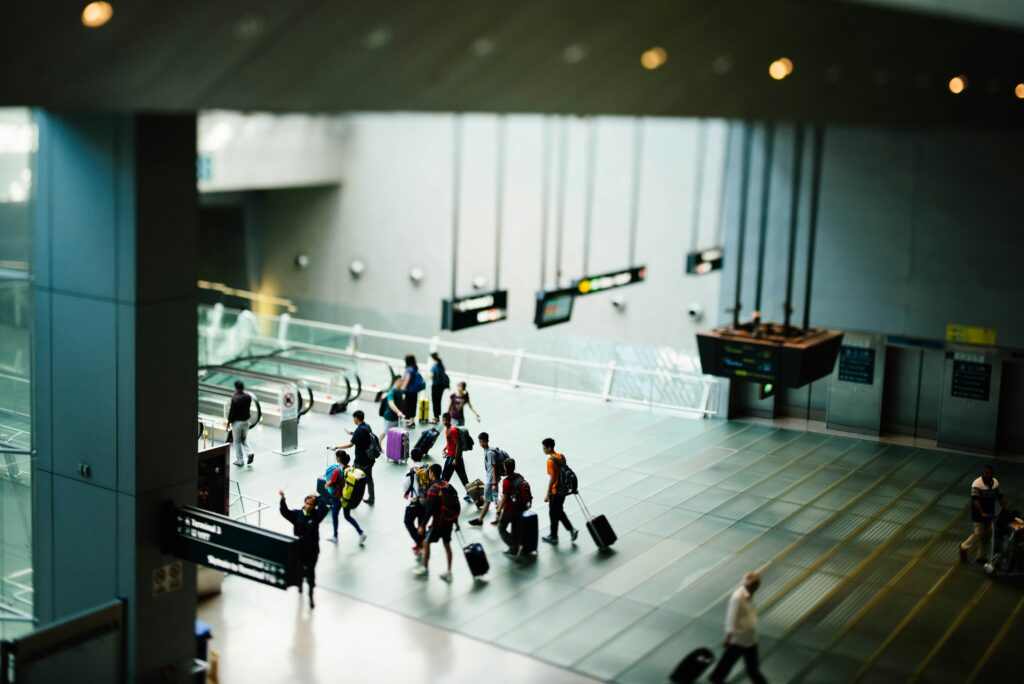
Three aviation associations warned Brussels on Wednesday: queues at the EU’s new border checks have reached breaking point. European airports expect roughly 40m more passengers in July and August than in the two months before. For millions of travellers, that could mean the difference between catching a flight and watching it leave without them.
The Entry/Exit System (EES) became fully operational on 10 April, replacing manual passport stamps with fingerprint and facial-scan registration for non-EU nationals entering the Schengen area. The extra step adds only a few minutes per traveller, but multiplied across millions of passengers, it has produced queues of up to seven hours at some of Europe’s busiest airports since the rollout began.
Adam Hoijard found that out the hard way. He arrived at Milan’s Linate airport three hours early for his flight to Manchester this spring. He still got stuck in a queue for hours. He and his family missed the flight and spent £1,000 booking a replacement to London Gatwick two days later. Officials blamed him for not arriving early enough, which he called “atrocious.” “How much time can you leave to wait in a queue?” he asked the BBC afterwards.
A summer deadline looms
The EU always knew EES might cause turbulence. Border authorities can suspend biometric checks at busy crossing points to ease the pressure. That flexibility runs out at the beginning of September, right in the middle of peak summer travel. After that, no more pausing, whatever the queues look like.
The consequences are already visible. Passengers have queued for extended periods outside terminal buildings. Planes have departed with empty seats because travellers were still stuck at passport control, according to airport and airline groups. The problem does not stop at Europe’s biggest hubs, either: smaller airports serving popular holiday destinations are struggling just as much.
The European Commission has so far stood by the rollout. A spokesperson told the Financial Times on 25 June that the system was “fully operational and working well.” The spokesperson blamed long queues on airlines concentrating flights in the same arrival slots, not on any flaw in EES. The aviation industry disagrees: airlines set flight schedules a year in advance, it points out, so peak periods should come as no surprise.
At Wednesday’s midday briefing, a journalist pressed Commission spokesperson Markus Lammert on the industry’s concerns. “The purpose of this system is to improve the security of EU citizens, while keeping traveling smooth for legitimate travelers,” he said. He added that the Commission continues to work with national authorities and the aviation sector as the peak season approaches.
What it means for your holiday
For most people, the worst is over after the first crossing. Fingerprints and a facial image, once on file, cover later entries within the data-retention period. Those trips need only a quick facial check, not a full re-enrolment. First-time visitors, in particular, should build in extra time this summer.
The stakes go beyond a missed connection. The World Travel and Tourism Council surveyed more than 2,500 travellers from Britain, the United States, Canada and Australia. Around a third said they would be much less likely to visit the Schengen area, or would avoid it altogether, if three-hour queues became routine. British respondents felt this most strongly.
Today we have reached a critical point. — Ourania Georgoutsakou, Olivier Jankovec and Thomas Reynaert, heads of A4E, ACI EUROPE and IATA
That is exactly the message the three association heads sent to Brussels. “Today we have reached a critical point,” they wrote in Wednesday’s letter. They pointed to waiting times of up to five hours at some airports. Families with young children, elderly passengers and people with reduced mobility bear the brunt, they warned. They want Brussels to let border posts suspend EES entirely throughout July and August, and to make that flexibility permanent for future peak seasons, before, as they put it, the situation deteriorates further.