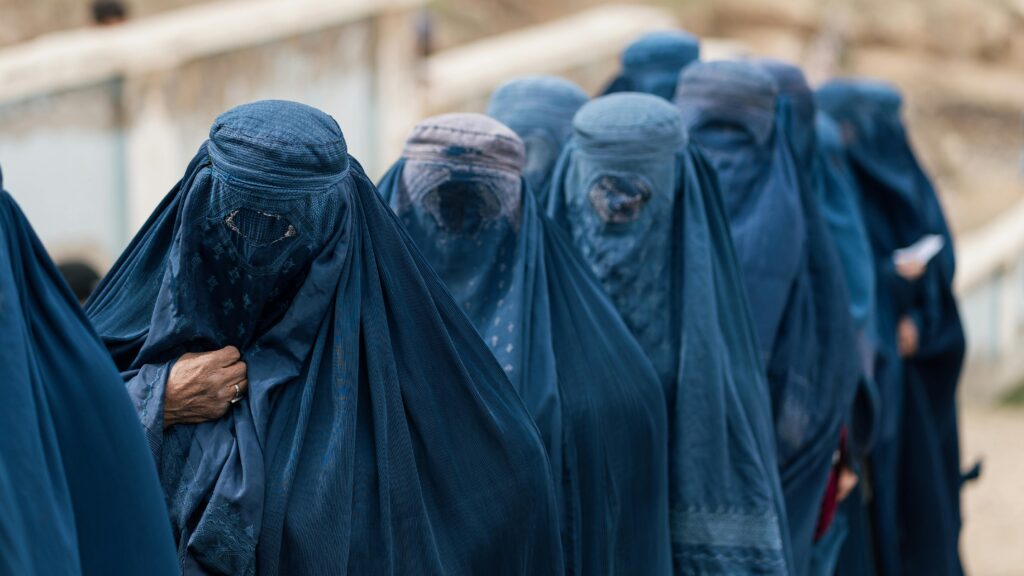
The Taliban continues to tighten its grip on Afghanistan, while the EU prepares for talks with its representatives in Brussels, focused largely on migration and returns. “Europe risks trading its own human rights principles for migration containment deals,“ warns Ahmad Wali Ahmad-Yar of an Afghan diaspora organisation in an interview with EU Perspectives.
Nearly five years after the Taliban’s return to power, Afghanistan remains trapped in a deepening crisis, both humanitarian and political. Inside the country, a collapsing economy and widespread poverty are compounded by systematic repression, especially of women and girls, under a regime increasingly described as enforcing “gender apartheid”.
Beyond its borders, Afghans in Europe face a different struggle: navigating uncertain asylum systems, tightening migration policies, and growing political pressure to treat return as an option despite ongoing risks.
In an exclusive interview to EU Perspectives, the Secretary General at Network of Afghanistan Diaspora Organisations in Europe (NADOE) Ahmad Wali Ahmad-Yar warned about the upcoming meeting—set in June in Brussels—arranged by the EU with the Taliban.
What is the reality of life in Afghanistan today under Taliban rule?
The country is not simply experiencing poverty or instability. It is being governed through exclusion, coercion and fear. Humanitarian needs remain extremely high. Millions of people are struggling with poverty, food insecurity, unemployment, declining international aid and the consequences of mass returns from neighbouring countries.
The Taliban have built a closed and repressive system with no meaningful political participation, no inclusive government, no independent justice system and almost no space for dissent. For ordinary people, daily life is marked by economic survival, shrinking freedoms and constant uncertainty.
For women and girls, the situation is even more extreme. Their exclusion from education, employment and public life has transformed gender discrimination into a system of governance.
Afghanistan today is therefore a country where humanitarian collapse and authoritarian rule reinforce one another. People are deprived not only of income and services, but also of rights, voice, dignity and meaningful control over their future.
Several European countries are discussing or implementing returns to Afghanistan. Do you see Afghanistan as a safe place for people being sent back?
No, Afghanistan is not currently a safe country for returns. This should be stated clearly. Under Taliban rule, people do not return to a normal state with functioning rights, legal protections and accountable institutions. They return to a context marked by political repression, gender apartheid, arbitrary punishment, economic collapse and widespread fear.
At the same time, an important distinction needs to be made. Afghanistan may indeed feel “safe” for individuals who actively support, collaborate with or ideologically align themselves with the Taliban system. Unfortunately, in many European debates, this distinction is often ignored.
The question of safety also cannot be reduced only to the absence of active battlefield fighting. Safety means the ability to live without fear of persecution, collective punishment, forced disappearance, ideological policing or structural exclusion. Those conditions do not exist in Afghanistan today.
In practice, it is frequently ordinary civilians, dissidents, minorities, women, journalists, former civil servants, artists and politically vulnerable individuals who face legal insecurity, rejection of asylum claims and threats of deportation. While Taliban sympathisers or individuals connected to extremist networks are not always prioritised in public discussions around returns.
Many people from Afghanistan in Europe fled precisely because they opposed Taliban ideology, feared persecution, or belonged to communities systematically targeted under Taliban rule. These include ethnic and religious minorities, women activists, human rights defenders, former members of the security forces, academics, journalists and people associated with international organisations or democratic institutions.
The question of safety also cannot be reduced only to the absence of active battlefield fighting. Safety means the ability to live without fear of persecution, collective punishment, forced disappearance, ideological policing or structural exclusion. Those conditions do not exist in Afghanistan today.
When — if — refugees have to return, what could be the consequences?
For women and girls in particular, return can mean being forced back into a system of institutionalised gender oppression where education, employment, movement and even basic autonomy are heavily restricted. For many minorities and critics of the regime, return can mean intimidation, retaliation or social exclusion.
It is also important to recognise that many people from Afghanistan now in Europe were themselves born or raised in Iran or Pakistan after earlier waves of displacement. Some have never meaningfully lived under the current Taliban state structure and may have no support networks or protection mechanisms inside Afghanistan at all.
From within many diaspora communities, there is also growing frustration that European migration debates often criminalise or suspect the victims of Taliban rule while failing to seriously confront Taliban propaganda, extremist sympathies or intimidation networks operating abroad.
Many community members would have no objection to the removal of individuals who actively support violent extremism or Taliban repression. What they oppose is the growing tendency to deny protection to vulnerable civilians while normalising engagement with one of the world’s most repressive regimes.
For these reasons, forced returns to Afghanistan should not be normalised. European states should uphold protection obligations consistently and distinguish far more carefully between those fleeing persecution and those who actively support systems of repression.
The European Commission is preparing for talks with Taliban representatives. What message does that send?
This development is extremely significant, and frankly, deeply worrying. What we are witnessing is not simply a ‘technical discussion’ about migration management. It is part of a broader process of gradually normalising one of the world’s most repressive regimes in exchange for short term migration control objectives.
Even if the EU insists this does not constitute formal diplomatic recognition, it still contributes to something perhaps more dangerous: gradual normalisation. Europe risks trading its own human rights principles for migration containment deals. That is a very dangerous precedent.
There is also a profound contradiction here. On the one hand, European governments publicly condemn Taliban brutality, women’s oppression and extremist governance. On the other hand, they increasingly discuss cooperation with the very authorities responsible for these abuses. For many people from Afghanistan, especially refugees who fled Taliban persecution, this feels like a betrayal of the principles Europe claims to defend.
Beyond the moral issue, there is also a strategic one. Multiple international reports have warned about ongoing links between Taliban structures and extremist networks. Normalising engagement without accountability risks undermining long term counter terrorism, human rights and regional stability.
But the Commission claims this does not mean a diplomatic recognition.
The Taliban are not an ordinary government. So when European institutions invite Taliban representatives to Brussels, issue visas, or intensify official contacts, this carries enormous symbolic and political weight. Even if the EU insists this does not constitute formal diplomatic recognition, it still contributes to something perhaps more dangerous: gradual normalisation. Europe risks trading its own human rights principles for migration containment deals. That is a very dangerous precedent.
Of course, humanitarian communication channels may sometimes be necessary in order to deliver aid or address urgent operational matters. But there is a major difference between limited humanitarian contact and political normalisation.
Europe should be extremely careful not to cross that line. Because once a regime built on repression, gender apartheid and ideological violence becomes treated as a normal partner, the damage is not only done to the people of Afghanistan. It is also done to Europe’s own credibility, legal commitments and moral foundations.
Can the EU realistically engage with the Taliban while still defending human rights principles, especially women’s rights?
No, not in any meaningful or credible sense. The problem is not simply whether the EU can maintain diplomatic contacts while verbally continuing to support human rights. The real issue is that sustained political engagement with the Taliban inevitably contributes to legitimising and normalising a regime whose governing model is fundamentally built on the systematic violation of those very rights.
The Taliban’s repression of women and girls is not accidental, temporary or misunderstood. It is central to their ideological project. You cannot simultaneously describe a regime as responsible for systematic gender persecution while treating it as a legitimate operational partner for political bargaining.
If the EU genuinely wants to defend women’s rights and human rights in Afghanistan, then accountability, protection, support for civil society, protection pathways for refugees, and international legal pressure are far more coherent tools than legitimising engagement with a regime built on repression.
Do you think Europe is seeking the right balance between controlling migration and protecting people fleeing Afghanistan?
The current European debate increasingly shows a tension, and in some cases a direct contradiction,
between migration control policies and international protection obligations. On paper, many European governments openly acknowledge the severity of the situation in Afghanistan. They condemn Taliban repression, speak about women’s rights, recognise the humanitarian crisis, and publicly express concern about extremism and instability.
However, in practice, the political atmosphere in Europe has increasingly shifted toward deterrence, restriction and border management. As a result, people fleeing Taliban rule are often treated less as individuals in need of protection and more as part of a broader migration control problem.
Europe risks undermining its own credibility when it simultaneously recognises the Taliban as deeply repressive while normalising returns or restricting protection for those fleeing that repression.
This has led to stricter asylum procedures, growing scepticism toward applicants, increasing use of temporary or precarious statuses, and renewed discussions around deportations or ‘safe return’ frameworks that ignore realities on the ground. This contradiction becomes especially visible in the treatment of women and vulnerable groups.
If a regime is acknowledged as authoritarian, exclusionary and dangerous, then asylum and protection systems should logically reflect that reality consistently.
Ultimately, the debate should not be framed as a simplistic choice between ‘open borders’ and ‘migration control’. States have the right to manage migration, but they also have legal and moral obligations toward people fleeing persecution and systematic human rights abuses. The problem today is that protection principles are increasingly being subordinated to short term political pressures around migration management.
What categories of people from Afghanistan are currently most at risk if returned?
A wide range of people are currently at risk if returned to Afghanistan. The danger is not limited only to high profile political figures or activists. Under Taliban rule, risk often emerges from a combination of identity, background, beliefs, lifestyle, gender, ethnicity or simply refusing to conform to the Taliban’s ideological system.
Women and girls are among the most vulnerable groups. Also ethnic and religious minorities. Many non Pashtun communities, including Hazaras and certain others, have experienced discrimination, persecution, forced displacement, exclusion and targeted violence both historically and under current Taliban structures.
Former government employees, members of the security forces, judges, prosecutors, journalists, civil society actors, human rights defenders and people who collaborated with Western governments, international organisations or foreign institutions are also at risk because they may be viewed as politically suspect or ideologically hostile by Taliban authorities.
LGBTQI+ individuals face extreme danger. Taliban ideology leaves virtually no room for sexual or gender diversity, and social protection mechanisms are almost nonexistent.
At the same time, risk should not be understood only through formal political categories. Many ordinary people are vulnerable because they don’t want to live under strict Taliban interpretations of Islam and social control.
Another overlooked issue is that many people from Afghanistan returning from Europe, Iran or Pakistan may be perceived with suspicion. Simply because they spent years abroad, adopted different lifestyles, worked with international actors or are viewed as culturally ‘Westernised’. Returnees can therefore face surveillance, intimidation, social stigma or pressure to conform.
So the risk landscape in Afghanistan today is very broad. It is not only about direct political opposition. But about whether a person fits within an increasingly narrow ideological, ethnic, religious and social order imposed by the Taliban.
What do you think many people in Europe still misunderstand about Afghanistan today?
One of the most misunderstood aspects of the Afghanistan debate in Europe is the tendency to reduce the situation to simplistic categories such as ‘war’ versus ‘stability’ or ‘security’ versus ‘chaos’. What many outside observers fail to understand is that most people in Afghanistan, especially the younger generations, have almost never experienced a situation where peace, liberty and security existed together at the same time.
Usually, one existed at the expense of the others. There were periods with relatively more freedom and openness, but accompanied by war, corruption, bombings and insecurity. And now, under the Taliban, there is a form of imposed and heavily controlled ‘security’, but without liberty, political rights, gender equality or genuine freedom.
Many people therefore compare today not to an ideal democratic society, but to the violence and instability they previously experienced. That creates a very dangerous illusion. This is something many Western policymakers also misunderstand.
Some have started interpreting the Taliban’s consolidation of power as a form of ‘stabilisation’, simply because large scale urban attacks or front line warfare have decreased in some areas. But authoritarian control and fear should not automatically be confused with genuine peace or societal stability.
Another overlooked issue is that Afghanistan is not socially or politically homogeneous. Experiences of Taliban rule differ dramatically depending on ethnicity, gender, religion, geography, class and political background.
Many minorities and vulnerable communities experience Taliban rule not as ‘order’, but as exclusion, domination and fear. These nuances are often lost in European discussions that treat Afghanistan as a single unified reality.
The danger today is that the international community may slowly begin normalising authoritarian repression simply because it appears more predictable than open conflict. But a society built on fear, exclusion and silencing is not genuinely stable. It is only temporarily controlled.