Moscow calls her a foreign agent. Thousands of Russians fleeing Vladimir Putin’s war call her a beacon.
EU Perspectives spoke to Anastasia Burakova, a human rights lawyer and founder of The Ark, the largest support network for Russian citizens opposing the invasion of Ukraine. In 2025, a Russian court sentenced Ms Burakova in absentia to 7.5 years in prison over a speech she gave at an anti-war rally in Tbilisi.
She spoke about a double crackdown. On one side stands the Kremlin, crushing any form of dissent. On the other stand European states, which she says risk making a strategic mistake: lumping together Vladimir Putin’s regime and the hundreds of thousands of Russians who defied it, often at very high personal cost, as a single bloc.
What are the main challenges currently faced by anti-war Russian citizens seeking protection or a new life in the EU?
The Kremlin keeps inventing new methods of pressure against those who oppose the war, who help Ukraine, who help victims of repression, who push back against propaganda. The criminal code now contains a huge number of articles applied for political reasons: civic activism, opposition politics, critical comments on social media, anti-war posts, journalism.
I and The Ark project, for example, have been declared “foreign agents,” with the official justification that we “speak out against the special military operation” — the term the authorities use for the war in Ukraine. For speaking at an anti-war rally on the anniversary of the war and publishing the speech, I was sentenced to 7.5 years under the wartime censorship article on “fakes” about the Russian army. What the Court treated as a “fake” was the statement that Russia bombs Ukrainian cities and kills civilians, because the official position of the Ministry of Defence is that Russia “only strikes military targets”. I was also sentenced to a further year under the foreign agent article for not attaching the degrading huge disclaimer to every publication, comment and message I post on social media.
Many people face persecution in different forms. Not everyone has the opportunity or the grounds to leave for the safest EU countries, which is why most of the new wave of emigration live in countries outside the European borders: in the South Caucasus, Central Asia, the Balkans. Some of these countries have direct interstate agreements with Russia on search and extradition. In others, anti-war activists are pressured through administrative barriers; in some, there have been cases of outright abduction, where people persecuted by Russia for political reasons were taken back to Russia bypassing any formal extradition procedure.
European migration policy is currently changing in general – not only towards Russians, but this affects our human rights work too. Humanitarian visa programmes are closing: in practice, an ordinary activist who has just come under prosecution can now apply for such a visa essentially in France only. Asylum is a last resort. And with the entry into force of the EU’s new Pact on Migration and Asylum in June 2026 – where applications can be processed in an accelerated procedure at the border without admitting the person into the country – we are seriously concerned for applicants who have every ground under the Geneva Convention on the Status of Refugees.
Which is the main political problem Russians face in the EU?
There’s no strategy on Russia. Many decisions are not thought through in detail. Once adopted they generate a long list of implementation problems. Together with the German Marshall Fund we studied the new Russian anti-war diaspora that emerged after 2022. These are educated people with democratic views who want and try to integrate, who work, and who rarely rely on state support. This wave of emigration is very different from the older Russian-speaking migration.
Since 2022 Russian consulates have systematically denied passport renewals to people facing politically motivated cases.
— Anastasia Burakova, human rights lawyer, founder of The Ark
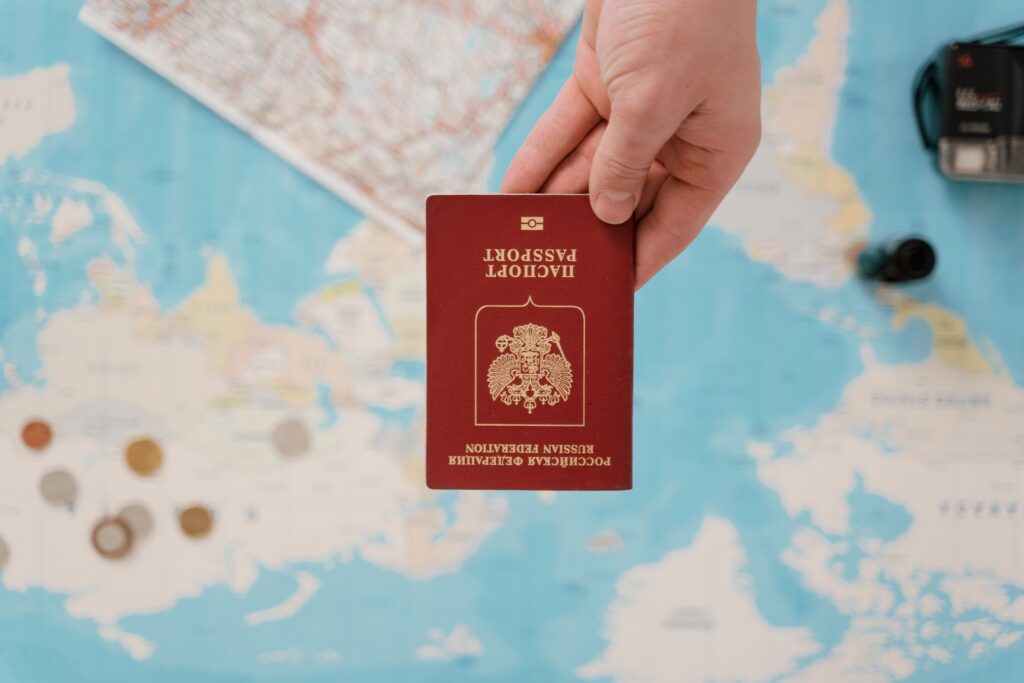
The specific political problem we are currently working on is that the Kremlin has discovered a powerful tool of transnational repression that requires no physical presence in Europe: simply refusing to issue documents to its own citizens abroad. Since 2022 Russian consulates have systematically denied passport renewals to people facing politically motivated cases. In January 2023 the Russian Supreme Court confirmed that the mere status of “suspect” or “accused” is enough. More than 311,000 Russians received first EU residence permits between 2022 and 2024, and many of their passports are now expiring.
How do you assess current EU policies toward Russian citizens?
The Kremlin is expanding repression. The UN Special Rapporteur on the situation of human rights in Russia, Mariana Katzarova, describes a structural, state-sponsored system of human rights violations legalised through new legislation and used to silence civil society, dissent and anti-war expression. According to OVD-Info’s most recent overview, repression is shifting into the “grey zone”: treason, espionage and terrorism charges are now widely used against ordinary critics. The list of “undesirable” and “extremist” organisations grows constantly. And prosecutions for “failure to fulfil the duties of a foreign agent” have multiplied.
The regime passes new laws and stretches the existing ones. Peaceful political organisations, youth movements, the Russian Anti-War Committee, the LGBT “movement” as a whole, and even businesses like Meta – services people in the West use every day, are being designated “extremist.” Critical comments on social media become grounds for “justification of terrorism” cases. Participation in grassroots anti-war initiatives is prosecuted.
Against this backdrop, a parallel process is unfolding in the EU which is not only about Russia but defines most member states’ migration policy as a whole. On the one hand, countries are expanding pathways for general migration of professionals and digital nomads. On the other, they are closing the humanitarian admission programmes that, until recently, allowed us to bring out of the Kremlin’s reach a large number of journalists, human rights defenders and independent municipal deputies, people who openly oppose the war and Putin’s regime.
We understand the internal dynamics in EU countries: the pressure of asylum applications, the rise of right-wing sentiment, the growing popularity of populist parties. We take these processes into account and look for alternative pathways to protect people accordingly.
Do you receive reports of discrimination or exclusion for Russian citizens living in the EU regarding their nationality, even when they have publicly opposed the war?
What we see most often is not interpersonal hostility but a layer of administrative exclusion that is, frankly, much harder for people to challenge. Banking is one of the sharpest examples. After the EU added Russia to its list of high-risk jurisdictions for money laundering at the start of 2026, banks began screening Russian clients much more aggressively. Revolut went further than most: in November 2025 it started blocking accounts of Russian clients who did not hold a residence permit in the EU, EEA or Switzerland. And from 2026 it began retroactively reviewing transactions made over the previous months and demanding new proof of the origin of funds, even on payments already approved. If the client cannot produce a satisfactory answer, the funds are treated as Russia-linked. The account is closed.
Individual member states also introduce sector-specific restrictions of their own. In the Czech Republic, Russian citizens have been barred from a long list of technical specialties. Students already enrolled have been pushed to switch fields. In Lithuania, Finland, Russian and Belarusian citizens are now restricted from buying real estate.
The Kremlin benefits from every European measure that treats nationality as a political category.
— Anastasia Burakova, human rights lawyer, founder of The Ark
There is also a more direct form of exclusion in public discourse, when the line between the Russian state and Russian citizens who oppose it is collapsed. The Kremlin benefits from every European measure that treats nationality as a political category. It can then tell its own citizens, including those still inside Russia, that the West rejects them regardless of their views, and this is one of effective recruitment arguments the regime has. It is a basic question of fairness towards people who, often at significant personal risk, have publicly chosen the right side.