A court ruling, an expiring tax break, and a far-right presidential frontrunner are making bankers in the French capital nervous.
The Sir Winston Churchill pub, a short walk from the Champs-Élysées (and Goldman Sachs’s Paris office), fills up most evenings with French and international bankers. The bar staff mention, almost in passing, that there is a private room available for events — farewell parties, for instance. The joke lands differently these days.
A ruling on 7 July that Marine Le Pen, far-right leader and longtime critic of global finance, may stand in France’s 2027 presidential election has sharpened an anxiety that was already building. Generous French tax breaks, which lured hundreds of bankers from London after the Brexit vote, are set to expire. Politics, many now say, has made the calculus harder still.
The Brexit dividend, unwinding
“The potential rise to power of a political figure from an extremist party risks significantly increasing the prevailing tension in the country,” Robert Zarader, president of Bona Fide, a communications agency for businesses and executives, told Bloomberg this week. “This could influence their decision on whether to stay in Paris or not, especially if their tax benefits were set to expire anyway.”
Between 2017 and 31 March 2026, the financial and insurance industry added around 35,000 roles in the Paris region, according to the French National Institute of Statistics and Economic Studies. Bank of America went from 70 staff in Paris to more than 750. JPMorgan Chase now employs around 1,000 people there, up from 250 just before Brexit. Morgan Stanley, Goldman Sachs, and Citigroup have roughly tripled their workforces.
The engine behind much of that growth was France’s “impatriation” regime, under which workers relocating to France received breaks that reduced their taxable income by up to 50 per cent for eight years. President Emmanuel Macron, a former Rothschild investment banker, expanded the scheme in 2017. It worked. Paris established itself, credibly, at the heart of European finance.
Now the scheme is expiring, and efforts to extend it have quietly failed. The financial community held discussions for months with the French administration, according to people familiar with the matter, but without success. There were fears that drawing attention to the issue could see it dropped entirely in the current political climate.
Beyond the numbers
“Some banks are asking us to run calculations to assess the loss of net income for employees when their ‘impatriation’ regime expires and determine whether or not they could make up for it,” said Stephanie Chartier, a partner at KPMG Lawyers. Most banks have concluded that the cost of compensation would be too high, she said.
The expiry could also trigger job movements for a structural reason: the tax advantages are not transferable between employers. Once they lapse, bankers are no longer bound by deals tied to them. One trader at a large US bank says he is in ongoing discussions with his manager about whether to move to Dubai or Milan. An equity trader at a French bank says he has until 2028 before his new tax rate kicks in. Like many others, he is weighing a return to London.
Around a dozen bankers told Bloomberg that politics is now a critical factor in what comes next, alongside the tax question. They knew the scheme would expire, they said. The momentum of the far right and the far left before the 2027 vote is now also in the mix.
What happens to finance
“The ‘impatriate’ tax regime was part of measures clearly identified with Macron’s efforts to make France more attractive,” said Gilles Ivaldi, who researches far-right socio-economics and teaches at Sciences Po in Paris. “Le Pen has strong anti-capitalist views. She sees global finance as a bête noire.”
Ms Le Pen’s National Rally party has yet to publish its manifesto for the 2027 election. But her record offers a clear enough signal. She has previously pushed for higher taxes on the wealthy and attacked aspects of global finance. Her economic programme includes lowering the retirement age to 62, cutting VAT and energy taxes, ending income tax for the under-30s, and applying a “nationality preference” in welfare spending. She also proposes immediate cuts in France’s EU budget contribution.
The potential rise to power of a political figure from an extremist party risks significantly increasing the prevailing tension in the country. — Robert Zarader, Bona Fide
Bond spreads widened in previous elections when her party polled strongly. A real victory could revive debt-sustainability fears in the €3.5tn French economy. Heads of American banks in Paris viewed her protégé Jordan Bardella as more business-friendly. That is a sign that the financial community is already stress-testing different outcomes.
The EU dimension
The stakes extend well beyond Paris. If Ms Le Pen wins in 2027, the EU would face a founding member openly challenging its legal and fiscal architecture. Her manifesto calls for national law to take precedence over EU and international law. She has dropped the idea of an immediate euro exit but still brands the single currency “a brake on sovereignty” and wants to renegotiate fiscal surveillance.
As any other member country, France holds a veto in areas requiring unanimity. Unilateral cuts to France’s EU budget contribution could blow a hole of roughly €7bn a year in the next financial framework. This would paralyse programmes, unless offset by higher contributions from Germany, Italy, or fresh EU borrowing.
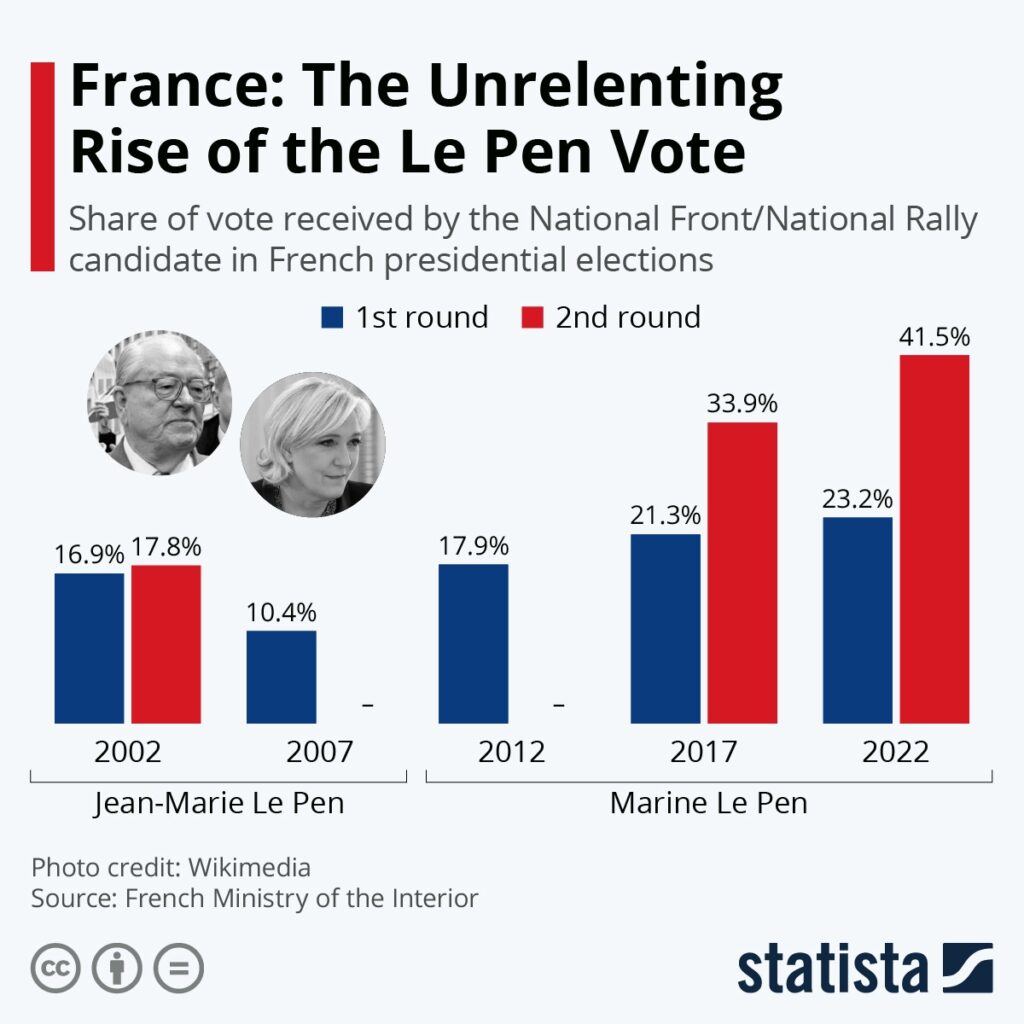
A Le Pen Élysée would also align with hard-right governments in Vienna, Budapest, and The Hague, making blocking minorities in the Council easier to assemble and pro-integration majorities harder.
Guardrails, and their limits
Far-right parties already hold about a quarter of European Parliament seats after the 2024 elections. A French far-right presidency would normalise their role in core EU decision-making and shift the agenda further still (particularly on migration, climate, and the rule of law) even in centrist parties.
“International banks are currently looking into this issue,” said Olivier Vigna, chief executive of Paris Europlace, a French financial services association. “There is an urgency for Paris’s appeal to remain, the risk being that other capitals in Europe, as well as in the Middle East, may indirectly benefit from the upcoming expiry of France’s ‘impatriation’ programme by attracting some of the affected employees.”
Le Pen has strong anti-capitalist views. She sees global finance as a bête noire. — Gilles Ivaldi, Sciences Po
Some mitigating factors exist. The French Constitutional Council and the Council of State could strike down the most legally exposed measures, though Ms Le Pen has proposed altering the constitution to sidestep them. Without an absolute National Assembly majority, a President Le Pen would need coalition partners, which could force moderation. Market pressure and business lobbying, already in lively contact with National Rally leaders, could soften euro-hostile moves.
The end of integration
None of that is reassuring enough for everyone. A Le Pen presidency would not immediately disintegrate the EU. It would, however, mark the end of the Union’s post-1992 integrationist momentum. For the bankers who bet on Paris after Brexit, it would close a chapter that once looked like it had only just begun.
Recruitment firms say they have already seen bankers and traders leaving Paris for London, Milan, Luxembourg, and Dubai. For many, with children in school and professional networks built over years, uprooting is hard. But the calculation is shifting. At the Sir Winston Churchill, the private room for farewell parties is ready.