Anti-corruption watchdogs with real powers, an independent judiciary, clean public procurement: Hungary has until 31 August to make such reforms or lose €10.4bn in EU funds.
Three European Commissioners laid out to members of the European Parliament on Tuesday the mechanics by which Hungary can recover €16.4bn of the €18bn in frozen EU funds.
Appearing before a joint session of the Parliament’s Budgets and Budgetary Control committees, Executive Vice-President Raffaele Fitto and Commissioners Piotr Serafin and Michael McGrath insisted the conditions for unfreezing have not changed, but “What has changed,” Mr Serafin said, “is the willingness of the Hungarian government to address those issues and demonstrate that it remedied the situation that led to the adoption of measures.”
The money on the table
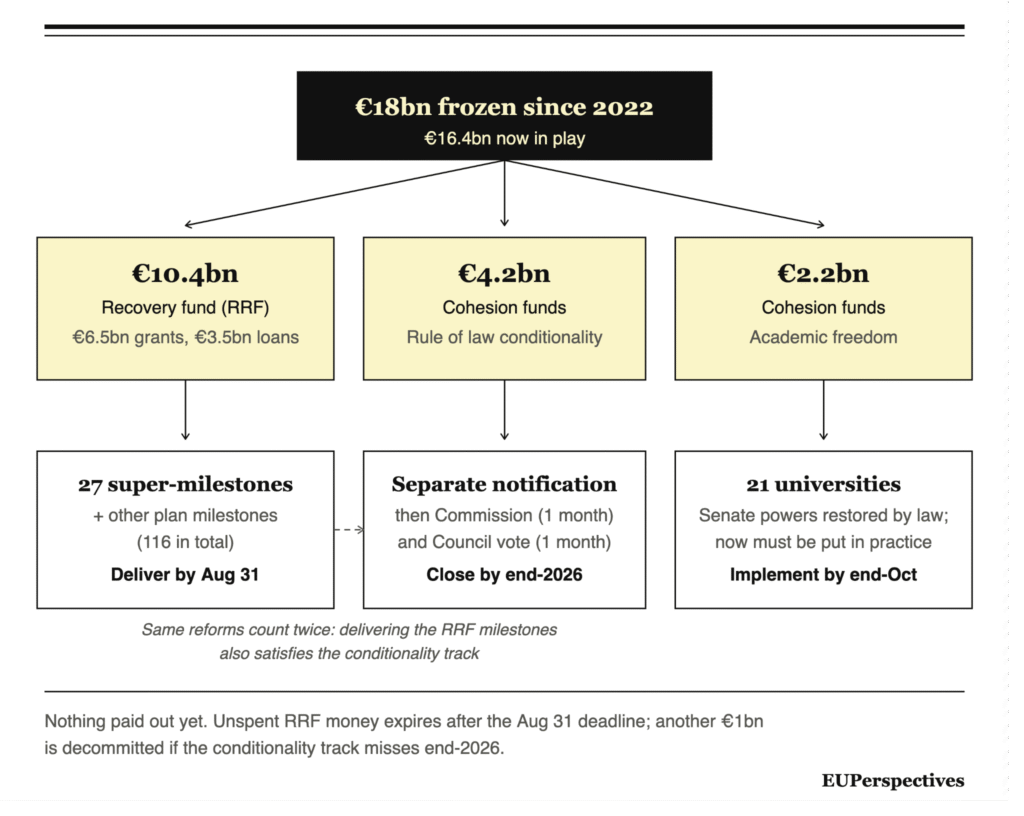
The looming date of implementation is 31 August. By then Prime Minister Péter Magyar’s government must deliver the 27 super-milestones that unlock the largest tranche. Otherwise, Hungary would forfeit the €10.4bn in recovery funds entirely.
The 27 super-milestones are a to-do list of reforms Hungary agreed to in 2022. This includes setting up anti-corruption watchdogs, ensuring judiciary independence, and cleaning up the process of awarding public contracts.
The €10.4bn under the Recovery and Resilience Facility (RRF)—€6.5bn in grants and €3.5bn in loans—required a rewritten recovery plan. The original 2022 version concerns projects that can no longer meet the fund’s hard end-of-year deadlines.
EU finance ministers approved the new plan on 10 July, clearing the last legal hurdle. What remains is delivery: the 27 super-milestones.
The rule-of-law hurdle
A further €4.2bn in cohesion funding sits behind the Rule of Law Conditionality Regulation, the mechanism triggered against Hungary in December 2022 over corruption concerns. The final €2.2bn is suspended under the horizontal enabling condition on academic freedom, tied to the fate of the 21 universities transferred to public interest trusts under then-PM Viktor Orbán.
“All other member states have also revised their plans, so there is no special treatment for Hungary,” Mr Fitto told MEPs. “The Commission will assess the fulfillment of the super milestones and will proceed with the payment” once Budapest fulfils all of them, he added.
The revised plan is markedly slimmer than its 2022 predecessor. Restructured around 116 milestones, it can feasibly be delivered before the August deadline.
In its assessment, the Commission rated the plan “A” on 12 of 13 criteria. This is a formal rebuttal to suggestions the slimmed-down plan lost substance, marking it down only on the robustness of its cost estimates.
Fidesz’s concerns
Fidesz MEPs however used the parliamentary meeting to raise their own concerns. Delegation leader MEP Tamás Deutsch (PfE/HUN) attacked the 17th amendment to Hungary’s Fundamental Law, adopted by the Hungarian parliament the day before the hearing. It would remove the sitting President and restructure the Constitutional Court’s leadership.
MEP Csaba Dömötör (PfE/HUN) zeroed in on its retroactive 12-year term limit for MPs. This would bar Viktor Orbán from standing again.
The Commission is ready to work together with the Hungarian government to make sure that this decommitment by the end of the year is not going to take place. — EU Budget Commissioner Piotr Serafin
Commissioner McGrath declined to assess the package: the amendment enters into force only after promulgation, he said, and “the Commission will continue to monitor developments on an ongoing basis.” The chairs referred the constitutional questions to written procedure.
Beware of decommitment
Hungary must deliver all super-milestones by 31 August and submit its payment request by 30 September, with the Commission assessing fulfillment before any disbursement. RRF payments must be made by 31 December.
Hungary must also submit a distinct notification with evidence that the 2022 concerns have been remedied. The Commission and the Council will then have one month apiece to assess it and decide by qualified majority, respectively.
And if the procedure is not closed by the end of 2026, Commissioner Serafin warned, another €1bn could be decommitted. “The Commission is ready to work together with the Hungarian government to make sure that this decommitment by the end of the year is not going to take place,” he said.
The academic freedom track has its own deadline: the 21 universities have until the end of October to implement the Public Interest Trust reform passed on 23 June. Afterwards, the Commission can formally assess the condition and release the remaining €2.2bn.