The Dutch defence ministry has signed a €30m strategic partnership with Intelic, a domestic tech scaleup. Both the company and The Hague call it the first deal of its kind in the world.
The conventional approach to military procurement runs roughly as follows: buy the hardware, then figure out how to make it work together. The Dutch defence ministry has decided to reverse that sequence entirely.
On 3 July, it signed a three-year strategic partnership worth over €30m with Amsterdam-based defence-technology company Intelic. It makes the Netherlands the first country in the world to formally invest in what both parties call a “software-first” approach to military interoperability.
The contract tasks Intelic with building the software architecture needed to connect the Dutch armed forces’ unmanned aerial and ground systems into a single operational ecosystem. At its core sits NEXUS, Intelic’s command-and-control platform, which allows unmanned systems from different manufacturers to operate together within a single mission environment.
Forged in wartime
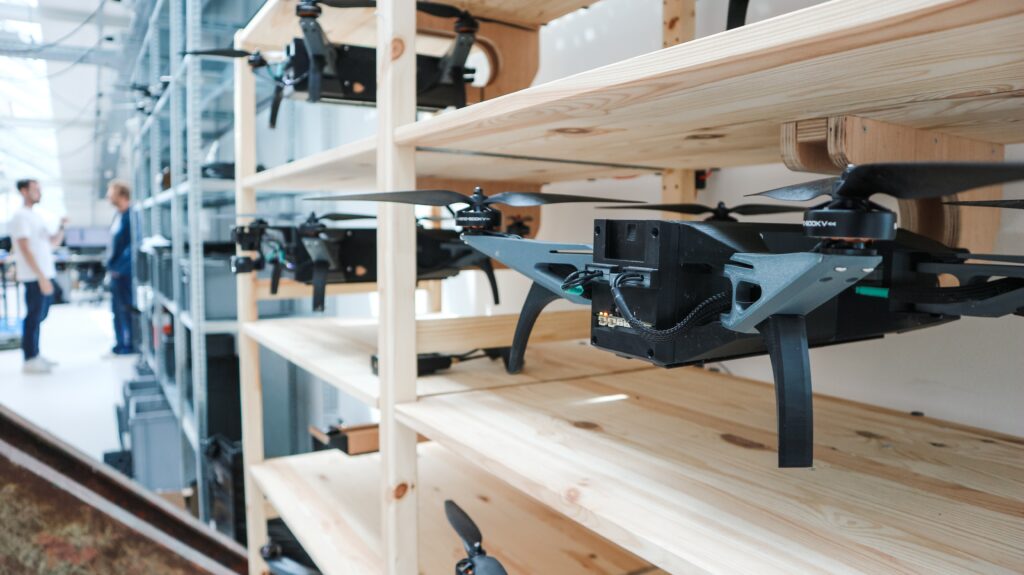
The Dutch military currently fields more than 20 drone types across its army, navy, and special forces. A common software layer eliminates the proprietary ground stations and manual workarounds that currently slow deployment and complicate training.
Derk Boswijk, Minister for Arms Procurement and Personnel of the Netherlands, was direct about the lessons driving the decision. “Ukraine teaches us that not only the hardware, but also the software is of great importance,” he said. “Making different drone systems work together makes the fight easier. I am proud that a Dutch company can now meet this demand. We are entering into a partnership together, leaving the classic customer–supplier relationship behind us and committing to each other for a longer period of time.”
Intelic is a young company by any measure. Founded in 2021 under the name Avalor AI, it raised a seed round of roughly €2.1m in 2024, led by Keen Venture Partners. The €30m contract represents a transformation in scale and ambition. The company employs between 51 and 200 people and keeps a deliberately low public profile, in part for operational-security reasons.
What it lacks in size it makes up for in battlefield credibility. NEXUS has been deployed on the Ukrainian front since 2025, where drone operators have used it to respond rapidly to changing conditions. It reroutes tasks dynamically and maintains datalinks under electronic-warfare pressure. That combat validation matters enormously to defence ministries evaluating unproven vendors. For Intelic, Ukraine served as both a proving ground and a marketing exercise.
A breakout in the making
Maurits Korthals Altes, co-founder and CEO of Intelic, framed the broader significance of the deal in terms that go beyond his own company. “Europe now has more than 700 drone manufacturers, and that number continues to grow,” he said. “For defence organisations, the challenge is no longer access to technology, but ensuring those technologies can operate together.”
The entrepreneur’s vision does not stop there. “Military advantage increasingly depends on software that connects platforms rather than locking governments into individual systems,” Mr Altes says. This partnership reflects a fundamental shift from platform-centric procurement to software-defined defence capabilities built around interoperability.”
Ukraine teaches us that not only the hardware, but also the software is of great importance. Making different drone systems work together makes the fight easier. — Derk Boswijk, the Netherlands’ minister for arms procurement and personnel
Earlier in 2026, Intelic launched BASE, a procurement platform connecting European drone manufacturers with defence ministries. The platform’s launch cohort included manufacturers from ten European countries, among them DeltaQuad, Acecore, and Beyond Vision. According to Intelic, BASE can shorten typical EU drone procurement timelines from 18–24 months down to weeks. The claim, if borne out, would address one of the most persistent frustrations in European defence acquisition.
The Dutch way of war
The Intelic contract does not exist in isolation. It reflects a pattern of doctrinal flexibility that the Dutch armed forces have cultivated deliberately over the past decade. The 2025 Netherlands Defence Doctrine frames adaptability as a core institutional attribute, stating that Dutch forces “operate in a dynamic environment” and must be able to “anticipate these changes and strengthen our ability” through multi-domain operations.
Independent research commissioned by the Ministry of Defence drives the point home. It calls adaptability “the most crucial feature of a future-proof Defence force”. That doctrine has translated into concrete structural choices. The Netherlands has embedded two of its brigades directly into German formations: the 11th Airmobile Brigade operates under Germany’s Rapid Forces Division, and the 43rd Mechanised Brigade falls under Germany’s 1st Panzer Division.
The 414 Tank Battalion goes further still. It is a fully binational unit in which Dutch crews man Leopard 2A6 tanks supplied by Germany. The arrangement gives the Netherlands access to heavier German enablers while offering Germany Dutch air-assault and amphibious expertise, producing a modular force package that NATO can task at short notice.
From Lithuania to the cloud
Technological agility has kept pace with structural reform. The Royal Netherlands Air Force reached full operational capability with the F-35A in September 2024. Simultaneously, it retired the F-16; 24 of those it earmarked for transfer to Ukraine. In 2023, the Netherlands doubled its order for MQ-9A Reaper drones and moved to arm them with GBU-12 and AGM-114 munitions. This created an expeditionary strike option operable from home bases with a minimal forward team.
For defence organisations, the challenge is no longer access to technology, but ensuring those technologies can operate together. — Maurits Korthals Altes, CEO of Intelic
Dutch deployments reflect the same modular logic. Approximately 250 troops (rising to 350 since 2022) rotate through the German-led NATO battlegroup in Lithuania, with the current mandate running to the end of 2026. In Romania, three armed MQ-9s and 140 personnel support NATO surveillance activities while operators fly missions from the Netherlands itself, illustrating a split-base model that reduces the physical footprint without sacrificing reach.
Logistics modernisation underpins all of it. A 2025 contract with Iveco Defence Vehicles supplies 785 logistic trucks, covering semitrailer, recovery, and hook-lift variants, with an option for 785 more, harmonising parts and training with other EU fleets.
A model for Europe
For Intelic, the Dutch contract is a credibility multiplier. It is already in advanced talks with Belgium, Denmark, and the Baltic states. The contract value alone, more than ten times its seed round, underwrites the hiring and research investment needed to harden NEXUS modules, particularly in electronic-warfare-resilient communications and blue-force tracking. A sovereign contract with a NATO member also accelerates the product’s technology-readiness level in ways that commercial deployments cannot.
For the Netherlands, the bet is partly financial. A €30m software investment could, by the ministry’s own internal estimates, avoid more than €100m in duplicated ground-station upgrades over the coming decade. It also supports a broader ambition to position the country as Europe’s drone test bed, giving domestic small and medium-sized enterprises a faster route into formal defence sales through the BASE marketplace.
The wider signal, however, is doctrinal. A small country with limited defence budgets has concluded that the most effective way to stay relevant in an era of rapidly evolving unmanned warfare is not to buy more platforms, but to make the ones it has (and the ones it will buy) work together from the outset. Whether larger NATO members draw the same conclusion may determine how European defence modernisation unfolds over the rest of the decade.