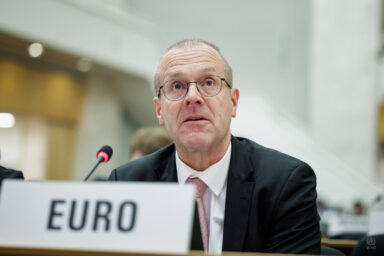
For many governments, public-private partnerships (PPPs) are still primarily a way to finance and build hospitals. That thinking is outdated, argues Munad Akbari, an Oxford-based researcher and UAE healthcare official, and outlines how Europe could benefit from a new approach focused on healthcare delivery, innovation and patient outcomes.
You have a very international background, including studying at University of Oxford. How did that experience shape the way you now approach healthcare projects, including PPP projects, across different countries?
To begin with, it was an absolute privilege to study at University of Oxford alongside regional and global leaders. One of the first things I took away from the experience was exposure to different ways of thinking and different approaches to executing projects. Oxford has a habit of challenging people to think differently. I remember that before we even started our degree, one of the first exercises was to unlearn what we thought we already knew. It was a simple concept, but a powerful one.
“Projects often fail when policymakers try to import models from elsewhere without accounting for local realities.”
— Munad Akbari
As I progressed through the programme, I understood why that mattered. By questioning our assumptions, we became more open to new ideas. We also learned the importance of clear thinking and how it can shape ideas, businesses and entire organisations. I wouldn’t say I lacked this mindset before Oxford, but it was still quite raw. Oxford helped refine it and made it more mature.
Are there any differences between countries like the UAE, where you come from, and EU member states in how they approach healthcare projects?

Yes, absolutely. Projects — or, in my case, PPPs — are always context-driven. In fact, both in my professional practice and at Oxford, we often say that “context is king”. Every country has its own regulations and institutional structures.
One of the UAE’s greatest strengths is the stability and clarity of its leadership. That creates an environment where we can explore innovative approaches and deliver new services and infrastructure. Other countries have different strengths and different challenges.
Even within the Gulf region, there are important differences. The UAE, Saudi Arabia and Qatar may share certain cultural characteristics, but they each have their own way of executing projects. The underlying principles can often be transferred across borders, but they must always be adapted to the local context.
This is something we see repeatedly in the PPP literature. Projects often fail when policymakers try to import models from elsewhere without accounting for local realities. For me, the key lesson is that you can transfer principles, but the design must always reflect the needs, regulations and circumstances of the local market.
So are the lessons that you learned also applicable here?
From a principles perspective, yes. However, the way those principles are applied depends on the legal and institutional framework of each country.
For example, in the UAE we have dedicated PPP legislation that provides a clear framework for implementing these projects. In some countries, PPPs are instead governed through broader public procurement laws. That difference alone can significantly affect how projects are structured and delivered.
The principle remains the same: there needs to be a regulatory framework that enables these projects to be implemented effectively. But that framework must be adapted to local conditions.
Healthcare offers a good example. Regardless of the country, patient wellbeing should remain at the centre of decision-making. If every major decision is guided by what benefits patients most, the project is far more likely to create value for society. The exact level of investment may vary, but the principle itself is universal.
Let’s talk about the projects you did in the UAE. What results have you seen in practice?
Before answering that, it is worth mentioning that I was fortunate to be empowered to lead the UAE’s first healthcare PPP unit in 2017. The mandate was to attract private-sector expertise into the public healthcare system, introduce new technologies, improve infrastructure and expand service delivery. And over the years, we delivered projects across a range of areas, including diagnostics, mental health, emergency services, sterilisation and dialysis. In total, we completed more than a dozen projects.
The strongest results came when the problem we were trying to solve was clearly defined from the outset. Whenever we had a precise understanding of the operational challenge and a clear role for the private partner, outcomes were consistently stronger.
Diagnostics, mental health and dialysis are particularly good examples. In both areas, we achieved significant efficiency gains, reduced turnaround times and improved patient outcomes. At the same time, we modernised infrastructure and introduced new technologies. Today, for example, AI is used as the first reader in much of our tuberculosis testing. We also introduced greater automation, standardised testing procedures across the country and improved patient satisfaction, while reducing overall costs.
Conversely, projects that were less successful tended to be those where the initial case for change required further refinement, particularly in relation to the specific operational challenge being addressed. In some cases, the implementation journey provided important learning and showed that the proposed model may need to be revisited or adjusted to better deliver sustainable value for the healthcare system and broader public interest.
In the EU, are PPP projects on the rise, or is it simply something we talk about more today without much real delivery?
I think it is important to view PPPs in their historical context. Public-private cooperation is not a new concept. If you go back centuries, you can find examples of governments granting private actors the right to build and operate roads, bridges and other public assets in exchange for fees.
In the twentieth century, particularly after the world wars, many governments brought these functions back under public control. Since the 1980s, however, there has been a renewed shift towards involving the private sector in the delivery of public infrastructure and services.
Europe has extensive experience with PPPs. If you look across sectors, there has been a steady pipeline of projects worth billions of euros, particularly in transport and education. Healthcare is part of that picture as well, but the focus has largely been on infrastructure rather than service delivery.
In my view, that is where the next stage of development lies. For many developed economies, financing and constructing buildings is no longer the primary challenge. The bigger challenge is accessing the right expertise, technology, equipment and operational capabilities to deliver better services. PPPs therefore need to evolve beyond construction and focus more on outcomes and service provision.
“A well-designed PPP should not simply deliver services faster; it should deliver them better.”
— Munad Akbari
Considering the form of governance within the EU, what specific lessons or forms of PPP projects might work here?
The first question is whether the regulatory environment allows the private sector to participate efficiently. The main reasons governments use PPPs are speed, efficiency and improved service delivery. If the regulatory framework creates excessive delays, then policymakers should consider whether reforms are needed to make collaboration with the private sector easier while maintaining transparency and fairness.
This is particularly important because PPPs are long-term arrangements. Governments often operate on four- or five-year electoral cycles, while PPP contracts may run for 25 or 30 years. In a typical build-operate-transfer model, construction alone can take several years after the contract has been awarded. By the time operations begin, an entire political cycle may have passed.
That is why procurement processes need to be both efficient and transparent. Governments must ensure genuine competition among bidders while maintaining public trust in the process.
Another important lesson is flexibility. PPP contracts should be structured in a way that allows them to adapt to changing circumstances. Healthcare needs evolve over time, and facilities may need to be repurposed or expanded. Contracts that are too rigid can become obstacles rather than enablers.
At the same time, governments should establish clear contractual terms from the outset. The framework should be defined before procurement begins, rather than being renegotiated after a private partner is selected.
Finally, payment mechanisms should be closely linked to performance. If providers are rewarded for achieving clearly defined outcomes, they have a strong incentive to focus on service quality and operational excellence. In my experience, performance-based payments are one of the most effective tools available in PPP design.
“I would argue that the future of healthcare PPPs lies in service delivery, prevention and innovation rather than in traditional construction-focused models.”
— Munad Akbari
Beyond speed, what are the other reasons governments should choose PPP projects?
Speed is certainly one of the main advantages, but it is not the only one. PPPs can also help governments reduce bureaucracy and access capabilities that may not exist within the public sector. In some cases, public-sector rules can make it difficult to attract highly specialised talent or adopt new technologies quickly. A private-sector partner can provide an alternative route to accessing those resources.
Another important benefit is quality. A well-designed PPP should not simply deliver services faster; it should deliver them better. That includes improved expertise, stronger management capabilities and access to innovation.
Knowledge transfer is another often overlooked advantage. A PPP should not be viewed as a form of privatisation. The objective is not simply to outsource a service but to create a partnership in which skills, expertise and best practices are shared with public-sector staff. Over time, that can strengthen the public system itself.
Finally, PPPs can help mobilise private capital and reduce the immediate financial burden on governments, particularly for projects that require significant investment or advanced technical capabilities.
And what are the reasons not to choose a PPP project?
Based on both my professional experience and my ongoing research at Oxford, I would argue that governments, particularly in upper-middle-income and high-income countries, should avoid using PPPs solely as a mechanism for financing and constructing infrastructure. Many governments already have access to favourable borrowing conditions and sophisticated financing tools. If the objective is simply to build a hospital, there may be more efficient ways to achieve that goal.
The real value of a PPP lies in bringing in capabilities that do not already exist within the public system. That may include specialised expertise, advanced technologies, innovative service models or operational improvements.
In healthcare, most costs arise from service delivery rather than from constructing buildings. Equipment can often be leased, and financing solutions are widely available. As a result, governments should focus less on using PPPs to build facilities and more on using them to improve the quality and effectiveness of healthcare services.
In fact, I would go a step further and argue that the future of healthcare PPPs lies in service delivery, prevention and innovation rather than in traditional construction-focused models.
When you say PPP projects in healthcare, I usually imagine that someone will build a hospital and then run it. What are the other ways that can be used?
That is probably the most common perception of a healthcare PPP, but the model is much broader than that. PPPs can be used for service contracts, management contracts, refurbishment projects and many other arrangements. For example, a government may bring in a private partner to modernise and operate specific departments such as imaging, dialysis, physiotherapy or laboratory services rather than an entire hospital.
Management contracts are another option. In some cases, the objective is not to build new infrastructure but to bring in specialised leadership and expertise to improve service delivery. We have seen significant improvements simply by placing the right people in key management and clinical leadership positions.
The structure should always reflect the specific problem being addressed. PPPs are not limited to building hospitals and handing them back to the government. They can be tailored to improve particular services, introduce new technologies or strengthen operational performance.
A good example is what we experienced in the UAE during the COVID-19 pandemic. One of our laboratory-services PPPs played a crucial role in scaling up testing capacity at airports and across the country. That gave policymakers an early understanding of the situation and helped the UAE respond quickly while maintaining a relatively open economy.
The lesson is that even a relatively focused service-based PPP can have a significant impact when it addresses a critical operational need.
When looking at the different types of PPPs, which structures are most suitable for healthcare and how should governments decide which type to use?
There is no single model that works in every situation. The most suitable structure always depends on the specific context and the problem that needs to be solved. For example, if a government needs to build a hospital in an underserved area but already has the workforce required to operate it, then the partnership may focus primarily on construction. If the necessary expertise or staffing is not available, then operations may also need to be included in the arrangement.
Similarly, if an existing facility requires modernisation, a refurbishment and operations model may be more appropriate than building a new hospital from scratch.
That is why the feasibility stage is so important. Before selecting a PPP structure, governments need to define the problem clearly, assess future needs and determine exactly what capabilities are missing. Once that analysis is complete, the appropriate model usually becomes much clearer.
In other words, the structure should emerge from the problem statement, not the other way around. A one-size-fits-all approach rarely works in healthcare.
You mentioned the feasibility study. What should it involve? Are we talking about cost-benefit analysis, value-for-money assessment and similar tools?
Absolutely. A robust feasibility study should include both quantitative and qualitative value-for-money assessments.
The quantitative component compares the expected costs of public delivery with those of private delivery. In simple terms, it asks whether a private-sector partner can provide the same outcome at a lower overall cost.
The qualitative component looks beyond direct financial costs and evaluates factors such as efficiency, innovation, service quality and operational performance. These benefits can then be incorporated into the overall assessment. To reach a reliable conclusion, governments need to examine a wide range of factors, including political, economic, social, technological, environmental and legal considerations. PPPs are fundamentally based on risk allocation and performance-based delivery, so understanding these factors is critical.
A feasibility study should also assess future requirements, regulatory constraints and implementation risks. In many cases, legal or regulatory changes may themselves generate additional costs that need to be reflected in the analysis.
Ultimately, the process is similar to developing a business plan. The objective is to understand the project from every angle, quantify both costs and benefits and determine whether a PPP offers greater value than traditional public delivery. That said, value-for-money analysis should support the decision making process and not act as a final decision making mechanism. Governments must also consider their broader strategic objectives and the outcomes they want to achieve for citizens and society.
How should risks be shared in PPP projects? What part of the risk should be held by the private party and what part by the public party?
Risk allocation should always reflect the nature of the project. There is no universal formula that applies to every PPP.
As a general principle, risks should be assigned to the party best able to manage them. For example, in a construction-focused project, the private partner would typically assume responsibility for construction and delivery risks because those are areas under its direct control. In service-based projects, a significant share of operational risk may also be transferred to the private provider. However, some risks will always remain with the government.
Reputational risk is a good example. Even when services are delivered by a private partner, citizens will often continue to hold the government accountable for outcomes. Similarly, risks related to regulation, policy changes or broader public-sector responsibilities cannot be fully transferred. Other risks, such as currency fluctuations or economic shocks, may need to be shared between both parties depending on the circumstances.
The key point is that risk allocation should be carefully tailored to each project. Effective PPPs are built on a balanced distribution of risks and responsibilities rather than an attempt to transfer all risks to one side.
“Too often, PPPs have resembled little more than long-term financing arrangements, with payments spread over decades.”
— Munad Akbari
How are PPP projects usually financed today? Is it mainly through banks or specialised investment funds?
In most cases, PPP projects are financed through banks and large financial institutions. Once a private operator secures a contract, they can use that agreement as the basis for obtaining financing to deliver the project.
Is there a risk that PPPs ultimately become more expensive for the public sector than simply borrowing the money directly and paying over time?
Yes, that risk exists. Governments can typically borrow at lower interest rates than private companies, particularly in upper-middle-income and high-income countries. For example, if a PPP is used solely as a financing mechanism for construction, it may not represent the most efficient option.
That is precisely why I believe governments should move beyond viewing PPPs primarily as a way to finance infrastructure. If the objective is simply to build, public borrowing or bond issuance may often be the better solution. The real value of a PPP lies in what the private partner contributes beyond financing. That could include technology, expertise, innovation, management capabilities or improvements in service delivery.
Too often, PPPs have resembled little more than long-term financing arrangements, with payments spread over decades. In those cases, it is reasonable to ask whether the government could have achieved the same outcome more cheaply through conventional borrowing. For PPPs to justify their additional cost, they need to deliver additional value. That is why I believe the future of healthcare PPPs lies in operations and service provision rather than construction alone.
“One of the gaps in the PPP field is the lack of robust evaluation frameworks. We still need better ways of measuring whether these partnerships have genuinely delivered better outcomes over the long term.”
— Munad Akbari
What are the largest healthcare PPP projects in the world today?
Türkiye is probably one of the most notable examples. The country launched a large healthcare PPP programme aimed at developing dozens of hospitals, with total investments estimated at tens of billions of euros. Ankara City Hospital is among the best-known projects and alone is valued at around one billion euros.
The United Kingdom also has extensive experience through its Private Finance Initiative (PFI) programme, which has been used to develop a large number of healthcare facilities. Similar examples can be found in Canada, Australia and parts of Latin America.
However, what many of these projects have in common is that they focus primarily on infrastructure. They are largely about financing, building and maintaining healthcare assets rather than improving clinical operations or service delivery. That is where I see the next stage of development. The healthcare sector no longer needs PPPs only to build hospitals; it needs partnerships that improve how healthcare is delivered within those hospitals.
Are there already examples of PPPs that include clinical operations?
There are some examples, including one in Poland where private partners are involved not only in developing facilities but also in clinical operations.
The challenge is that evaluating PPP performance is often difficult. Any assessment requires comparing the project with a hypothetical alternative — namely, what the government might have achieved on its own. That comparison is never straightforward.
Many evaluations rely on assumptions, historical data and modelling exercises. Critics may argue that the public sector could have delivered better results, while supporters may argue the opposite. The reality is that factors such as inflation, technological change and shifting geopolitical conditions make direct comparisons extremely difficult.
In my view, one of the gaps in the PPP field is the lack of robust evaluation frameworks. We still need better ways of measuring whether these partnerships have genuinely delivered better outcomes over the long term.
Based on your PhD research, what do governments still misunderstand about working with the private sector, and what should an effective implementation framework address?
One of the main objectives of my research is to develop an implementation framework for private-sector participation in healthcare systems, particularly in upper-middle-income and high-income countries.
I deliberately use the term “private-sector participation” rather than “PPP” because the boundaries between different forms of collaboration are often unclear. Some arrangements that are labelled PPPs resemble outsourcing contracts, while others operate more like strategic partnerships. The terminology can sometimes obscure more than it clarifies.
My expectation is that an effective implementation framework must be adaptable rather than prescriptive. Countries operate in very different institutional, regulatory and healthcare environments, so any framework needs to account for local realities rather than impose a single model.
The framework should provide guidance on defining objectives, assessing value for money, allocating risks, selecting the appropriate partnership model and managing implementation over time. It should also help governments determine how these arrangements can remain effective in a rapidly changing environment.
Ultimately, the goal is not to create a rigid template but a practical tool that helps governments work more effectively with the private sector to improve healthcare outcomes.