The continent is heading towards the next heating season with its lowest gas reserves in years, just as renewed fighting around the Strait of Hormuz threatens global LNG supplies. EU, however, is keen to calm nerves, saying there is no risk to Europe’s energy security.
The EU will need to import more liquefied natural gas (LNG) this summer if it wants to refill its gas storage sites before winter. A report by the European Network of Transmission System Operators for Gas (ENTSOG) shows that Europe entered the summer injection season with its lowest gas inventories in years. Ongoing tensions in the Middle East have made the task even harder by pushing up gas prices and reducing the financial incentive to store gas.
The Agency for the Cooperation of Energy Regulators (ACER) estimates that the bloc will need around 13 per cent more LNG imports than it did in 2025 to fill storage sites to 90 per cent of capacity by 1 November. If member states choose to use the flexibility built into the EU’s gas storage rules and aim for 80 per cent instead, last year’s level of LNG imports should be enough.
The European Commission, however, insists there is no immediate threat to Europe’s energy security. “For the time being, no concerns for our security of supply. Our concern since the beginning has been the prices,” said European Commission energy spokesperson Anna-Kaisa Itkonen. She added that the Commission remains in regular contact with member states, industry and the International Energy Agency, and continues to monitor the situation closely.
The message also reflects the Commission’s effort to avoid unsettling the market, as panic buying would risk pushing gas prices even higher.
Storage sites emerged from winter far emptier
ENTSOG says Europe’s gas storage sites stood at just 28 per cent full on 1 April. That was lower than at the start of the previous three filling seasons and roughly in line with levels seen before the 2022 energy crisis.
The report notes that Europe entered the heating season in early October 2025 with storage sites 83 per cent full. A colder winter in 2025/26 forced countries to draw much more heavily on stored gas.
ACER says storage facilities have now recovered to around 49 per cent of capacity, but refill rates still trail both last year’s pace and the ten-year average for the summer injection season.
Europe will rely even more on LNG
ENTSOG estimates that Europe will need around 943 TWh of gas over the summer to reach the 90 per cent storage target. That equals roughly 86 billion cubic metres of LNG. If the remaining Russian pipeline gas supplies stopped completely, Europe would need another 66 TWh, or about six billion cubic metres.
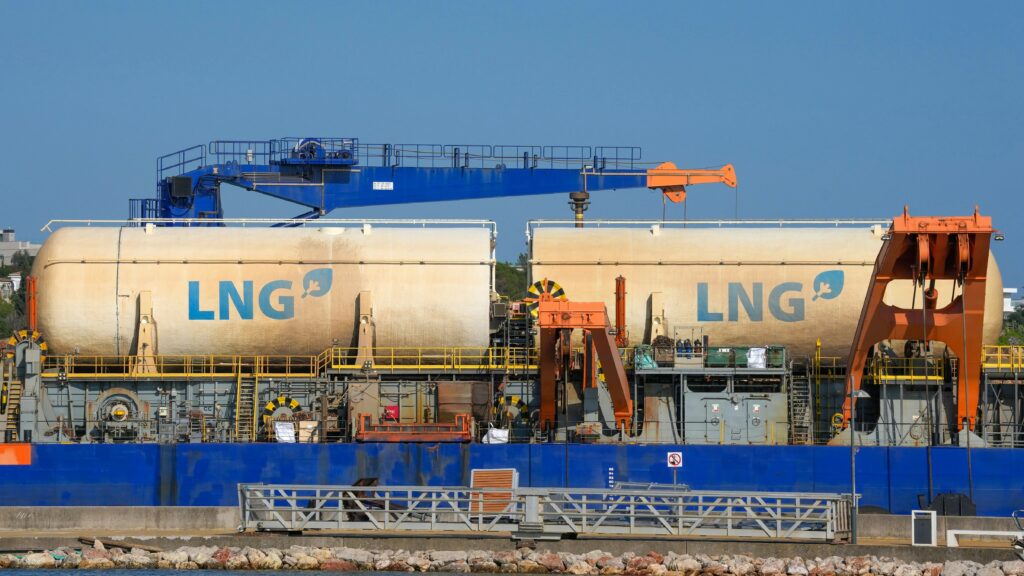
LNG now accounts for around half of all gas imports into the EU, making the bloc the world’s largest importer.
ENTSOG warns that this year’s storage refill campaign has become more difficult because of the continuing conflict in the Gulf region. Concerns have intensified in recent days after a fragile ceasefire between the United States and Iran collapsed. Both sides resumed military strikes, while attacks on commercial vessels have once again raised the risks for shipping through the Strait of Hormuz, one of the world’s most important routes for oil and LNG exports.
The organisation says damage to part of Qatar’s export infrastructure, combined with disruption of Hormuz, has tightened global LNG supplies. That has pushed up European gas prices and narrowed the gap between summer and winter gas contracts, making it less profitable for traders to inject gas into storage.
Qatar ranks among the world’s biggest LNG exporters, and most of its exports depend on safe passage through the Strait. Although only around eight per cent of Qatar’s LNG shipments went to the EU in 2025, any disruption quickly ripples through the global market and drives prices higher. European consumers inevitably feel the impact.
Infrastructure remains resilient
Despite lower storage levels, ENTSOG believes Europe’s gas infrastructure remains robust. New LNG terminals have expanded import capacity and made the system more flexible. The organisation says Europe’s regasification capacity can partly offset lower gas stocks ahead of winter.
The report also warns that everything depends on sufficient LNG being available on global markets. In a scenario where global LNG supply falls by 20 per cent, European storage sites would reach only around 76 per cent of capacity by the end of September. If that happened alongside a complete halt to the remaining Russian pipeline gas supplies, storage levels would end up at roughly 70 per cent.
The European Commission nevertheless stresses that today’s situation bears little resemblance to the crisis of 2022, when Russia’s sharp cuts to pipeline gas deliveries triggered an unprecedented energy emergency. The Commission argues that member states now have much greater flexibility when refilling storage sites and that the current rules consider 80 per cent storage levels enough to secure winter supply.