Russia gained €13.5bn in windfall oil revenues from the Iran war. The relief to Moscow’s federal deficit, already twice its annual target, is tangible but brief.
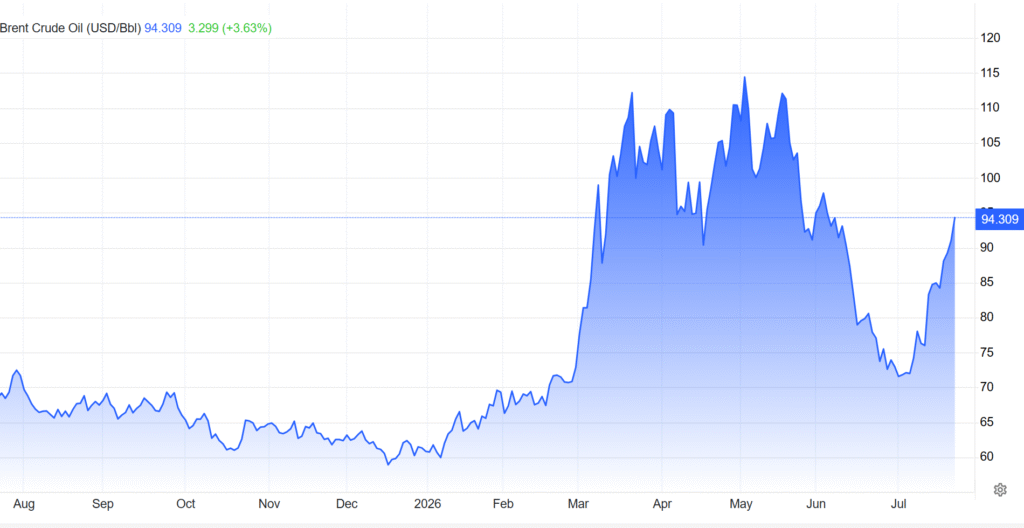
Any missile strike on Tehran helps, by an indirect route, Moscow pay for its war in Ukraine. The connection runs through the oil market. When the US and Israel attacked Iran, the Brent crude price spiked to $112 per barrel on 20 March 2026, up from $69 on 25 February. The Urals crude price rose even more sharply, from $55 per barrel on 25 February to $125 on 7 April, according to an analysis by Marek Dabrowski, a non-resident fellow at the Brussels-based think tank Bruegel. (It has since retreated to $92 on 22 July).
The windfall was real, if temporary. Russia’s federal hydrocarbon revenues jumped from 393.3bn roubles in January to 855.6bn roubles in April. Comparing March-to-June revenues against the January-February average, Mr Dabrowski calculates windfall gains of 1,184bn roubles — about €13.5bn, or roughly 0.5 per cent of Russian GDP as forecast by the International Monetary Fund for 2026. That is not a transformative sum. It is, however, a useful one for a budget under severe strain.
The budget’s breaking point
The relief came at a convenient moment. By the end of May, Russia’s federal deficit had hit 6tn roubles ($83bn), 2.6 per cent of GDP, twice last year’s level, and already well past the 3.8tn roubles meant to cover all of 2026, according to the Financial Times.
The deeper story is one of structural deterioration. A CASE report by Mr Dabrowski, published in January 2026, found that “in 2022–2025, the Russian economy and public finances demonstrated a high level of resilience despite the increasing costs of the war. Fiscal accounts, though under strain, remained under control.” That control is now visibly slipping.
Military expenditure rose from 3.6 per cent of GDP in 2021 to 7.1 per cent in 2024, according to SIPRI. The CASE report noted that “national defence is crowding out non-war-related spending,” displacing social policy, education, and regional transfers. To plug the gap, the government raised personal income tax to a progressive rate of up to 22 per cent for high earners, and lifted corporate income tax from 20 per cent to 25 per cent.
The National Wealth Fund, Russia’s sovereign rainy-day reserve, has been heavily drawn down. Its liquid assets stood at just 3.4tn roubles by mid-2026, a fraction of their pre-war level. The CASE report put liquid assets at RUB 4.085tn as of 1 January 2026, equivalent to 1.9 per cent of projected 2025 GDP. The fund is also being redirected toward long-term strategic projects such as transport infrastructure and aircraft leasing, further eroding its buffer function.
Borrowing past the rules
Russia’s parliament moved swiftly to accommodate the deterioration. It took just 72 hours in June to grant the finance ministry the power to spend more and borrow past the legal debt ceiling, without formally rewriting the budget or obtaining parliamentary approval, the Financial Times reported. The ministry said it needed to react to a worsening environment “not every month or every quarter, but every day.”
Easy come, easy go
The fiscal rule, reinstated in late 2023 with a Urals oil benchmark of $60 per barrel, is being quietly set aside. Outstanding corporate debt grew by 86 per cent between February 2022 and October 2025, driven by government-directed lending. Under Federal Law No. 275-FZ, designated banks must provide concessionary financing for defence contracts, cross-subsidising the war effort through higher margins charged to civilian borrowers.
Finance Minister Anton Siluanov has been candid about the pressure. In a letter (again reported by the Financial Times), Mr Siluanov warned that the military and security services might need an extra 2tn roubles this year, with a “negative scenario” putting the overspend at up to 4tn roubles, and projecting similar overruns in 2027 and 2028. “Our reserves are not endless,” Mr Siluanov said. “We can’t allow any weak points in our finances while such major transformations are going on in the world.”
Prices fall, problems return
The Iran windfall has already begun to fade. The US-Iran memorandum to end the war was announced on 14 June. By 2 July, Brent had fallen back to $72 per barrel and Urals to $51. The discount on Russian oil, which had briefly disappeared during the conflict, has widened again. Federal hydrocarbon revenues fell from their April peak of 855.6bn roubles to 683.6bn roubles in June.
The boost was also partially offset. Payments to Russian oil companies to limit domestic petrol price rises, and a stronger rouble—trading near its highest level against the dollar in more than three years—both reduced the net fiscal benefit. Mr Siluanov noted that in April Russia received 200bn roubles in surplus energy revenue, but that expected energy revenues had fallen short by roughly the same amount in March.
Sofya Donets, chief economist at Moscow-based T-Investments, captured the mood. “The economy is not in spectacular shape, but it is resilient,” Ms Donets said. “Still, the budget is the number one topic in the media, in central bank statements, and in behind-the-scenes talks. People are looking at the budget to understand: who is next? Will there be room for rate cuts, and which taxes will be raised next? When will they come for us?”
Paying for the dead
The human cost is now a direct fiscal variable. An estimated 352,000 Russian soldiers have been killed since 2022. Each confirmed death triggers a federal payout of 14.2m roubles. A wounded soldier can receive up to 4m roubles. The death and injury toll is now affecting the budgetary process itself.
In 2022–2025, the Russian economy and public finances demonstrated a high level of resilience despite the increasing costs of the war. — Marek Dabrowski, Bruegel, CASE
Alexandra Prokopenko, a former central bank official and now a fellow at the Carnegie Russia Eurasia Center, was direct. “The finance ministry needs money for the war, so whatever happens, it’s not defence and security that gets cut, but procurement, subsidies to corporates, and financing public institutions,” Ms Prokopenko told FT.
The CASE report’s conclusion remains apt: “Russia’s fiscal situation still appears manageable in the short term, which will allow it to continue the war for some time.” The Iran war bought a few more months of that manageability. It did not change the arithmetic. As Mr Dabrowski wrote in Bruegel, the important lesson of the last four months is that “in the highly interconnected global economy, political and military actions in one geopolitical theatre can have unintended consequences for other regions and policies”. For Ukraine, those consequences have been unwelcome, if not decisive.