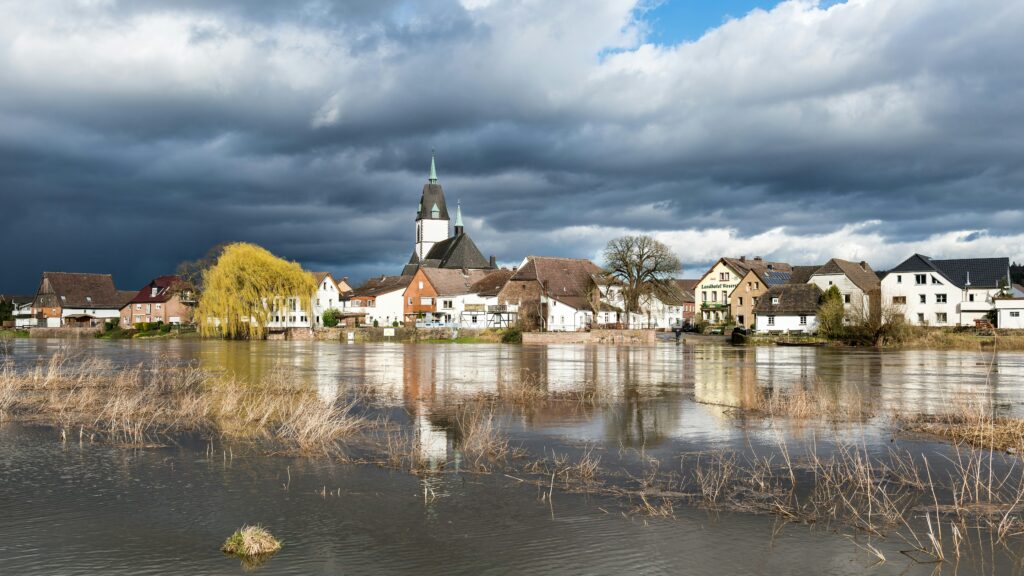
A stolen laptop is easy to insure. A flooded farmhouse or a burned out vineyard increasingly is not. As droughts, floods and wildfires tear across Europe with growing force, governments, not insurers, are quietly left to pick up the bill.
Three quarters of the economic damage caused by climate disasters in the European Union goes uninsured. In some countries, insurers cover less than five per cent of the losses. The gap between what nature destroys and what policies pay out has a name in Brussels: the climate protection gap. It is no longer a technical footnote. It is becoming one of the defining fiscal questions of the decade.
The numbers explain why. According to the European Insurance and Occupational Pensions Authority (EIOPA), each of the past four years ranks among the five costliest on record for climate related losses in Europe since 1980. Just 17 per cent of Europeans hold insurance against natural catastrophe damage to their property, according to a 2025 Eurobarometer survey. Many who think they are covered are not. Insurers call this the insurance illusion, a situation where complex policy documents leave households believing they are protected when key risks sit outside the small print.
The insurer of last resort
When private cover fails, someone still has to pay for the rebuilding. Increasingly, that someone is the state.
For governments, the protection gap often results in increasing pressure to act as the insurer of last resort.
— Petra Hielkema, Chairperson, European Insurance and Occupational Pensions Authority
Petra Hielkema, chair of EIOPA, warned in April that the protection gap cuts across borders, sectors and institutions. “For governments, the protection gap often results in increasing pressure to act as the insurer of last resort. This places significant strain on public finances, especially as disasters become more frequent and more destructive. When fiscal capacity is stretched, the ability to invest in long-term prevention is weakened, creating a vicious cycle,” she said.
That role comes at a cost. Every euro a government spends on post disaster reconstruction is a euro it cannot spend preparing for the next one. Economists at Bruegel, a Brussels based think tank, describe the result as a vicious cycle. Thin insurance coverage forces public budgets to absorb the damage, which then leaves less money for the flood defences, early warning systems and drought resistant infrastructure that could have limited the damage in the first place.
The pattern already has a track record. Underinvestment in hydraulic infrastructure worsened flood losses in Spain’s Valencia region in 2024. In Germany, fragmented data sharing between authorities meant early warning systems failed to reach people in time during severe flooding that same year. Neither failure was inevitable. Both were expensive.
For households, a single flood or wildfire can mean years of financial hardship. For small businesses, the backbone of many regional economies, being underinsured can decide whether a company reopens after a disaster or closes for good. The German Insurance Association has warned that property premiums could double within a decade as climate driven claims mount, which risks pushing cover even further out of reach for the people who need it most.
Two pillars, one gap
EIOPA and the European Central Bank (ECB) have jointly proposed a way to narrow the gap. The plan rests on two pillars: a public private EU reinsurance scheme that would pool risk across member states, and an EU disaster fund to coordinate public risk management. Neither exists yet. Both would require political agreement that has, so far, not materialised.
Bruegel’s researchers back a European natural catastrophe pool combined with a loan based backstop worth ten to sixty five billion euros, arguing this would let the EU diversify climate risk across the bloc while limiting what falls on taxpayers. They also want clearer limits on unconditional state compensation after a disaster, paired with build back better conditions attached to any reconstruction funding, so that rebuilding does not simply recreate the same vulnerabilities.
What Brussels is planning
The European Commission is not starting from nothing. A climate resilience dialogue running from 2022 to 2024 already produced a report on narrowing the protection gap. Its successor, a new European Climate Resilience and Risk Management framework, is now moving through an impact assessment after a public consultation closed last year. The Commission expects to adopt it in the second half of 2026.
Whether that framework goes as far as EIOPA, the ECB and Bruegel are urging remains an open question. Respondents to the Commission’s consultation called for long term adaptation funding and resilience by design written into public spending and procurement, demands that echo the economists’ proposals almost word for word. What is missing so far is a firm commitment on the reinsurance pool itself, the piece EIOPA and the ECB regard as central to closing the gap.
There are climate risks that private markets alone cannot absorb, because they are too large, too correlated, or too complex.”
— Petra Hielkema, Chairperson, European Insurance and Occupational Pensions Authority
Insurers, for their part, insist they should remain the first line of defence, not the last. But even the industry’s own regulator concedes that private markets cannot absorb every risk alone. “There are climate risks that private markets alone cannot absorb, because they are too large, too correlated, or too complex,” Hielkema has said. Closing that gap, she argues, will ultimately depend on decisions made by political leaders in Brussels and national capitals, not by insurers alone.