
Beijing is ill-equipped to manage the shift from chasing growth to sustaining ageing citizenry. In the global race for talent, that gap may be Europe’s opening.
The demographic future is no longer a distant concern for the second half of the 21st century. In Beijing (as well as in European capitals), the future has arrived with a startling lack of ceremony. China is currently facing a population collapse that is both abrupt and historically unprecedented.
Allen Feng, Associate Director with Rhodium Group’s China Markets Research team, has provided a rather dark assessment of the situation. “We estimate China will lose nearly 60 million people in the next decade, roughly equivalent to the population of France,” he wrote.
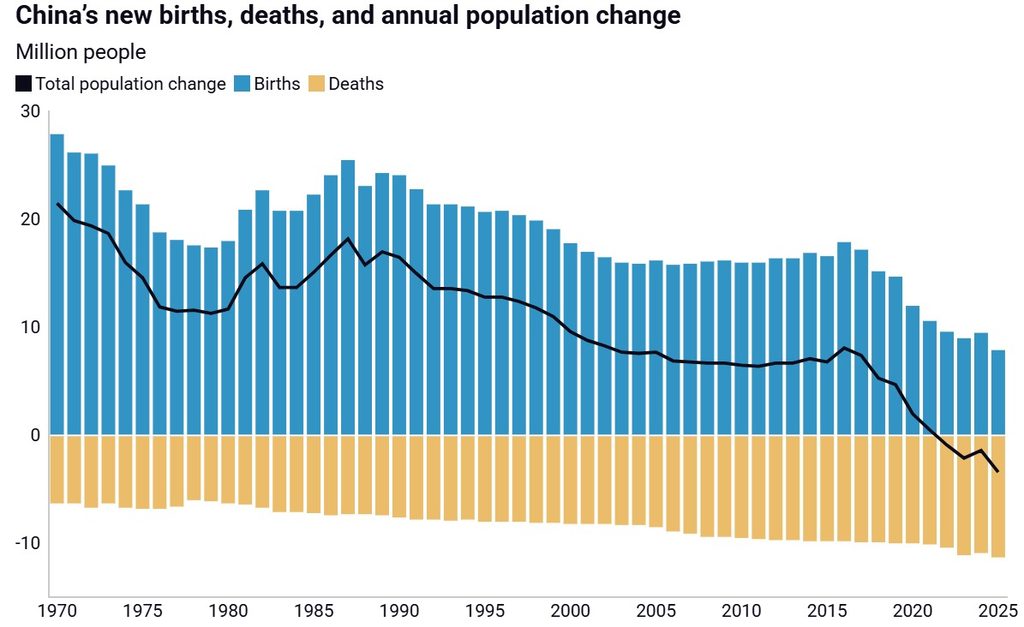
This decline is driven by a collapse in births that has shocked even seasoned observers of the region. In 2025, total births in China fell to only 7.92 million. This figure is less than half of the number recorded just a decade ago. It represents the lowest level of births since 1939, a time when the total population was just above one quarter of the current count.
The struggle for stability
The presence of these demographic headwinds is well-known by now. What is less known is how to read it. Mr Feng describes them as a gray rhino for the Chinese economy. “The 2025 data pointing to double the population loss from 2024 suggest the rhino is now charging directly at China’s political and economic ambitions,” he writes.
The rhino presents itself as the ratio of new births to the total population; it reached only 0.563 per cent last year. This is a dramatic fall from 1.199 per cent in 2015. Such a rapid decline suggests that the era of China as a demographic superpower is ending. The implications for household consumption are obvious to any economist. However, the larger problem for the central government may be the looming hit to social security funds.
Even if the fertility decline doesn’t reverse itself anytime soon, the consequences are unlikely to be apocalyptic.
— Idrees Kahloon, The Atlantic
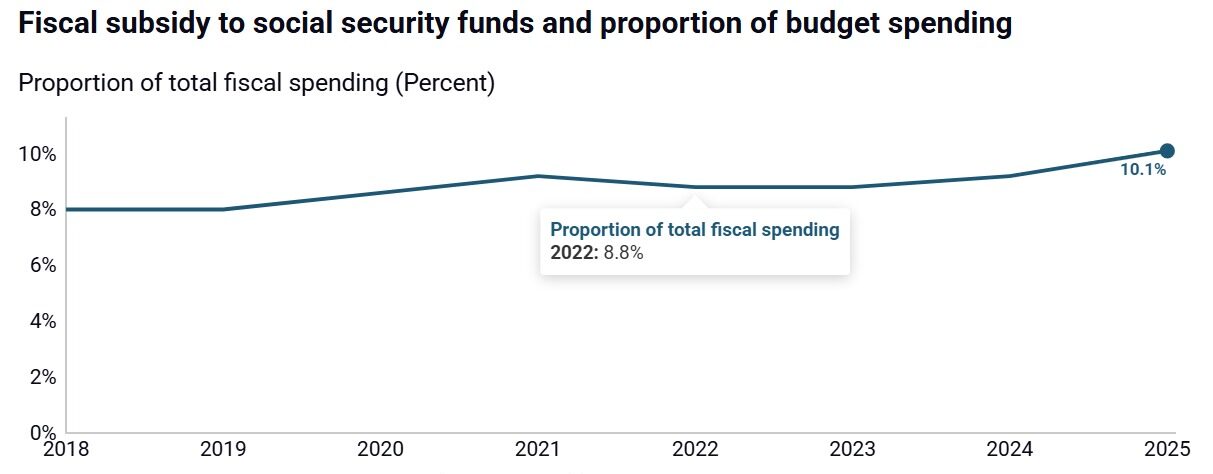
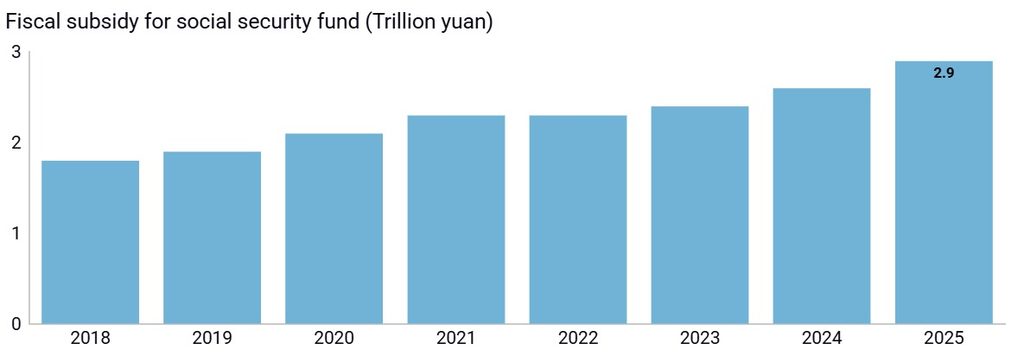
The regional breakdown of this decline is particularly concerning for the Chinese Communist Party. Developed coastal provinces are seeing falling populations, which will impact future productivity. Last year, the population of China declined by 3.4 million people. This followed a 1.4 million drop in 2024. Mr Feng notes that “The fiscal subsidy to social security funds rose to a record 2.9 trillion yuan last year, or 10.1% of general budget spending, and appears set to rise in the future.”
The one-child fallacy
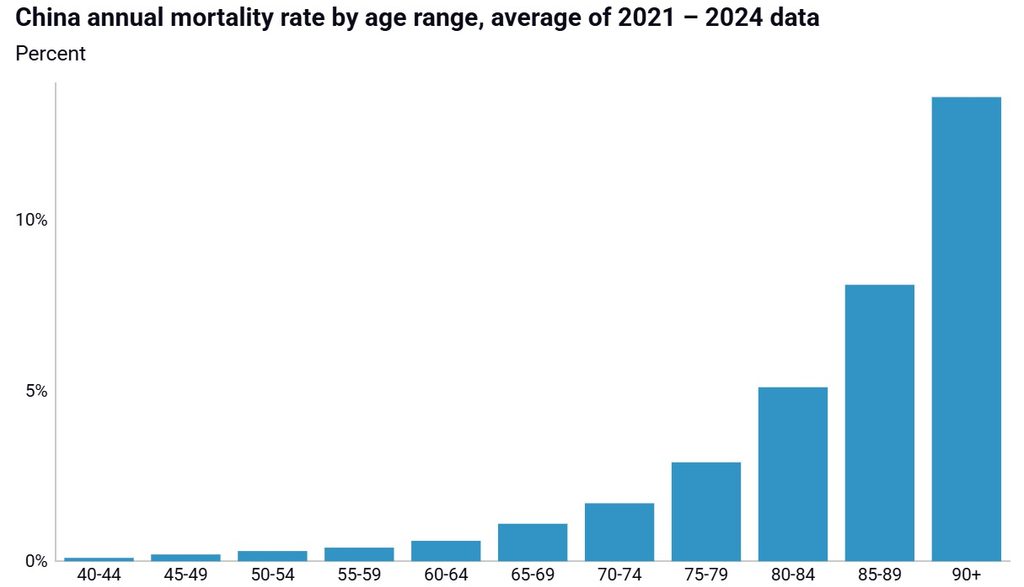
This fiscal strain is a direct result of an aging society that was born during previous booms. Between 1962 and the early 1970s, China experienced a massive baby boom with over 20 million births annually. Those cohorts are now entering retirement, placing an immense burden on the working-age population.
Then, to make matters worse, the one-child policy kicked in in 1980, in an unprovoked act of self-destruction by the Chinese leadership. The policy itself took 36 years to repel, and will take much longer to fix.
In 2024, eight years after Beijing officially allowed two children per family, there were around 4.4 working-age people for every dependent person. By 2035, that figure is expected to fall to just 2.8. Without massive fiscal subsidies, the pension fund would have reported a deficit of 1.4 trillion yuan last year. This has all sorts of implications.
First, these pressures have generated a new narrative in the West regarding peak China. A decade ago, the dominant story was one of an unstoppable rise toward global hegemony. Today, that optimism has largely evaporated. This shift in perception reflects the reality of a country that is flatlining both politically and economically.
The peak China debate
The concept of peak China suggests that the country may have reached the upper limit of its power. Evan Medeiros, senior fellow at the Asia Society Policy Institute, argues that this view may be premature. “Xi still believes China is rising, and he is acting accordingly,” he said. Mr Medeiros believes that Chinese elites see the US as the power in terminal decline. For them, the power gap is still narrowing in the favour of China.
However, other economists like George Magnus, a researcher at the University of Oxford, suggest thing just the other way around: that the peak may be closer than expected. He points to the role of inclusive institutions in fostering long-term prosperity. “The sequencing flows from good governance to better economic outcomes, not the other way round,” he said. Mr Magnus argues that the government of Xi Jinping has backed away from key reforms. This centralisation of control has caused economic performance to falter and revealed a political stasis.
China now wrestles with systemic problems including a real estate bust and chronic weakness in demand. High youth unemployment has become a major social issue. The jobless rate among workers aged 16 to 24 stood at 18 per cent recently. Many educated young people feel a sense of disenchantment. The idea proposed by the Russo-American historian Peter Turchin—that a society’s decline is precipitated by the lack of career prospects for those educated for elite jobs—appears to strike uncomfortably close to home.
The European comparison
The European Union is hardly in a position to gloat about the demographic misfortunes of its rival. Between 2020 and 2026, the EU-27 has moved deeper into sub-replacement demography. The total fertility rate in the EU fell to a record-low 1.34 in 2024. This is a significant decline from 1.51 in 2020, if nowhere near China’s collapse. While China faces an abrupt shock, Europe is managing a more gradual (but equally persistent) aging process.
The median age in the EU is 44.4 years, a noticeably higher than the median age of 40.6 in China. People aged 65 and over accounted for 22 per cent of the EU population in 2025. This compares to 14.1 per cent in China. However, the EU possesses a demographic cushion that China lacks, net immigration. In 2024, net migration added 2.6 per 1,000 to the European population. This offset a negative natural change of 2.8 per 1,000 — unfortunately, against the will of what appears a growing percentage of the bloc’s population.
The sequencing flows from good governance to better economic outcomes, not the other way round.
— George Magnus, University of Oxford
China, by contrast, continues to see net outflows of people. Net migration remained negative throughout the 2020 to 2025 period. It hit a low of minus 268,000 in 2025. Qualitatively, China is losing high-skilled workers to OECD countries. It attracts mainly short-stay, lower-skilled migrants. This lack of a migration safety valve makes the Chinese demographic crisis more acute than the European one.
The policy landscape
The policy responses to these crises diverge sharply in both scope and philosophy. The European Union has focused on a life-cycle approach to aging. The Green Paper on Ageing, published in 2021, calls for reforms in labour markets, pensions, and care systems. The European Care Strategy of 2022 sets quality-of-care benchmarks and workforce targets. These frameworks aim to manage an already-aged society rather than simply encouraging more births.
Individual member states have taken further actions. Germany passed the Skilled-Worker Immigration Act in 2023 to attract foreign talent. France continues to provide generous family allowances to support its birth rate. The Nordic countries have expanded parental leave to make child-rearing more compatible with professional life. These measures reflect a recognition that demography is a multifaceted challenge requiring more than just cash grants.
China has also introduced pro-natalist policies, but not to much avail. The two-child limit was eased in 2016 and a three-child policy was adopted in 2021. Beijing introduced an income-tax deduction of 1,000 yuan per month for children under three in 2022. A 3,600-yuan subsidy per child for three years is set to start in 2025.
The problem? All this is hardly working. “None of these measures are likely to have a meaningful impact on the birth rate, as they are not addressing the aforementioned headwinds,” Mr Feng writes.
The failure of incentives
The experience of other Asian nations suggests that reversing fertility declines is nearly impossible. Singapore has been paticularly aggressive in promoting births for decades. Yet its total fertility rate fell to a new low of 0.87 in 2025. In China, the average age of people getting married rose to 34 years old in 2024. The number of marriages has declined by 40 per cent since 2018. These trends reflect deep changes in behaviour and preferences that subsidies cannot easily reach.
Chinese youth have (unlike, say, their fellow sufferers in Korea) embraced social phenomena such as ‘lying flat‘or ‘letting it rot’, rejecting the intense work pressure. These trends indicate a reduction in the willingness to have children or enter stable relationships.
Employment conditions are weakening and income growth is slowing. Total disposable household income growth slowed to its lowest level last year. “Beijing is trying to put this burden on companies, individuals, and local governments instead of spending out of the central government’s own pocket,” the Rhodium Group study reads.
The 15th Five Year Plan includes a chapter on population, suggesting a heightened focus on the issue. Within government rhetoric, investing in human beings is becoming an increasingly popular phrase. However, the meaning of this phrase remains in question. Migrant workers are likely the highest-return investments in human capital available to Beijing. Yet there is no sign that investments in equalising their pensions will accelerate.
The strategic rivalry
The demographic squeeze is already reshaping the economic and strategic rivalry between the two blocs. A shrinking Chinese workforce will lift unit-labour costs. This could erode the low-cost manufacturing edge that China has enjoyed for decades. Global firms may be nudged toward automation or relocation to other regions. The EU already faces labour tightness in health, STEM, and agriculture. Europe therefore competes with China, as well as the US, in a global talent war.
Ageing also affects innovation and productivity. A stagnating population may lead to fewer people being around to have new ideas. This is a scenario known as the Empty Planet result. However, companies may adapt by developing productivity-boosting technology. China’s demographic squeeze may accelerate its industrial-upgrade agenda, known as Made in China 2025. The EU is also focusing on silver-economy innovation.
Xi still believes China is rising, and he is acting accordingly.
— Evan Medeiros, Asia Society Policy Institute
The structure of consumer markets is also changing. The senior population in China already exceeds 200 million. This will pivot consumption toward health care and wealth management. These are fields where European firms often hold brand advantages. Conversely, greying consumers in the EU may demand affordable assistive devices. Chinese suppliers aim to dominate these niches. Demographic trends are now an active driver of the strategic calculus between the two powers.
A case for chilling out
The prevailing sense of demographic doom is not shared by everyone. Idrees Kahloon, formerly of The Economist, argues in The Atlantic that population panic often ages poorly. “Even if the fertility decline doesn’t reverse itself anytime soon, the consequences are unlikely to be apocalyptic,” he notes. Mr Kahloon points out that humanity has a long history of panicking about population levels. In 1798, Thomas Malthus predicted that population growth would lead to premature death.
Later, in 1968, Paul Ehrlich warned that hundreds of millions would starve to death. Instead, the world population grew and living standards increased. Mr Kahloon suggests that dire projections often rely on simple mathematical constructs like exponential curves. These models assume that people will continue to have the same number of children for centuries. “Yet the experience of the past century, with its baby booms and busts, demonstrates just how dubious that assumption is,” he said.
Family sizes seem to change as the world does, often in ways that are hard to predict. For the past half a century, people in almost every country have chosen to have fewer children. This decline occurs even as species enjoy the best average living standards in history. As societies get richer and better educated, their citizens desire fewer children. If this is the cause of the fertility collapse, it defies easy correction.
The question of growth
The decline in birth rates raises the question of whether population shrinkage is inherently harmful. Many economists argue that it is, because fewer people lead to fewer ideas. However, economies could compensate by devoting a greater share of workers to innovation. AI may also increase the pace of discovery.
“If the population should flatline or even fall in half, you could still have as many engineers and people coming up with new ideas as you had before just by drawing more people into that work,” says Dietrich Vollrath, an economist at the University of Houston, with a hefty dose of optimism.
Mr Vollrath views the ongoing baby bust as analogous to past changes like urbanization. It is a clear change in preferences with unintended consequences that may drag out for decades. This may change the growth rate of the economy. “But ultimately—it’s always interesting to say this as a growth economist—who gives a shit about the growth rate?” he said. The goal of a society should be to optimise welfare and living standards rather than just growth.
This perspective suggests that the demographic crisis is a transition rather than a catastrophe. Living standards in a low-birth world might be slightly lower than in a high-birth one. Consumption per capita could be about 8.7 per cent lower in a world with very low fertility. Shrinkage brings problems like unused infrastructure and fewer customers for businesses. But these are management challenges rather than existential threats to civilisation.
The graying of society
Societies will be dominated more and more by the elderly. Senior citizens are expected to make up a majority of the South Korean population starting in 2045. This graying could be an economic drag as most successful start-ups are led by people in their 40s. There will be intense demand for care which is labor-intensive and difficult to scale. Because birth rates are falling globally, importing care workers from abroad will become more difficult.
Governments already spend considerably more on the elderly than on the young. Unwinding entitlement promises is politically unpalatable. When gerontocracy becomes genuinely majoritarian, this problem will likely worsen. Within the next decade, the Social Security trust fund in America is expected to run out. “Even an immediate baby boom the size of Musk’s dreams would do little to alleviate the financial strain, because children generally take time to turn into taxpayers,” Mr Kahloon admits.
The demographic future is already impacting investment and consumption growth in the present. China has downgraded the average pace of GDP growth needed to meet its 2035 goals. The National Development and Reform Commission expects a 0.2 per cent annual drop in population. This appears optimistic to many analysts. Further downgrades in long-term economic growth projections are probable for both China and the European Union.
Europe’s path forward
The aforemenioned (and other) works may boil down to a set of policy recommendations. The European Union would seem likely to benefit from a cautious and pragmatic approach to its demographic challenges. It must avoid the trap of panic-driven policy that has seen little success in Asia. Instead, the focus should remain on productivity gains and the integration of the existing population.
Along with Mr Vollrath, Pietro Galeone and Daniel Gros of the Centre for European Policy Studies argue that as a population shrinks, its skill level may increase. “Our calculations suggest that the increasing qualification of the new entrants to the workforce more than compensates for the decline in raw numbers,” they said.
The EU may continue to leverage its migration cushion while improving the quality of its human capital. Research funds should focus on silver-economy innovation to turn an aging population into a commercial opportunity. The reliance on foreign care workers increases external vulnerability. Therefore, the EU must ensure stable migration corridors and invest in care-tech to reduce the labour intensity of elder care.
We estimate China will lose nearly 60 million people in the next decade, roughly equivalent to the population of France.
— Allen Feng, Rhodium Group
Ultimately, the competition between China and the EU may be a race to see which region adapts best to a shrinking world. China’s labour scarcity will push it toward higher automation and capital intensity. Europe’s challenge is to finance care while attracting and integrating the talent it needs. Demographics have ceased to be a background variable. They are now the primary driver of the strategic calculus between the two powers.
A measured response
European policymakers should resist the urge to implement expensive and ineffective pro-natalist subsidies. The evidence from Singapore and China suggests that cash alone does not change the fundamental preferences of modern citizens. Instead, the EU should focus on removing the practical barriers to family life. This includes improving the availability of childcare and ensuring that housing remains affordable for young families.
The EU must also prepare for the fiscal reality of an aging population. This means making difficult decisions about pension ages and entitlement structures before they become politically impossible. The goal should be to maintain living standards and social cohesion in a smaller, older, but more productive society. As Mr Vollrath suggests, the focus should be on welfare—in the general sense of the word—rather than just the growth rate.
The demographic future is not necessarily a doomsday scenario, but it is a fundamental shift. Both China and the EU are entering uncharted territory. The region that manages this transition with the most agility and the least social friction will likely emerge as the more resilient power. For the EU, the key may well lie in a balanced approach that combines technological innovation, sensible migration, and sustainable social systems. It appears to be better equipped to steer the gray rhino’s march than China; or so the continent’s hope goes.