A procurement failure cost an Estonian minister his job and has left Brussels’ rearmament push vulnerable to charges of poor governance.
The European Peace Facility (EPF) was designed to arm Ukraine swiftly. It was not designed to fund shells that never arrived.
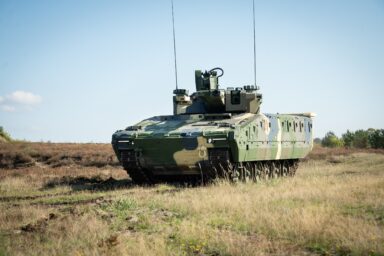
Between August and December 2024, Estonia’s Centre for Defence Investments (RKIK) signed four contracts worth roughly €70m with Datasel S.r.l., an Italy-registered firm owned by India’s Neco Defence Munitions. The goal was straightforward: deliver 155mm artillery shells to Ukraine within six to eight months. The €70m came almost entirely from EPF funds, not Estonia’s national budget.
Caught flat-footed
The outcome was not quite satisfactory. No shells arrived, and test batches that underwent inspection failed NATO standards. By spring 2026, Estonia had suspended the contracts and filed for arbitration at the European Court of Arbitration in Strasbourg.
On Thursday, 3 September, Estonian Defence Minister Hanno Pevkur offered his resignation. Press revelations about the opaque procurement process, and the risk to taxpayers, had made his position untenable.
The European Commission may have not been watching closely enough. The EPF operates through national implementing actors — in this case, RKIK, acting on behalf of Estonia’s Ministry of Defence. Those actors bear responsibility for contracting suppliers in compliance with EPF requirements and their own public-procurement rules. That arm’s-length structure left Brussels exposed.
At the Commission’s midday press briefing on 3 September, spokesman Christian Wigand confirmed that the institution had only just begun asking questions. “The Estonian Centre for Defence Investments is the implementing actor in this case on behalf of the Estonian Ministry of Defence, and as you can imagine, of course in this context we are now in contact with the Estonian authorities to look exactly into the questions,” Mr Wigand told reporters.
The repayment question
The admission was telling. The EPF has mobilised €6.4bn to support Ukraine since 2022. Yet the Commission appeared to learn of the procurement failure from the press, not from its own monitoring systems.
Reporters pressed Mr Wigand on whether Estonia would have to return the money. The analogy offered was blunt: if a member state builds a bridge with EU co-funding and the bridge is not built on time, the money comes back. Would the same logic apply here?
Mr Wigand declined to give a straight answer. “We cannot confirm at the moment but cannot exclude either,” he said, referring to the possibility of a formal recovery case. The Commission, he added, would examine whether existing safeguards and recovery processes applied.
Governance under the microscope
According to the European Commission, Tallinn may have to repay EPF money if due-diligence procedures were found to be insufficient. Estonia, for its part, argues that normal procurement checks were applied and that any loss should fall on the supplier, not on taxpayers.
The case lays bare a structural tension in the EPF’s design. Wartime urgency pushed member states to ‘buy fast’. Supplier vetting, it appears, did not always keep pace. Datasel S.r.l. delivered nothing; the Commission’s oversight mechanisms caught nothing in time. Whether Estonia ends up refunding Brussels will set a compliance precedent. Other member states are watching.
We are now in contact with the Estonian authorities to look exactly into the questions.
— Christian Wigand, European Commission spokesman
Mr Wigand was asked directly what criteria the Commission would use to determine whether repayment was required, and when the next conversation with Estonian authorities would take place. His answer offered little comfort. “I’m afraid there’s not much more that I can offer you at this stage,” he said. “But you can be sure that we will be following this very closely and, as I said, ensure that taxpayers’ money is well spent.”
The bigger pot
The fiasco arrives at an awkward moment. Hungary’s new government lifted its two-year block on EPF reimbursements in June 2026, freeing roughly €6.6bn. Member states are now debating how to spend it. Germany and the Netherlands favour straightforward reimbursement of past arms deliveries. Poland and the Baltic states want the funds recycled into fresh joint purchases, such as Patriot air-defence systems and more artillery shells. A hybrid model, splitting the sum between reimbursements and a top-up of the EU’s joint ammunition scheme (ASAP), is also on the table.
Unanimity is required. Budapest retains leverage. And discussions in the Council, Mr Wigand confirmed, remain ongoing, with no resolution in sight. “The swift mobilisation of those funds remains a priority for the High Representative,” he said. “Discussions in the Council are ongoing, so there are no further comments you can make at this stage.”
The EPF’s firepower is expanding. Its governance, the Estonian case suggests, has not kept up.