No EU capital is closer to Russia than Tallinn, at a mere 180 kilometres. Estonians are edgy, and are taking precautions as the Kremlin steps up its campaign of aggression.
Estonia announced on Sunday that it was moving troops permanently closer to its border with Russia. The same day it attributed a recent arson attack on a defence company to Russian intelligence. The two announcements were not coincidental. They reflect a country that has concluded it can no longer afford to wait.
The arson came first. A fire broke out at a site used by Milrem Robotics, a defence contractor, in the Estonian capital Tallinn on 15 August. Three suspects were arrested in Latvia and deported to Estonia. Estonia’s domestic intelligence agency Kapo described it as “a deliberate and pre-planned act commissioned by Russian security services.” Estonian Prime Minister Kristen Michal called the attack “absolutely unacceptable and irresponsible”.
Estonia’s foreign minister, Margus Tsahkna, placed the attack in a broader pattern. “Russia is boiling western democracies like a frog — turning on the heat step by step, and testing our responses,” he told the Financial Times. “Our main goal is to show (Russian Presiden Vladimir) Putin that we attribute, we react, and we prepare for any kind of provocations.”
From deterrence to forward defence
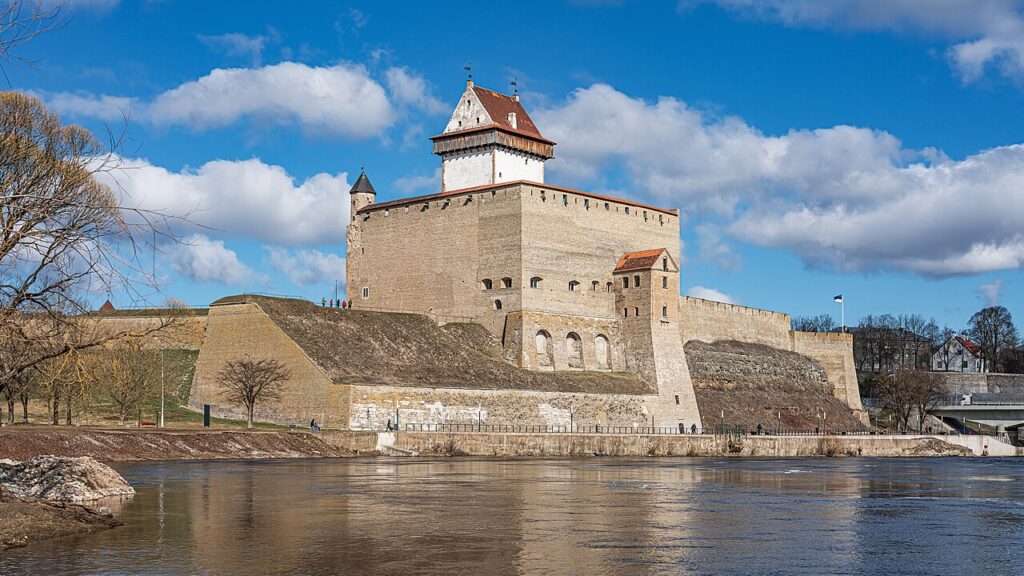
The troop movements represent a more fundamental shift. Estonia’s main fighting force, the First Brigade, will permanently relocate from Tapa to Jõhvi, just 50km from the Russian border. A new base in Narva—the small, mainly Russian-speaking city that sits directly across the river from Russia—will house 200 soldiers permanently, with capacity for 800 more in a crisis.
The doctrine driving this reconfiguration has a name: “active defence”. Its logic is blunt. Colonel Tarmo Kundla, commander of the First Brigade, stated: “We have to start from the border and win from the first battles.”
Russia and its services are doing things as long as we let them. We can’t deter them from trying, we can’t stop them. But we can make it as difficult and costly as possible to carry them out. — Harrys Puusepp, Estonian intelligence official
The old doctrine assumed Estonian forces would trade space for time, waging a guerrilla-style defence through the country’s forests until NATO reinforcements arrived. Having watched Russia fight in Ukraine—absorbing casualties without flinching, holding destroyed ground rather than yielding it—Estonia’s military chiefs concluded that plan would not work. For a country of 1.3m people and 45,000 square kilometres, losing any territory is not a tactical setback. It is an existential one.
Weapons that reach St Petersburg
Estonia’s new weapons purchases reflect the same logic. In the past year, it signed contracts for nine US-made Himars multiple rocket launcher platforms with a range of up to 300km, and nine South Korean Chunmoo systems with a similar range. One senior officer at Tapa noted that St Petersburg is 260km away. The implication was deliberate.
“We are in the process of changing everything,” said a military policy official at Estonia’s defence ministry. “The reality is that Estonian defence planning has been the same for the last ten years. But Russia is already planning to double its forces across our border.”
Defence spending has risen to match. Estonia increased its military budget by 42 per cent this year, to €2.4bn, or 5.4 per cent of GDP. The United Kingdom has committed to raising its troop deployment in Estonia from 800 to 1,200 by April next year.
Hybrid war, hybrid response
The build-up sits alongside a longer-running argument about how to handle Russian sabotage. Estonia’s intelligence service has pressed European partners to prosecute Russian-backed operatives as publicly as possible. Harrys Puusepp, head of bureau at Kapo, made the case directly: “Russia and its services are doing things as long as we let them. We can’t deter them from trying, we can’t stop them — but we can make it as difficult and costly as possible to carry them out.”
Not all European governments have been willing. Some, according to one Brussels-based security official, feared provoking Moscow even when confident it was responsible. The Milrem attribution drew strong support from Sweden. Acting Prime Minister Ulf Kristersson called the attack “extremely serious,” adding: “This pattern of attacks is directed against Europe as a whole. The aim is to weaken our support for Ukraine and to intimidate us. It will not work.”
We were afraid of the war. Now we are afraid of the end of the war. — unnamed Estonian intelligence official
The hybrid pressure has taken aerial form too. In May, a Romanian F-16 shot down a drone over Estonian territory after Russian electronic jamming diverted it from its course. Mr Tsahkna took a relaxed view. Ukrainian drones targeting St Petersburg occasionally veer into Estonian territory because of Russian jamming. He told the Financial Times the strikes were worth tolerating. “Of course we are not happy about these incidents. But we are not saying to Ukraine to stop it. This is hitting the lifeline of Putin.”
The fear behind the confidence
Estonia does not believe Russia wants full-scale war with NATO in the near term. What it fears is something more limited: a targeted strike on Narva, designed to test whether NATO’s mutual defence clause means anything in practice.
A senior Estonian military intelligence official made no bones about it when speaking to FT: “Deterrence is not working. The critical period to address that, for all of us in the Baltic states, is in the next one to four years.”
One variable dominates all others. For as long as the war in Ukraine continues, Russia’s military remains tied down. A ceasefire would change the calculus entirely. “We were afraid of the war,” said one senior Estonian intelligence official. “Now we are afraid of the end of the war.”