Drones, cheap interceptors, fast-built missiles? Talk of startup innovation sits awkwardly beside the contracts. Most orders for the new kinds of weaponry go to established firms.
Ukraine remains the demand signal; its battlefield data shapes EU specifications. New missiles are earmarked for Kyiv. Prime contractors such as Thales, Elbit Systems, Rheinmetall, and Diehl are retooling production lines, automating final assembly and pre-fund critical components. Their aim is to meet ‘surge’ delivery schedules set for 2026–28. A cluster of small British firms is retooling too.
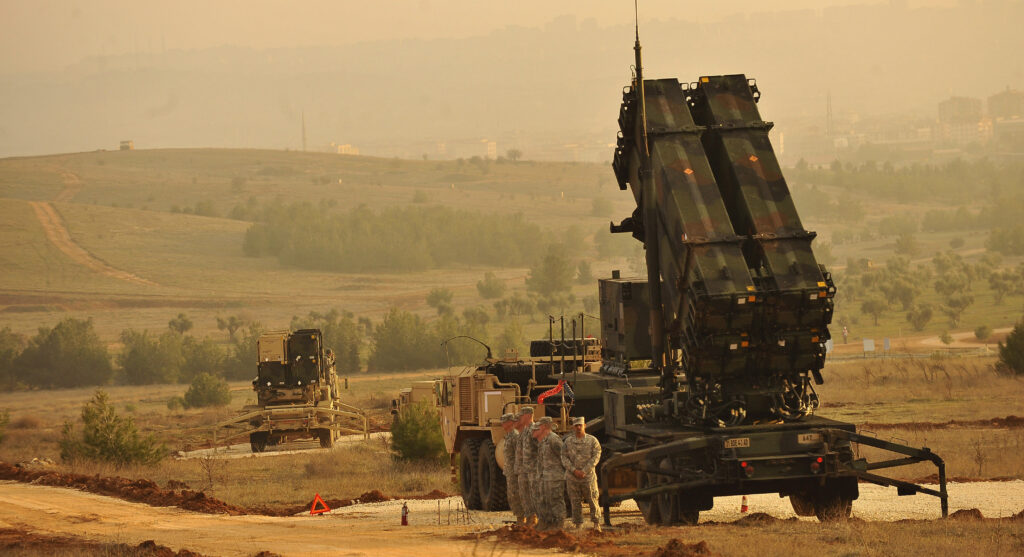
This is because cheap, mass-produced drones over Ukraine, the Middle East, and the Red Sea expose gaps in Europe’s short-range air defences. Serial production from mid-2026 is to fill the gap left by Patriot scarcity. EU and NATO governments respond by front-loading orders. They want missiles, sensors, and electronic-warfare kits that firms can build quickly and fire economically.
Thales shows the pattern. On 1 June 2026, the British Ministry of Defence ordered hundreds of Lightweight Multirole Missiles for £36m. A day later, it placed a follow-on order for another £36m. Together, £72m of awards fell in the second quarter.
Missiles by the hundred
The missiles serve as rapid-fire counter-drone and short-range air-defence weapons. The second order rebuilds stocks after more than 100 drone kills in the Middle East theatre. Two earlier replenishment lots, of undisclosed value, came in April and May.
The sums add up. Ministry paperwork shows a running total of about £1.6bn in missile awards since 2024, although some outlets cite £1.16bn. The tally covers 5,000 missiles for Kyiv in March 2025, plus British stocks. A joint UK-Ukraine group, Task Force Hirst, created a co-production pathway.
Faced with the critical challenges of jamming and access denial of global navigation satellite system signals, (we) guarantee accuracy in all circumstances. — Alexandre Ziegler, Safran Electronics & Defense
Thales has changed how it builds. Missiles for land launchers, naval DS30M mounts, and Wildcat helicopters leave the same modular line. Output at its Belfast plant has quadrupled since 2022. The plant added an extra shift pattern and additive manufacturing cells.
Digital twins and AI-based quality control cut acceptance-testing time by 25 per cent. Thales now stores motors and warheads equal to six months of peak output. Automation has cut the unit price of the missile by about 12 per cent since 2022.
Old firms rebuild their lines
The Belfast line sustains about 700 jobs. Elbit Systems signed a $1.4bn modernisation package, worth about €1.3bn, with an undisclosed European customer on 28 May 2026. It bundles loitering munitions, AI-enabled command and control, and multi-mission drone and air-defence batteries.
Elbit will automate circuit-board potting and seeker-head alignment to double monthly throughput. Its new European facility adds more than 300 high-skill positions. Rheinmetall, reported in September, will supply the Netherlands with Skynex gun-missile units and drone-jammer canisters for a short-range air-defence refresh.
Diehl Defence unveiled its IRIS-T SLS Mk 4 launcher at ILA Berlin in June 2026. It targets mobile counter-drone batteries. A framework memorandum came first. Contract values are due in the 2027 financial year, but Diehl signed advance funding for long-lead items at the show.
Small firms do appear, in the Low-Cost Interceptor Programme. Britain leads a five-nation consortium. In July 2026, it awarded £3.16m in first-phase feasibility contracts to three British small firms. The goal is missiles in the €100k-class that can swarm-kill Shahed-type drones.
Where the production slots sit
Compare the sums. One Thales order of £36m was more than ten times the small firms’ combined feasibility awards. Thales’s two June orders came to more than 20 times that amount.
Production tells the same tale. If demonstrations succeed, the programme reserves ‘spiral’ production slots for 2027 at MBDA and Thales. The small firms face the demonstrations. The two established names hold the slots.
By leveraging mature subsystems and an already established industrial ramp-up, we are able to respond with agility to the Army’s needs. — Stéphane Reb, MBDA
MBDA also leads work on a combat drone. The Remote Carrier Compact demonstrator—an unmanned aircraft that works with other combat platforms—passed its preliminary design review this summer. France, Germany, and Spain run the effort, with Spanish partner SATNUS. First flight is planned for 2029.
France chose Safran Electronics & Defense and MBDA for Thundart, a long-range land-strike system. The procurement agency selected the pair from several domestic contenders. Thundart will replace around nine Unitary Rocket Launchers by 2030. Its range of 150 kilometres compares with about 80 kilometres today.
Rockets with a joint venture
The two firms will form a joint venture in Paris in January 2027. It will support development, production, and in-service support. “Faced with the critical challenges of jamming and access denial of global navigation satellite system signals, Safran Electronics & Defense brings its proven leadership in inertial navigation and optronics technologies to guarantee accuracy in all circumstances,” director of the global business unit for defense at Safran Electronics & Defense Alexandre Ziegler said.
Executive Vice President of Programmes and Managing Director of MBDA in France Stéphane Reb stressed speed. “By leveraging mature subsystems and an already established industrial ramp-up, we are able to respond with agility to the Army’s needs,” he said.
Mr Reb added: “This close partnership with Safran Electronics & Defense, formalised by the creation of a joint venture, allows us to mobilise all the skills of our teams and our production capabilities to deliver a complete solution within optimised timeframes.”
The background shows what buyers reward. Contracts now emphasise volume and speed over the finest capability. Every missile buy since the second quarter contains an explicit drone-intercept clause. Plants that can reset tooling in under 48 hours, such as Thales Belfast and Rheinmetall Unterlüß, win fast-track orders.
Here lies the discrepancy. The new-style orders reward firms with running lines, stockpiles, and the ability to ramp up fast — a test that favours those already producing. The only small-firm award in these sources is feasibility money.