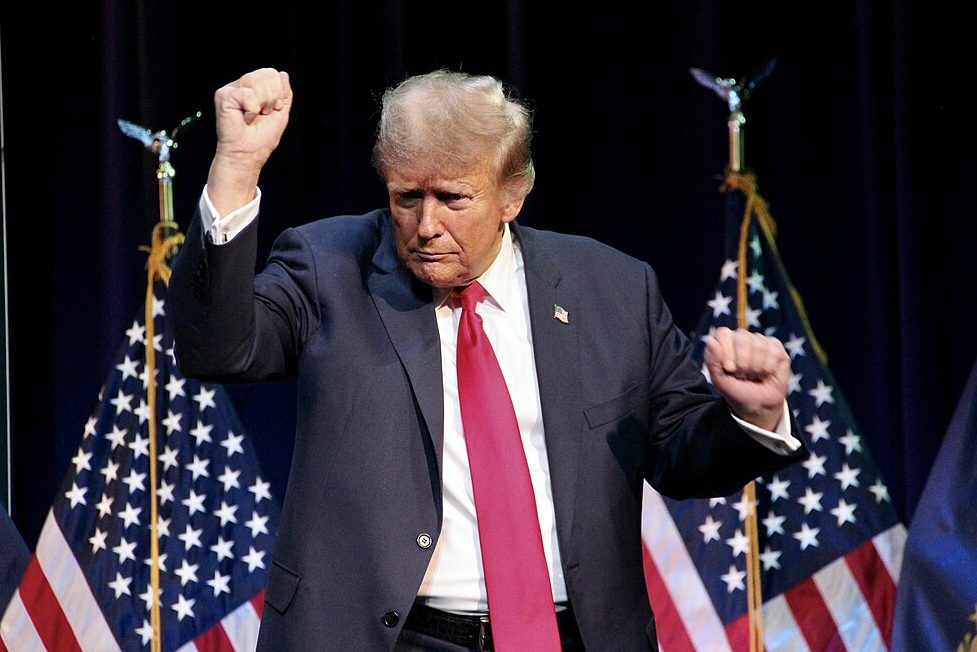
When the European Commission rolled back key sustainability rules, it framed the move as a boost to competitiveness. In reality, the changes followed months of pressure from the Trump administration and a coordinated lobbying campaign by major US corporations.
In December 2025, the US Ambassador to the EU, Andrew Puzder, publicly described the CSDDD as “economic suicide” for Europe. An unusual directness from an American diplomat regarding EU internal affairs.
The Omnibus I package, introduced earlier that year, significantly narrowed the reach of the Corporate Sustainability Reporting Directive (CSRD) and the Corporate Sustainability Due Diligence Directive (CSDDD). By the time it entered into force on 18 March 2026, it had become clear that the changes were not driven by technical considerations alone. Behind the scenes, the US government led by president Donald Trump and a coalition of multinational corporations had been pushing for months to weaken the rules.
“Particularly US corporations and the Trump administration lobbied very hard. To them, the CSDDD was one of those regulatory instruments which they thought were bad for American business,” said Geert Van Calster, full professor of law at KU Leuven.
Faced with pressure to prove it can bring Europe back to the forefront of business, the Commission found its justification. A senior Commission official told the investigative platform Follow the Money that dismantling due diligence obligations had been “a clear priority of the political leadership”. They considered it “a big step backwards”, he added.
A trigger, not a cause
The internal political conditions for a rollback were already forming before Donald Trump returned to the White House. Reports by former Italian prime minister Enrico Letta on the single market and by former European Central Bank president Mario Draghi on competitiveness had raised questions about regulatory burden. Business associations were lobbying loudly and the CSDDD had always faced resistance from member states worried about its extraterritorial reach. But the arrival of the second Trump administration transformed a simmering internal debate into a rapid capitulation.
The drive of the Trump administration is a part of a wider energy strategy: to try and tie Europe even tighter to the US through fossil fuel dependency. — Davide Panzeri, climate change think tank ECCO
“The Commission was under a lot of pressure from the Draghi and Letta reports, and from geopolitical changes,” says Judith Arnal, Senior Research Fellow at the Centre for European Policy Studies and at the Elcano Royal Institute. “But the arrival of Donald Trump to the White House in January 2025 was really a trigger for these exercises.”
What followed was not a methodical review but a political sprint—one conducted without an impact assessment. For Arnal, that procedural choice went to the heart of the Commission’s credibility problem. “They were really asking the Parliament and the Council to commit to impact assessments regarding relevant amendments. And I see that they come up with different Omnibus packages without an impact assessment. The whole credibility of the Commission around this is not great,” she said.
The US government as enforcement arm
What distinguished the Omnibus I episode from previous regulatory revisions was the degree to which the US government acted as an explicit enforcement arm for American corporate interests inside EU legislative processes.
On the day of the publishing of the Omnibus proposal, the chairs of the US House Financial Services Committee and the US Senate Banking Committee sent a letter to Treasury Secretary Scott Bessent and NEC Director Kevin Hassett. In the letter they identified the CSDDD and CSRD as “non-economic” trade barriers. They asked the president to treat them as targets in any trade initiative with the EU.
As a result, the CSDDD became a live issue inside the US-EU trade negotiations of summer 2025. ExxonMobil CEO Darren Woods had personally lobbied president Trump to use those negotiations as leverage. Woods visited Trump at his residence Mar-a-Lago and the White House in early 2025, according to the Centre for Research on Multinational Corporations investigation. The centre obtained over 170 pages of leaked internal documents and confidential correspondence.
Thus, Paragraph 12 of the August 2025 US-EU trade agreement committed the EU explicitly to proposing changes to the CSDDD’s harmonised civil liability regime, its climate transition obligations, and its application to non-EU companies. Those are precisely the priorities ExxonMobil had spent months lobbying for. Following the deal, the American Petroleum Institute publicly thanked the Trump administration for “standing up” against the directive.
For Davide Panzeri, head of Italy-EU policy at climate change think tank ECCO, the energy dimension of that pressure is inseparable from the broader strategic picture. “To try and tie Europe even tighter to the US through fossil fuel dependency. You see it with the attacks to the CSDDD, but in general to the Green Deal, to the wind turbines, everything to do with the transition.”
The corporate architecture behind the pressure
The US administration pressure was a coordinated industry exercise to influence European regulation. According to documents obtained by SOMO—the Centre for Research on Multinational Corporations—a coalition called the Competitiveness Roundtable operated under the New York-based consultancy Teneo. Between March and August 2025, it met at least 17 times. The Roundtable brought together 11 multinational companies, including ExxonMobil, Chevron, TotalEnergies, Koch Industries, Honeywell, and Dow.
The structure gave participating companies effective cover. Teneo was listed as the sole attendee in eight lobbying register entries during Strasbourg plenary sessions, with the names of the companies actually present nowhere disclosed.
That’s what created the Brussels Effect: non-EU companies building EU-standard processes globally because differentiation wasn’t worth it. Omnibus I erodes that, the gravitational pull weakens. — Alberto Alemanno, HEC Paris
The Roundtable assigned specific companies to target specific EU governments — TotalEnergies with France, Belgium, and Denmark; ExxonMobil with Germany, Hungary, the Czech Republic, and Romania. It also developed a strategy for mobilising non-EU countries to pressure Brussels with “minimal US visibility”, routing pressure through industry associations rather than direct American channels.
ExxonMobil alone held at least 25 meetings with the Commission and Parliament between January 2024 and July 2025. It threatened to withhold a $20 billion EU investment package if the directive was not revised. The company was the sole sponsor of an FT Live event in March 2025 titled Tackling Europe’s Red Tape Challenge.
Bram Vranken, researcher and campaigner at Corporate Europe Observatory, told EU Perspectives in February that “the homegrown deregulation wave and the pressure coming from the US reinforce each other. That combination is explosive.”
What they got
The final Omnibus I text tracks the Roundtable’s stated priorities with striking precision. The CSDDD’s scope threshold was raised to more than 5,000 employees and €1.5 billion in turnover. That cut the coverage to around 1,600 companies. Climate transition plan obligations were deleted. The harmonised civil liability regime was eliminated. Maximum penalties fell from 5 per cent to 3 per cent of global turnover. Entry into force was pushed to July 2029.
The CSRD was similarly gutted — restricted to companies with more than 1,000 employees and €450 million in turnover. That removed roughly 90 per cent of previously covered companies from scope and left some member states with fewer than 40 companies subject to reporting obligations at all.
What made the original CSDDD distinctive, according to Alberto Alemanno, Jean Monnet Professor in European Union Law at HEC Paris, wasn’t its extraterritorial reach per se — “any jurisdiction including the US regulates companies operating within it”. What was different was the scale and ambition. “Obligations rigorous enough that compliance effectively required restructuring global supply chains, not just local operations. That’s what created the Brussels Effect — non-EU companies building EU-standard processes globally because differentiation wasn’t worth it.” Omnibus I, he argues, “erodes that by reducing the obligations to a level where differentiation becomes viable again. The gravitational pull weakens.”
On the Commission’s process, Alemanno is more critical. “The rollback tracks what US business lobbying requested. The closed consultations leave no paper trail. The absence of an impact assessment means the Commission never had to show its working on whose interests were served.”
Van Calster is pointed on why Articles 29.1 and 29.7—which established that European law applies regardless of where a company is headquartered—were targeted: “It is one of those aspects of the CSDDD that is easy to delete.”
A precedent without a strategy
The European Council on Foreign Relations has noted that by repeatedly accommodating US demands rather than deploying available anti-coercion instruments, the EU has demonstrated to Washington that pressure works. And that far from rewarding simplification, the US simply presses harder.
“They needed to deliver. They needed to send the message that they were moving,” says Arnal. “And since sustainability was clearly losing support in other jurisdictions and companies were complaining loudly, they took the path of least resistance.”
For the Commission, the lesson of Omnibus I may be the hardest kind: that reactive simplification under external pressure does not buy stability. It buys the next demand.