Germany is quietly sketching a playbook for the next time US President Donald Trump threatens Europe with tariffs or extraterritorial edicts. If the EU plays along, it could retaliate against future US shenanigans in mere hours.
Officials in Berlin have begun “mapping vulnerabilities in U.S. supply chains” and preparing options to “hit US companies” should another clash erupt, according to people familiar with the work.
The task force, run by the economy and foreign ministries, feeds into a parallel exercise in Brussels that will inform the EU’s new economic-security strategy this summer. Its purpose is deterrence: raise the cost of unilateral pressure and nudge Washington back to negotiation.
A calculus of leverage
“By sticking together, Europeans can prove to Trump that they are prepared to match him,” Tobias Gehrke, an expert on economic statecraft at the European Council on Foreign Relations, told Bloomberg earlier this week.
The calculus echoes Berlin’s awakening during Mr Trump’s first term, when metals duties and threats against European carmakers exposed the bloc’s fragility. This time officials intend to brandish levers—export licences, regulatory delays and investment screens—before the White House reaches for Section 232 again.
A spokesperson for the economy ministry framed the effort in dispassionate terms. “The federal government is closely monitoring these developments with a focus on critical supply chains and dependencies,” the spokesperson said. “It considers not only its own dependencies but also those of countries of origin and countries that import goods from Germany and the European Union.”
Chancellor Friedrich Merz sharpened the message in the Bundestag. “We are identifying our interests,” he said, “and at the same time the means to defend them.” The remark previewed a pivot in German trade doctrine: accept that interdependence cuts both ways and codify that reality into EU law. President Frank-Walter Steinmeier added a dose of fatalism. “There will be no going back to the way things were,” he told reporters. “The rift is too deep.”
Insulin, lithography, power trains
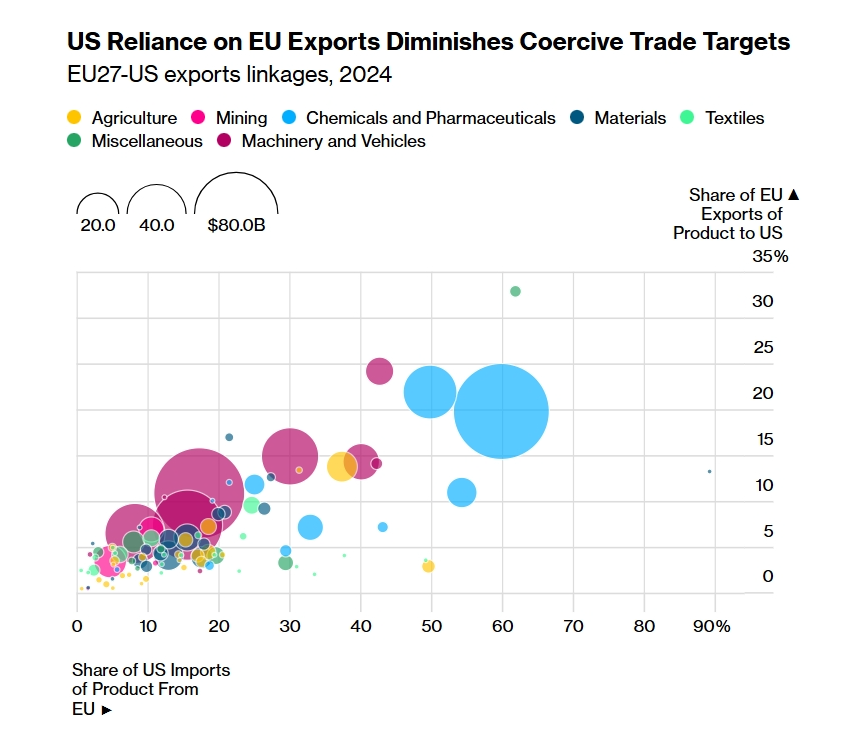
Concrete work has begun at desk level. Analysts list choke-points where Europe is indispensable. The Netherlands’ ASML and its German suppliers Zeiss and Trumpf dominate extreme-ultraviolet lithography. Swiss and German firms produce ingredients for blockbuster drugs and almost all insulin consumed in America. Power-train machinery from Bavaria feeds electric-vehicle plants in Michigan and Tennessee. Each node, charted in spreadsheets, could become a notice of licence suspension if tariffs return.
Regulation offers a subtler weapon. Bloomberg’s sources conclude that “restricting access or tightening regulation on American firms represents the bloc’s most potent economic weapon.” The Digital Services Act and Digital Markets Act already allow Brussels to fine or suspend platforms for breaches of competition or privacy rules.
There will be no going back to the way things were. The rift is too deep. — Frank-Walter Steinmeier, president of Germany
Alphabet, Amazon and Meta earn a tenth of global revenue inside the single market. Any new compliance cost reverberates across their balance-sheets faster than a customs duty.
Building a united front
Deterrence only works if the EU acts in concert. The European Commission is drafting an ‘economic security strategy’ that will weave Germany’s mapping into a legal tool-kit of export controls, investment screening and anti-coercion measures. Parliament, still bruised from past trade skirmishes, is inserting “multi-tiered safety nets” into a stalled metals accord with Washington—sunset clauses, standstill provisions and snap-back tariffs that can be triggered without a fresh vote.
Compensation looms large. Smaller member states fear bearing the brunt of American retaliation. Finance ministers therefore debate a burden-sharing pool that would channel EU budget funds toward the most exposed sectors. The idea echoes the bloc’s Covid-19 recovery facility: collective borrowing to preserve unity under pressure. Commission lawyers test whether such a pool can sit inside the existing Multiannual Financial Framework or demands a treaty tweak.
Cornelia Woll, president of Berlin’s Hertie School, offers a caution. “However, such threats should not be used lightly, because in an interconnected world — such actions always result in costs for both sides and can potentially set off a downward spiral.” Her warning resonates in Dublin, where jobs rely on US tech cash, and in Warsaw, which counts on American troops. Defence minister Boris Pistorius tried to square that circle. “This is not about confrontation, but about mutually defining our interests,” he said.
Pressure points in the AI boom
The AI investment surge gives Europe fresh leverage. US cloud giants scramble for semiconductor capacity just as advanced chips need EU-made tools. Any pause in spare parts for EUV machines would slow data-centre roll-outs across the Midwest. Fitch Ratings reckons that the American states benefiting most from AI capital are now the most vulnerable to tariff turbulence. Berlin’s memo notes the irony: the controls Washington urged against China could swing against Silicon Valley.
This is not about confrontation, but about mutually defining our interests. — Boris Pistorius, German defence minister
Pharmaceutical precursors present a people angle. Europe supplies nearly half of branded drug ingredients sold in America and ninety per cent of its insulin. A modest export licence fee could lift US prescription prices days before an election. Officials in Berlin say that option stays in the drawer unless tariffs resume, yet the mere existence of the spreadsheet, they argue, may tilt calculations in the West Wing.
Financial assets tempt hawks but scare central bankers. European investors hold $10.4tn in US equities and trillions more in bonds. George Saravelos of Deutsche Bank suggested a partial sell-down if relations sour further. Commission economists dismiss the notion as nuclear. Dollar dominance and transatlantic pension funds make coordinated divestment both impractical and self-harming, they say.
From blueprint to law
Turning slide decks into enforceable rules now falls to EU legislators. The Council of Ministers will debate the economic-security package in June. France wants automatic export controls on dual-use technology; Ireland demands opt-outs for digital services. Germany proposes a middle course: a fast-track regulation modelled on the Anti-Coercion Instrument, allowing the Commission to act within 48 hours but subject to parliamentary review within a week.
Credibility evaporates if enforcement lags for two years. — MEP Bernd Lange (S&D/DEU)
The European Parliament’s international-trade committee drafts its opinion next month. Rapporteur MEP Bernd Lange (S&D/DEU) plans to anchor any retaliation in WTO norms to preserve the EU’s image as a rules guardian. Yet he also insists on speed. “Credibility evaporates if enforcement lags for two years,” aides quote him as saying. A final plenary vote, pencilled for October, will determine whether the deterrence toolkit sits on a shelf or inside the Official Journal.
Washington watches. USTR officials hint that new EU export controls could breach the spirit of recent metals talks. Berlin replies that the toolkit is insurance, not a weapon of first resort. If Mr Trump spares Europe, nothing triggers. Should he revive the tariff carousel, retaliation could launch in hours, not months, without the need for 27 capitals to haggle afresh.
Trial of resolve
History suggests unity will wobble under fire. The 2018 steel spat split member states until the Commission dangled a €93bn tariff list. That blueprint still sits in a drawer. German officials say the new playbook refines it, adding civil-fines for tech firms and export licences for AI kit. Yet political resolve, not technical detail, will decide. Italy covets exemptions for its fashion exports; Poland prizes the Pentagon’s tanks.
Mr Merz bets that clarity deters. Show Washington the levers and perhaps it never pulls its own. European officials call the strategy ‘left-of-boom’: act before crisis, not after. Mr Trump may test that doctrine, and if recent history is anything to go by, he will. The EU now can hope to have an answer ready.